
Photographic Film
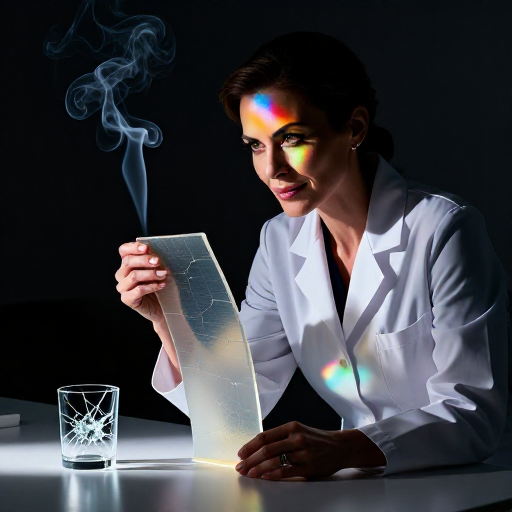
Photography began on metal and glass — rigid, heavy, one picture per plate. To put many exposures on a roll you need a support that is transparent, chemically inert, tough enough to be pulled through a camera, and flexible enough to coil.
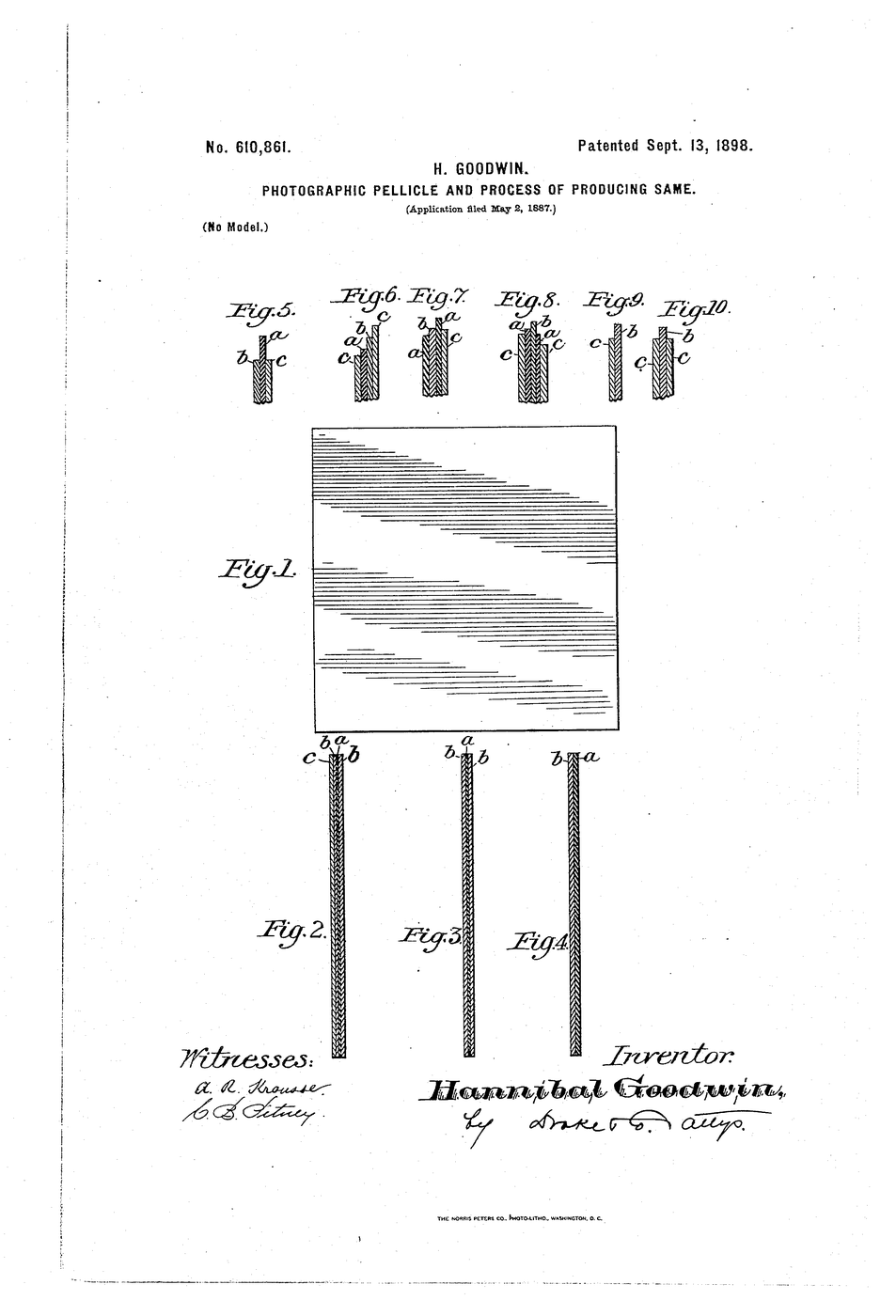
Hannibal Goodwin, an Episcopal priest in Newark, New Jersey, wanted better pictures for his Sunday-school classes and could not buy them. US 610,861, “Photographic pellicle and process of producing same”, claims a film whose principal ingredient is nitrocellulose, “transparent and insoluble in the usual developing, fixing, and intensifying solutions”, and “compact, hard, tough, self-supporting, non-porous” while remaining “capable of being rolled upon the spools or rollers of the camera”.
Read the dates carefully. Filed 2 May 1887. Granted 13 September 1898. Eleven years — and for nine of them, George Eastman was already selling celluloid roll film.
Instruções
List what a film base must do
List what a film base must do
Write the four requirements from the claim: transparent, insoluble in processing solutions, self-supporting and non-porous, flexible enough to roll. You will test all four.
Safety substitution — not nitrocellulose
Safety substitution — not nitrocellulose
Goodwin's base is nitrocellulose, closely related to guncotton. Nitrate film burns fiercely, needs no external oxygen, and destroyed archives and cinemas for decades. This blueprint casts a gelatin film instead. It meets three of the four requirements and fails the fourth in an instructive way.
Weigh the gelatin
Weigh the gelatin
Weigh 10 g gelatin powder.
Materiais para este passo:
 Gelatin Powder10 g
Ferramentas necessárias:
 Digital Kitchen Scale
Bloom it in cold water
Bloom it in cold water
Sprinkle into 60 ml cold water and leave 10 minutes until swollen.
Materiais para este passo:
Gelatin Powder10 gFerramentas necessárias:
 Stopwatch
Dissolve gently
Dissolve gently
Warm to about 50 °C, stirring until completely clear. Do not boil — boiling destroys the gel strength.
Cast a thin, even layer
Cast a thin, even layer
Pour onto a clean flat surface and spread to roughly 1 mm. Evenness is the whole craft — a thickness variation becomes a density variation in the picture.
Materiais para este passo:
 Pipette1 peça
Ferramentas necessárias:
 Steel Ruler (30cm)
Let it set undisturbed
Let it set undisturbed
Leave flat for 20 minutes to gel, then several hours to dry. Any vibration shows up as a ripple.
Ferramentas necessárias:
StopwatchTest transparency
Test transparency
Peel the dried film and hold printed text behind it. Can you read through it? Record how clearly.
Materiais para este passo:
 Paper1 folha
Ferramentas necessárias:
 Magnifying Glass
Test flexibility
Test flexibility
Roll the film around a dowel. Does it coil without cracking, and recover flat? This is Goodwin's “capable of being rolled upon the spools”.
Ferramentas necessárias:
 Dowel Rod
Test self-support
Test self-support
Hold a strip by one end. Does it support its own weight, or flop? Compare a 1 mm strip with a thin one.
Ferramentas necessárias:
Steel Ruler (30cm)Test the fourth requirement — and watch it fail
Test the fourth requirement — and watch it fail
Drop a corner into warm water for two minutes. Gelatin softens and dissolves. Goodwin's claim demands insolubility in developing, fixing and intensifying solutions, and this is exactly why a wet-processed film cannot use plain gelatin as its base. Record what happened.
Make an emulsion layer instead
Make an emulsion layer instead
Now use gelatin correctly: cast a very thin gelatin layer onto your dried film and tint it with a drop of food colouring. Gelatin's real job in film is to carry the light-sensitive grains, not to be the support.
Materiais para este passo:
Gelatin Powder2 g Food Colouring2 gotas
Ferramentas necessárias:
PipetteMeasure your film
Measure your film
Measure thickness and cut a 35 mm wide strip. Punch sprocket notches along one edge. Compare with a real 35 mm frame if you have one.
Ferramentas necessárias:
Steel Ruler (30cm) Sharp Scissors
History & Context
History & Context
US 610,861, “Photographic pellicle and process of producing same”, Hannibal Goodwin, filed 2 May 1887, granted 13 September 1898.
Goodwin was a rector, not a chemist. He wanted transparencies for Bible teaching, could not find suitable ones, and set out to make a flexible transparent support himself.
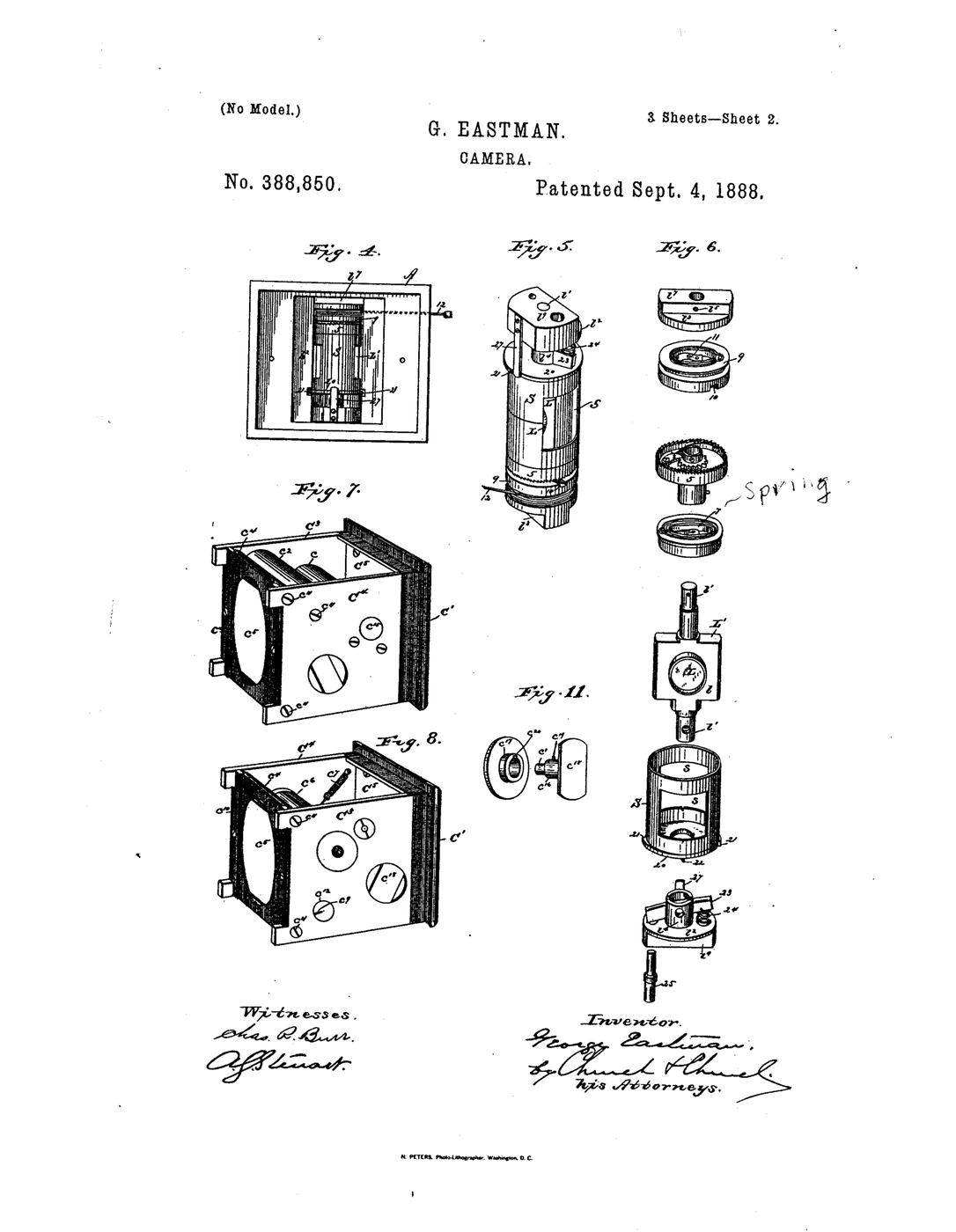
The eleven-year gap is the story. His original application was, by the assessment of the Science and Media Museum, broad, ambiguous and confused in its wording. It sat unissued and was amended repeatedly. In the meantime George Eastman and his chemist Henry Reichenbach entered the field, and by the time Goodwin's patent finally issued in 1898, Eastman had been selling celluloid roll film commercially for over nine years.
The Patent Office declared an interference — a formal contest of priority — between Goodwin and Kodak. Goodwin won. He then sued Kodak for infringement. He did not live to see the end of it: his estate was awarded roughly $5 million some years after his death.
Why nitrate film mattered and then had to go. Nitrocellulose gave the toughness and clarity the claim describes, and made roll film and cinema possible. It is also dangerously flammable and decomposes over time. “Safety film” on cellulose acetate replaced it, and a great deal of early cinema was lost to nitrate fires and decay before that changeover was complete.
Everything downstream of this patent — the roll, the sprocket, the cinema reel, and the colour films in this batch — depends on having a flexible base at all.
Materiais
4- 22 gReferência
- 1 peçaReferência
- 1 folhaReferência
- 2 gotasReferência
Materiais de Blueprints conectados

Blueprints relacionados
Estes blueprints compartilham conhecimento — técnicas, materiais ou princípios


CC0 Domínio Público
Este blueprint é liberado sob CC0. Você é livre para copiar, modificar, distribuir e usar este trabalho para qualquer finalidade, sem pedir permissão.
Apoie o Maker comprando produtos através do Blueprint, onde ele ganha uma Comissão Maker definida pelos vendedores, ou crie uma nova versão deste Blueprint e inclua-o como conexão no seu próprio Blueprint para compartilhar receita.