ARTE
BELEZA E BEM-ESTAR
ARTESANATO
CULTURA E HISTÓRIA
ENTRETENIMENTO
MEIO AMBIENTE
COMIDA E BEBIDAS
ENGENHARIA REVERSA
CIÊNCIAS
ESPORTES
TECNOLOGIA
TECNOLOGIA VESTÍVEL
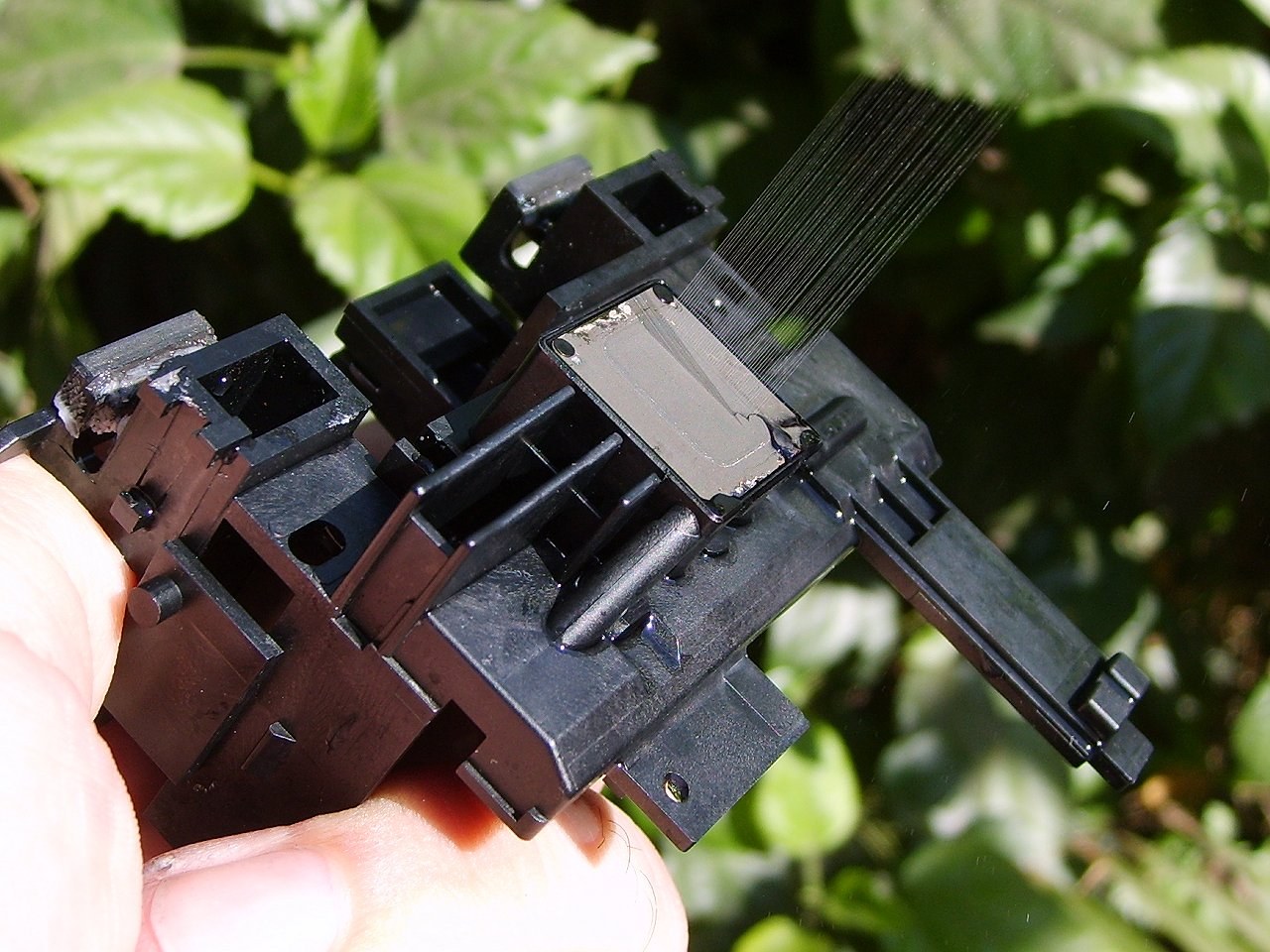

Piezoelectric Drop-on-Demand Inkjet
A continuous inkjet is always firing and throws away the drops it does not want. It buys reliability with a gutter, a pump, a filter and a solvent that evaporates. Drop-on-demand asks the opposite question: can a nozzle sit still and produce exactly one drop when told to?
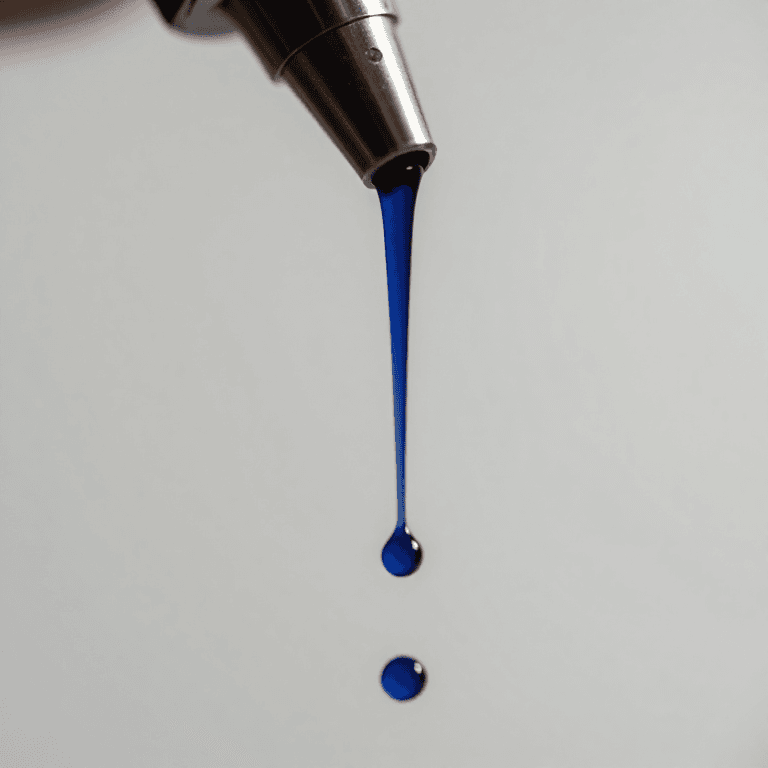
Steven Zoltan at Clevite and Kyser and Sears at Silonics both answered yes in 1972, with the same component in two arrangements. Zoltan wrapped a tube of piezoelectric ceramic around a glass capillary so it squeezed inward; Kyser and Sears put a piezo diaphragm on the wall of a small chamber so it flexed. Either way, applying a voltage changes the chamber's volume slightly and a drop leaves the nozzle.
Slightly is the word. Work backwards from a thirty-picolitre drop and a one-square-millimetre diaphragm has to move about ninety nanometres - which at four hundred picometres per volt is a couple of hundred volts - which is what the 1972 machines ran on - or a tenth of that once you bond the ceramic to a passive plate so it curls instead of stretching. The whole drive voltage of every piezo head ever built falls out of that one sum.
What is not obvious is that the chamber rings. A pressure wave runs to the far end and back in a few microseconds, so if the next pulse arrives while the ink is still sloshing the drop leaves at the wrong speed and the wrong size. The drive is therefore never a pulse - it is a pull, a push and a damping segment, each timed against that acoustic round trip. Tuning those three numbers is most of what a print head manufacturer actually sells.
And because nothing in the chamber gets hot, the ink only has to flow. UV-curable monomer, solvent, hot wax, conductive silver, live cells in buffer - all of it goes through a piezo head, and none of it through a thermal one.
Avançado
4 hours
Instruções
1
1
Make a squeeze-mode chamber
Make a squeeze-mode chamber
Draw a glass capillary to a 60 micrometre tip over a small flame and break it square. Slide a piezo tube - or wrap a disc element - tightly around the barrel and bond it with a thin film of epoxy so the ceramic really grips the glass.
Back-fill with dyed water and glycerol through a syringe until a meniscus sits flat in the tip. No bubbles, or nothing will eject.
Materiais para este passo:
 Kit de tubos de vidro1 peça
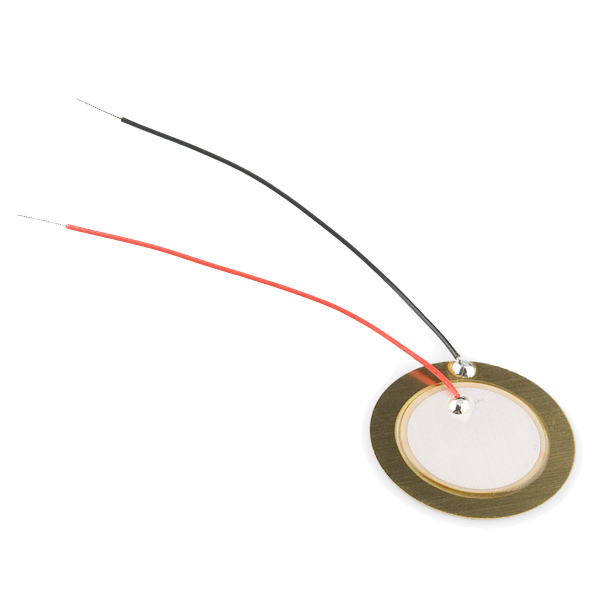 Piezo Element1 peça
 Adesivo epóxi de dois componentes (presa rápida)1 tube
 Glicerol (99 %)20 ml
 Corante alimentar5 ml
Ferramentas necessárias:
 Seringa de laboratório
 Bico de Bunsen
 Lupa de mão 10x
 Microscópio digital
2
2
Shape the waveform until the satellites stop
Shape the waveform until the satellites stop
Drive the element from the arbitrary generator through the amplifier, starting with a single 100 V push a few microseconds long. Catch the drops on a slide and look at them.
Now add a pull before the push and a small reverse pulse after it, and sweep each segment length through a few microseconds. There is a setting where the trailing satellite drops merge back into the main drop. That setting is the chamber's acoustic round trip, measured.
Materiais para este passo:
 Lâmina de microscópio10 peças
Ferramentas necessárias:
 Gerador de funções
 Amplificador de alta tensão (de bancada)
 Osciloscópio digitalMicroscópio digital
 Óculos de proteção estanques
3
3
Drop volume to drive volts, ringing, and three ejectors
Drop volume to drive volts, ringing, and three ejectors
A carregar o notebook Jupyter…
Ferramentas necessárias:
 Computador de secretária
4
4
Compendium: four modes, and the nozzle plate
Compendium: four modes, and the nozzle plate
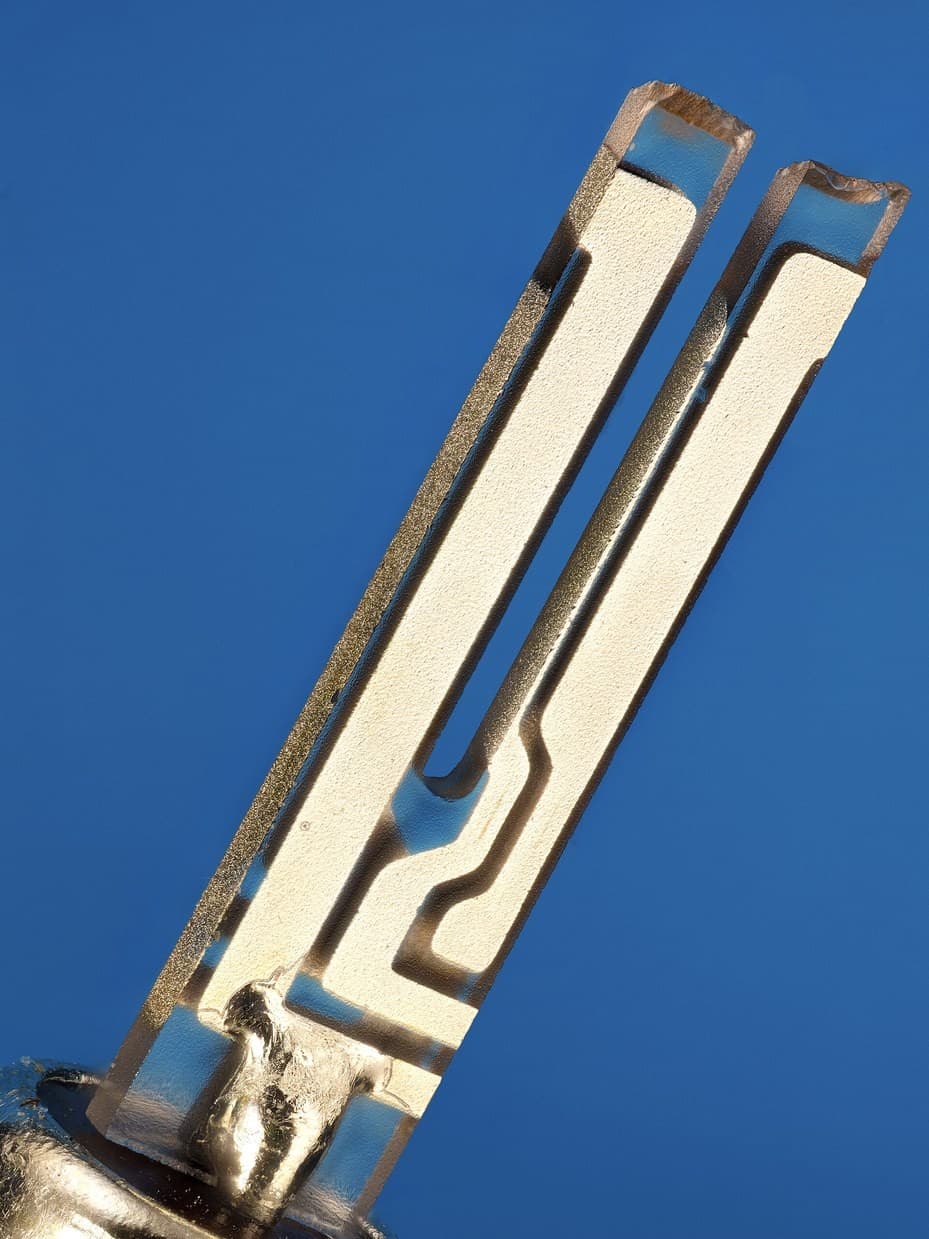
The 1972 pair became four modes, all the same trick in different geometry. SQUEEZE is Zoltan's tube round a capillary, easy to build one of and impossible to build a thousand of side by side. BEND is Kyser and Sears' diaphragm, and it is what nearly every desktop piezo head uses because it photolithographs into a silicon plate. PUSH drives a rod into the chamber end-on. SHEAR uses poled ceramic walls between adjacent chambers that rock sideways, so the wall between two nozzles does the work for both - the densest arrangement, and the one industrial heads use.
The nozzle plate is the part nobody expects to matter. Ink must not wet the outside face, or a film creeps across and pulls the next drops off-axis, so the plate carries a fluoropolymer coating and a wiper cleans it between passes. Everything that goes wrong with a working head - drops landing left of where they should, a nozzle that fires weakly, a sudden band across the page - is usually the last micrometre of that face rather than anything happening inside the chamber.
Materiais
6- 1 peçaReferência
- Piezo Element10% de comissão1 peçaR$11.33
- Referência
- 20 mlReferência
- Referência
- 10 peçasReferência
Ferramentas necessárias
9- Referência
- Referência
- Referência
- Referência
- Referência
- Referência
- Osciloscópio digital10% de comissãoMagento Legacy Storeships internationallyReferência
- Referência
- Referência
Total estimado
O que quem fez comprou. Os materiais sem preço obtêm-se onde os comprares.
Blueprints relacionados
Estes blueprints compartilham conhecimento — técnicas, materiais ou princípios


CC0 Domínio Público
Este blueprint é liberado sob CC0. Você é livre para copiar, modificar, distribuir e usar este trabalho para qualquer finalidade, sem pedir permissão.
Apoie o Maker comprando produtos através do Blueprint, onde ele ganha uma Comissão Maker definida pelos vendedores, ou crie uma nova versão deste Blueprint e inclua-o como conexão no seu próprio Blueprint para compartilhar receita.