ARTE
BELEZA E BEM-ESTAR
ARTESANATO
CULTURA E HISTÓRIA
ENTRETENIMENTO
MEIO AMBIENTE
COMIDA E BEBIDAS
ENGENHARIA REVERSA
CIÊNCIAS
ESPORTES
TECNOLOGIA
TECNOLOGIA VESTÍVEL
Youblob · CC0


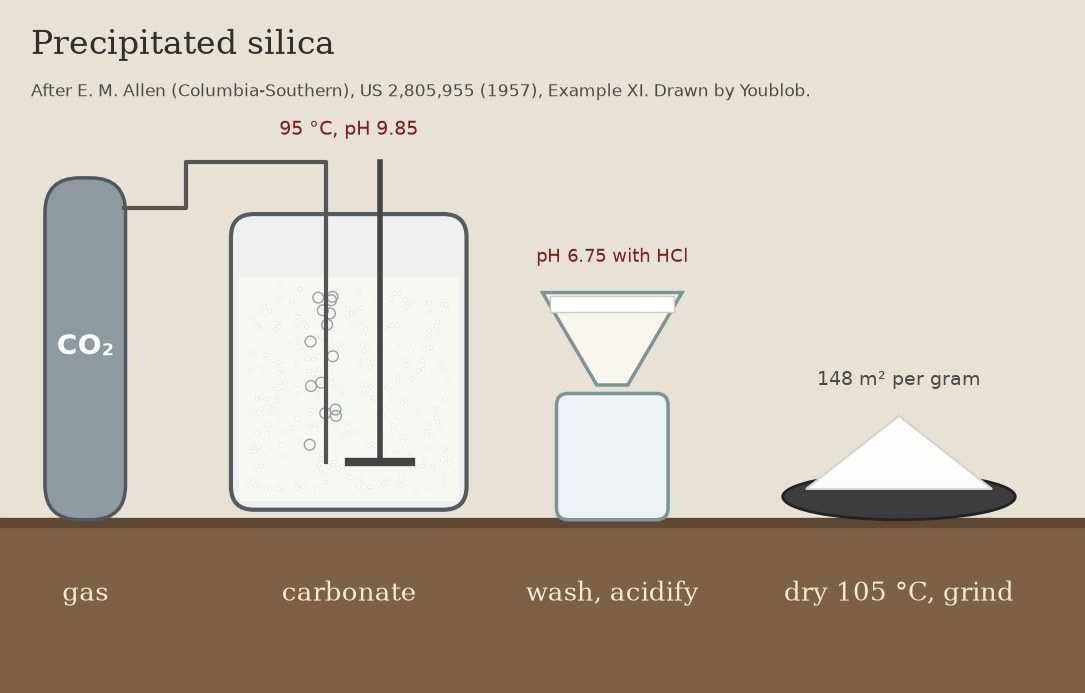
Precipitated Silica: Hot Water Glass Carbonated, Then Acidified to pH 6.75 (Allen 1957)
Bubble carbon dioxide through hot dilute water glass and the silica comes down as an extremely fine white powder rather than a gel. Edward Allen of Columbia-Southern made it this way as a white reinforcing filler for rubber; this follows his Example XI, which gave a powder of 148 m² per gram.
Source: E. M. Allen (Columbia-Southern), US 2,805,955 (1957), Example XI. The percentages are our arithmetic; the filter, mill and indicator are ours. Picture drawn by Youblob.
Intermediário
2 days
Instruções
1
1
Dilute the water glass
Dilute the water glass
Take 12,850 g of sodium silicate solution holding 976 g Na2O and 3115 g SiO2 (7.6 % and 24.2 %, a silica to soda ratio of 3.19 by weight; our arithmetic). Dilute it with water to 48 litres in a stirred kettle with a heating coil and thermometer, and heat to 95 °C.
Materiais para este passo:
 Vidro solúvel (solução de silicato de sódio)12850 g
 Água1 as required
Ferramentas necessárias:
 Reator de pressão
 Agitador
 Termómetro
 Balança de pratos
2
2
Carbonate for an hour
Carbonate for an hour
Bubble in pure carbon dioxide fast enough to add the theoretical amount in about 30 minutes, and keep going at that rate for about 1 hour. The slurry ends at pH 9.85.
Ferramentas necessárias:
 Dióxido de carbono gasosoReator de pressãoAgitadorTermómetro
 Papel indicador de pH
3
3
Filter and wash
Filter and wash
Filter the slurry and wash the cake twice with hot water.
Materiais para este passo:
Água1 as requiredFerramentas necessárias:
 Funil de Büchner (porcelana)
 Papel de filtro
4
4
Acidify to pH 6.75
Acidify to pH 6.75
Stir the cake back into water and bring it to pH 6.75 with 400 ml of 3.5 N hydrochloric acid.
Materiais para este passo:
Água1 as requiredFerramentas necessárias:
 Ácido clorídrico
 Recipiente de vidroAgitadorPapel indicador de pH
5
5
Wash out the chloride
Wash out the chloride
Filter again and wash the cake with hot water until it is nearly free of chloride.
Materiais para este passo:
Água1 as requiredFerramentas necessárias:
Funil de Büchner (porcelana)Papel de filtro6
6
Dry at 105 °C and grind
Dry at 105 °C and grind
Dry it at 105 °C in a fan oven and grind it to a fine powder. Allen's had a pH of 8.2, 0.61 % sodium and a surface area of 148 m² per gram.
Ferramentas necessárias:
 Estufa de secagem
 Almofariz e pilão
 Frascos de vidro com tampa
Materiais
2- Referência
- 4 as requiredReferência
Ferramentas necessárias
13- Referência
- Referência
- Referência
- Referência
- Referência
- Referência
- Referência
- Referência
- Referência
- Referência
- Referência
- Referência
- Referência
Este projeto faz
Blueprints relacionados
Estes blueprints compartilham conhecimento — técnicas, materiais ou princípios
CC0 Domínio Público
Este blueprint é liberado sob CC0. Você é livre para copiar, modificar, distribuir e usar este trabalho para qualquer finalidade, sem pedir permissão.
Apoie o Maker comprando produtos através do Blueprint, onde ele ganha uma Comissão Maker definida pelos vendedores, ou crie uma nova versão deste Blueprint e inclua-o como conexão no seu próprio Blueprint para compartilhar receita.