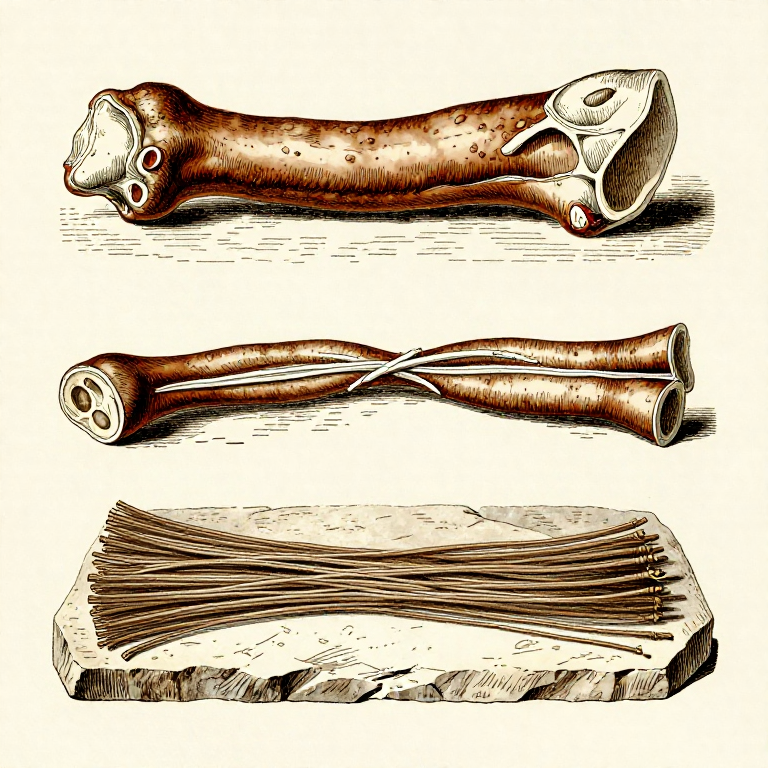


Processing Animal Sinew into Thread — Tendon Fiber Preparation
Instruções
Harvest the Tendons
Harvest the Tendons
The best sinew comes from the leg tendons and the backstrap (the long tendons running along either side of the spine) of large herbivores — deer, elk, moose, or cattle. The Achilles tendon of the hind leg is the single largest tendon and yields the longest fibers. Using a flint knife, cut along the tendon sheath and peel the tendon away from the surrounding muscle and bone. Remove as much meat and membrane from the tendon as possible. Fresh sinew is slippery and difficult to handle; the processing becomes much easier once it has dried.
Materiais para este passo:
 Flat Stone/Board1 peça
Ferramentas necessárias:
 Flint Knife
Clean and Dry
Clean and Dry
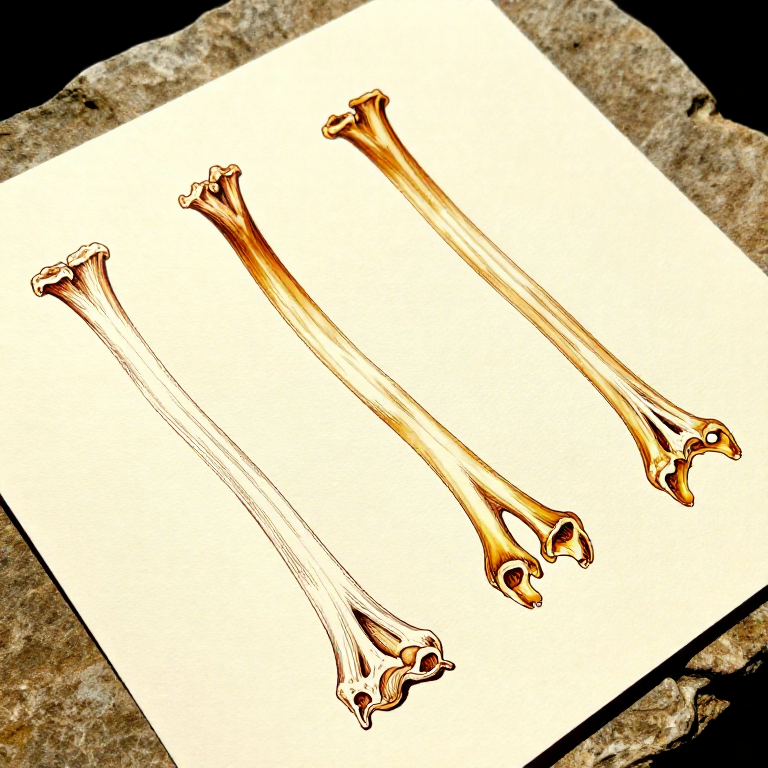
Scrape the tendons clean of any remaining fat, muscle tissue, or membrane using the edge of a flint scraper. Fat left on the sinew prevents proper drying and promotes bacterial decay. Stretch the cleaned tendons flat on a stone surface or wooden board and allow them to air-dry in the sun for 1-3 days. As they dry, the tendons become hard, translucent, and stiff — resembling pale, thin sheets of rawhide. Fully dried sinew is shelf-stable and can be stored indefinitely without deterioration. The collagen fibers in dried sinew have a tensile strength of approximately 560 MPa.
Materiais para este passo:
Flat Stone/Board1 peçaFerramentas necessárias:
Flint KnifePound and Shred into Fibers
Pound and Shred into Fibers
Place the dried tendon on a flat stone and pound it gently with a smooth hammerstone. The pounding breaks apart the parallel collagen fiber bundles without cutting them. As you pound, the tendon begins to separate into individual fiber strands. You can also shred the dried tendon by pulling fibers apart by working from one end. The fibers split along their natural alignment, producing threads of varying thickness. For fine sewing thread, split the fibers as thin as possible — individual sinew strands can be as fine as sewing thread, about 0.3-0.5 mm diameter.
Ferramentas necessárias:
 Smooth Stone
Prepare Thread for Use
Prepare Thread for Use
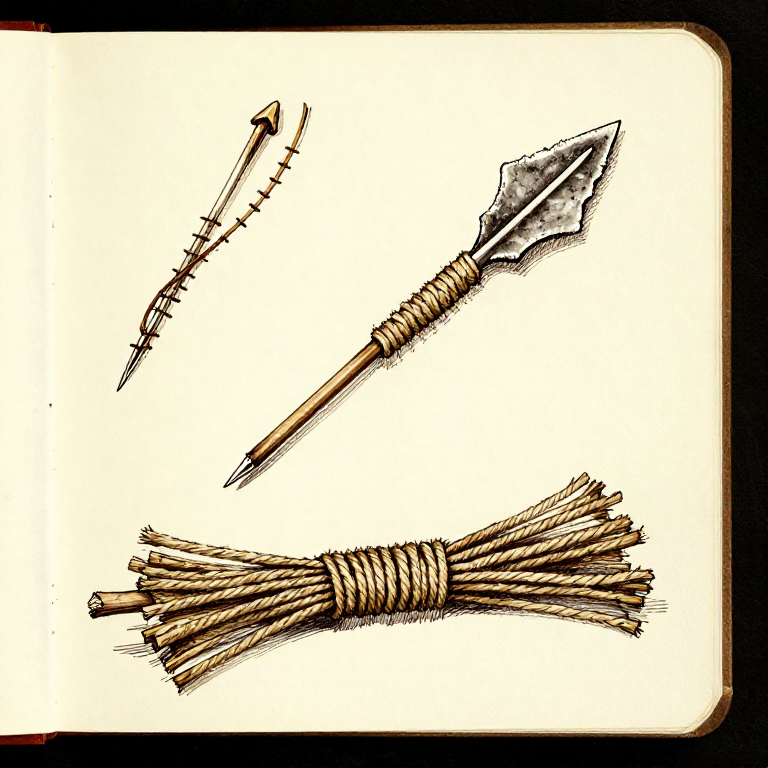
To use sinew for sewing, moisten the end of a fiber strand by placing it in your mouth briefly. The moisture makes the sinew pliable and slightly sticky, allowing you to twist and stiffen the end for threading through a bone needle eye. Sinew does not require spinning or twisting like plant fibers — each strand is inherently strong along its length. For heavier lashing applications (binding a stone point to a shaft, for instance), use multiple strands together or use thicker unsplit fibers. When sinew dries after being applied, it shrinks by approximately 4-5 percent, pulling the lashing extremely tight.
Applications and Storage
Applications and Storage
Sinew thread serves multiple functions. For sewing hides into clothing, pre-punch holes with a bone awl and pass the moistened sinew through each hole — as it dries, the stitches tighten and become waterproof. For hafting (binding a stone point to a wooden shaft), wrap wet sinew around the joint and allow it to dry; the shrinkage creates a joint stronger than most adhesives. For bow backing, glue long sinew fibers to the back of a wooden bow with hide glue to prevent the bow from breaking under tension. Store unused dried sinew in a dry container — it remains usable for years. Bundle finished threads by winding them around a small stick for easy access.
Materiais
2- Referência
- 2-3 tendons peçaReferência
Ferramentas necessárias
2- Referência
- Referência
Materiais de Blueprints conectados

CC0 Domínio Público
Este blueprint é liberado sob CC0. Você é livre para copiar, modificar, distribuir e usar este trabalho para qualquer finalidade, sem pedir permissão.
Apoie o Maker comprando produtos através do Blueprint, onde ele ganha uma Comissão Maker definida pelos vendedores, ou crie uma nova versão deste Blueprint e inclua-o como conexão no seu próprio Blueprint para compartilhar receita.