ARTE
BELEZA E BEM-ESTAR
ARTESANATO
CULTURA E HISTÓRIA
ENTRETENIMENTO
MEIO AMBIENTE
COMIDA E BEBIDAS
ENGENHARIA REVERSA
CIÊNCIAS
ESPORTES
TECNOLOGIA
TECNOLOGIA VESTÍVEL
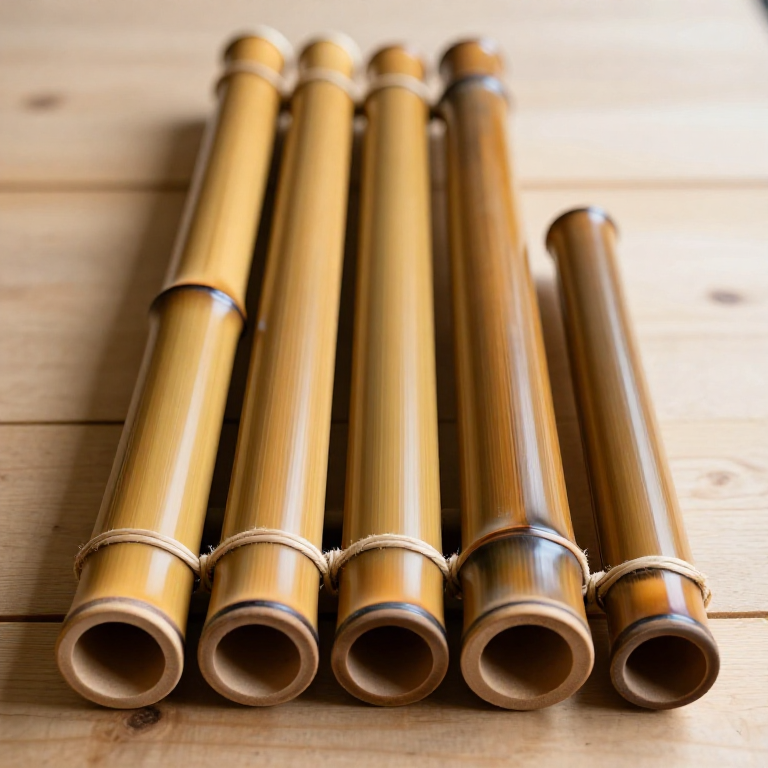


Making Panpipes — A Row of Tuned Bamboo Tubes
Build the syrinx: a row of closed bamboo tubes cut to graduated lengths, each sounding one note, bound side by side and blown across the top. Cut, tune and play a scale, then learn why a longer tube always sounds a lower note. A simple, buildable school project in the physics of closed pipes.
Iniciante
30 minutes
Instruções
1
1
A row of tubes, each a note
A row of tubes, each a note
Panpipes are one of the oldest melody instruments: a row of closed tubes, each cut to a length that sounds a single note when you blow across its top.
2
2
Choose your bamboo
Choose your bamboo
Pick straight bamboo about a finger-width thick. You want lengths that each keep a solid node (the natural wall inside) to seal one end.
Materiais para este passo:
 Bambu1 peça
3
3
Cut the longest tube
Cut the longest tube
Saw a tube about 18 cm long, cutting just below a node so the bottom is sealed. This will be your lowest note.
Ferramentas necessárias:
 Serra para bambu
4
4
Cut the rest, each shorter
Cut the rest, each shorter
Cut five or six more tubes, each about 2 cm shorter than the last, always keeping a sealed node at the bottom. Shorter tubes give higher notes.
Ferramentas necessárias:
Serra para bambu5
5
Smooth the top rims
Smooth the top rims
Rub the open top edge of each tube smooth and level, so your breath splits cleanly across it.
6
6
Line them up
Line them up
Stand the tubes side by side in order, longest to shortest, with all the open tops level in a straight line.
7
7
Bind the tubes together
Bind the tubes together
Lash the tubes together with twine, wrapping firmly near the top and again near the bottom so the row sits flat and rigid.
Materiais para este passo:
 Cordel de abacá1 peça
8
8
Make your first note
Make your first note
Rest the top edge of the longest tube on your lower lip and blow ACROSS it, not into it — like blowing over a bottle. A clear note appears.
9
9
Play a scale
Play a scale
Slide along the row, blowing across each tube in turn. The notes rise as the tubes get shorter — that is your scale.
10
10
Measure length against pitch
Measure length against pitch
Measure each tube with a ruler and note its pitch on a free tuner app. Longer tube, lower note — plot the pairs and see the pattern.
11
11
Tune a tube that is too low
Tune a tube that is too low
Drop a small pellet of beeswax into the bottom of the tube. Shortening the air column raises its pitch — add wax a little at a time until it matches.
Materiais para este passo:
 Pastilhas de cera de abelha1 peça
12
12
Fix a tube that is too high
Fix a tube that is too high
You cannot make a tube longer, so cut a fresh, slightly longer tube instead. A longer air column always gives a lower note.
13
13
Compendium — the physics of a stopped pipe
Compendium — the physics of a stopped pipe
Blowing across the top sets the air INSIDE the tube vibrating as a standing wave. Because the bottom is closed and the top is open, the tube is a 'stopped pipe': the longest wave that fits is about four times the tube's length, so the note's frequency is roughly f = v / (4L), where v is the speed of sound (about 343 m/s in air) and L is the tube length. That is why halving a tube's length raises its note by one octave, and why beeswax in the bottom (which shortens the air column) raises the pitch. Stopped pipes sound an octave lower than an open pipe of the same length and produce only the odd harmonics, giving panpipes their soft, hollow tone. Chain many tuned pipes together and add a wind supply and you have the pipe organ; the same idea lives on in the ancient Greek syrinx, the Andean siku and zampoña, and the Chinese paixiao.
Materiais
3- 1 peçaReferência
- 1 peçaReferência
- Referência
Ferramentas necessárias
1- Referência
Blueprints relacionados
Estes blueprints compartilham conhecimento — técnicas, materiais ou princípios

CC0 Domínio Público
Este blueprint é liberado sob CC0. Você é livre para copiar, modificar, distribuir e usar este trabalho para qualquer finalidade, sem pedir permissão.
Apoie o Maker comprando produtos através do Blueprint, onde ele ganha uma Comissão Maker definida pelos vendedores, ou crie uma nova versão deste Blueprint e inclua-o como conexão no seu próprio Blueprint para compartilhar receita.