

Processing Raw Flax into Linen Fiber — From Field to Thread
Linen is the oldest known textile fiber. Fragments of dyed flax fiber found in Dzudzuana Cave (Georgia) date to approximately 36,000 years ago — predating woven textiles by tens of thousands of years. The ancient Egyptians wrapped mummies in linen, wore linen garments, and used linen sails. The word 'line' derives from 'linen' (Latin linum), as does 'linger' (to lie on linen).
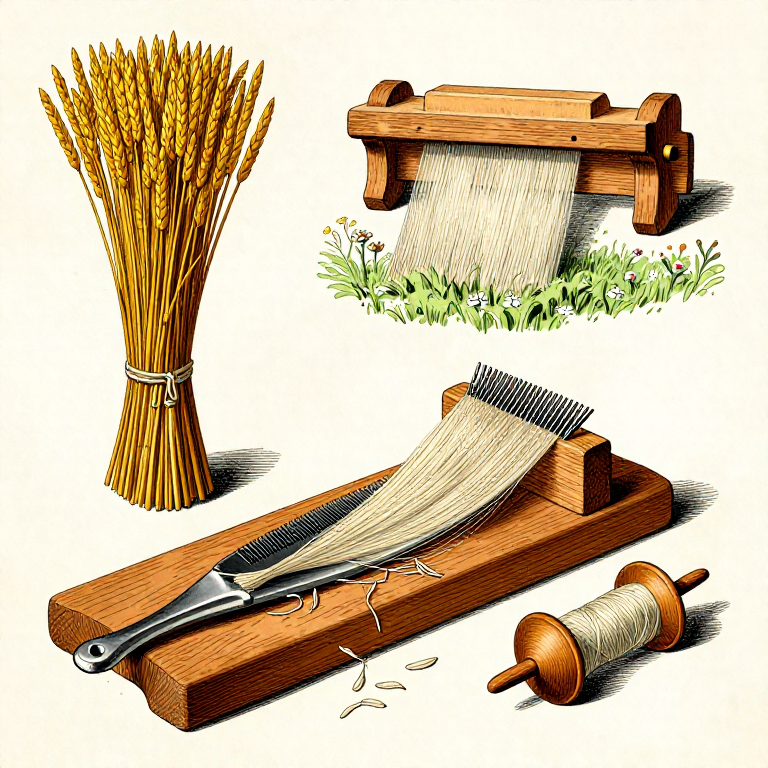
Linen comes from the bast (inner bark) fibers of the flax plant (Linum usitatissimum). Unlike cotton (which grows as fluffy seed fibers ready to spin), flax fibers are locked inside the plant's stem and must be liberated through a multi-stage process: pulling, rippling, retting, breaking, scutching, and hackling. Each step removes a layer of non-fiber material until only the long, lustrous bast fibers remain.
This process is labor-intensive — historically, processing one kilogram of linen fiber required approximately 40 hours of work. But the resulting fiber is extraordinary: stronger than cotton when wet, naturally antimicrobial, highly absorbent, and increasingly soft with every wash. Quality linen garments last decades.
Instruções
Harvest the flax
Harvest the flax
Flax for fiber is harvested by pulling the entire plant from the ground (not cutting) — pulling preserves the full fiber length from root to tip. The ideal harvest time is when the lower third of the stem has turned yellow, the seeds are brown but not yet dropping, and the leaves on the lower stem have fallen off. This is approximately 100 days after sowing.
Grasp a handful of stems near the base and pull firmly upward. Shake off loose soil from the roots. Bundle the pulled flax into sheaves (handfuls tied with a few flax stems) and stand them upright to dry for 3-5 days. Fiber-quality flax stems are 60-100 cm tall, slender, and unbranched.
Materiais para este passo:
 Flax Plant
Ripple the seed heads
Ripple the seed heads
Rippling removes the seed bolls from the stems. Pull each bundle of flax through a rippling comb — a row of upright iron or wooden teeth set in a board. The teeth catch the seed bolls and strip them from the stems without damaging the fibers. Alternatively, thresh the seed heads by beating them against a board over a sheet.
Save the seeds — flax seeds (linseed) are edible and highly nutritious (rich in omega-3 fatty acids), and linseed oil (pressed from the seeds) is used in woodworking finishes, oil painting, and as a nutritional supplement. Each plant produces approximately 10-15 seeds.
Ferramentas necessárias:
 Hand Card
 Rippling Comb
Ret the flax stems
Ret the flax stems
Retting is the controlled rotting of the flax stems to break down the pectin that binds the bast fibers to the woody core. This is the critical step — under-retting leaves fibers difficult to separate; over-retting weakens and damages the fibers.
Dew retting (simplest): spread the stems thinly and evenly on short grass in a field. Turn them every few days to ensure even exposure. Bacteria and fungi in the soil and atmosphere decompose the pectin over 2-4 weeks, depending on weather. The stems are ready when the bark peels away easily and the fibers separate from the woody core with gentle pulling.
Water retting (faster, higher quality): bundle the stems and submerge them in a pond, stream, or tank of still water for 5-10 days. Water retting produces finer, lighter-colored fiber but generates foul-smelling anaerobic decomposition — traditionally done in dedicated retting ponds downwind of the village.
Ferramentas necessárias:
 Bucket (5-gallon)
Break the retted stems
Break the retted stems
After retting, dry the stems completely (1-2 days in sun). Breaking crushes the woody core (shive) of the dried stems without cutting the long bast fibers. A flax brake is a hinged wooden device with interlocking blades — the stems are laid across the lower blades and the upper section is brought down repeatedly, snapping the woody core into small pieces while the flexible fibers remain intact.
Without a flax brake, stems can be broken by rolling them with a heavy wooden rolling pin on a flat surface, or by bending handfuls of stems back and forth over the edge of a board. The goal is to shatter all the woody material while keeping the fibers in long, parallel bundles. You'll hear the shive cracking as you work.
Scutch the broken stems
Scutch the broken stems
Scutching removes the broken shive fragments from the fibers. Hold a handful of broken flax over the edge of a vertical board (scutching board) and scrape downward with a blunt wooden knife (scutching knife) — a flat, paddle-shaped implement. The scraping action knocks the loose shive fragments out of the fiber bundle.
Work systematically: scutch the lower half, then flip the bundle and scutch the upper half. The shive falls away as dust and small fragments (this material, called 'boon,' was traditionally used as animal bedding or kindling). After thorough scutching, you should have a rough bundle of grey-golden fibers still containing some short fibers (tow) mixed with the long fibers (line).
Ferramentas necessárias:
 Steel Scraper
 Scutching Board
Hackle the fibers to separate line from tow
Hackle the fibers to separate line from tow
Hackling is combing the scutched fibers through progressively finer hackles (beds of upright steel pins set in a board). Pull the fiber bundle through a coarse hackle first (wide-spaced pins), then through finer hackles. Each pass removes shorter fibers (tow), aligns the long fibers (line), and removes any remaining shive.
The long, parallel fibers that pass through the finest hackle are called 'line' — the premium fiber used for fine linen thread and fabric. The short fibers caught in the hackle teeth are 'tow' — usable for coarse rope, stuffing, or rough cloth. A good flax crop yields approximately 15-20% line fiber by weight of the retted stems.
Ferramentas necessárias:
Hand Card Flax Hackle
Spin the prepared fiber into linen thread
Spin the prepared fiber into linen thread
Linen fiber is spun differently from wool — it is spun wet. The spinner dips their fingers in water while drafting (pulling out) the fiber, which softens the pectin and allows the fibers to slide and bond smoothly. Wet-spun linen produces a smoother, stronger thread than dry-spun. A drop spindle is the simplest tool; a spinning wheel with a flax distaff is faster.
The finished linen thread is strong, lustrous, and slightly stiff. It softens dramatically with washing and use. Linen has a natural sheen that cotton lacks — the long, smooth fibers reflect light rather than scattering it. Quality handspun linen thread can produce fabric that lasts generations.
Materiais
1- 1 peçaReferência
Ferramentas necessárias
6- Referência
- Referência
- Referência
- Referência
- Referência
- Referência
CC0 Domínio Público
Este blueprint é liberado sob CC0. Você é livre para copiar, modificar, distribuir e usar este trabalho para qualquer finalidade, sem pedir permissão.
Apoie o Maker comprando produtos através do Blueprint, onde ele ganha uma Comissão Maker definida pelos vendedores, ou crie uma nova versão deste Blueprint e inclua-o como conexão no seu próprio Blueprint para compartilhar receita.