ARTE
BELEZA E BEM-ESTAR
ARTESANATO
CULTURA E HISTÓRIA
ENTRETENIMENTO
MEIO AMBIENTE
COMIDA E BEBIDAS
ENGENHARIA REVERSA
CIÊNCIAS
ESPORTES
TECNOLOGIA
TECNOLOGIA VESTÍVEL
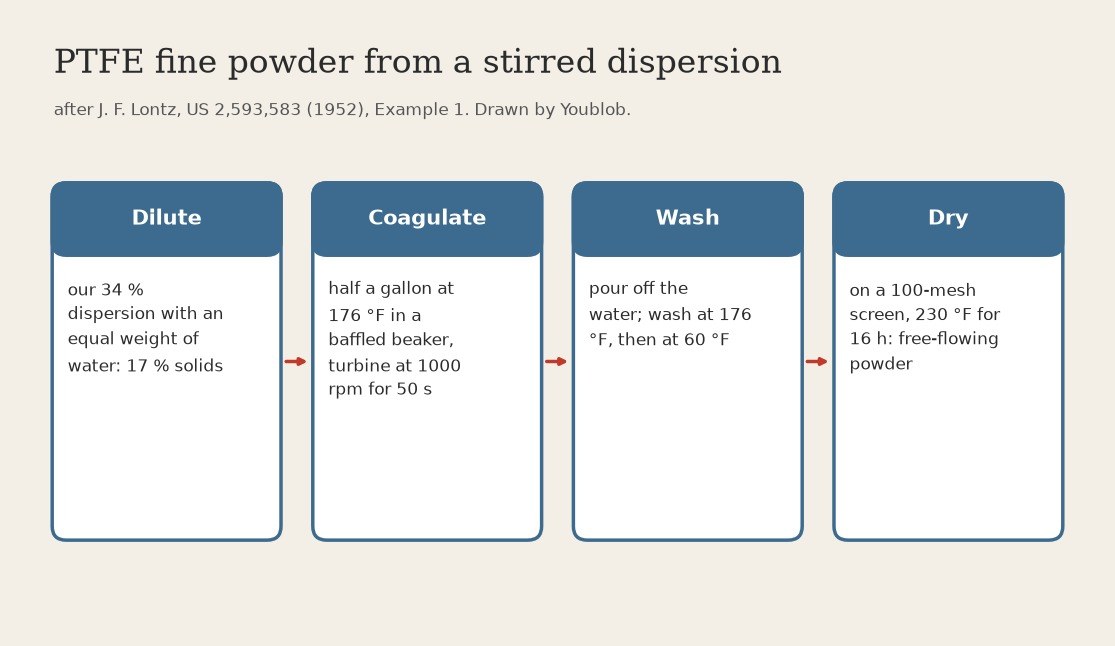


PTFE Fine Powder: a Dispersion Stirred Until It Curdles (Lontz 1952)
A PTFE dispersion is stable on the shelf, but stirred hard enough it curdles. Fifty seconds at 1000 rpm in a baffled beaker and the polymer floats up as a dry-looking, unwettable crumb. Washed and dried, it is a free-flowing powder for rolling into tape, or for cold lubricated extrusion.
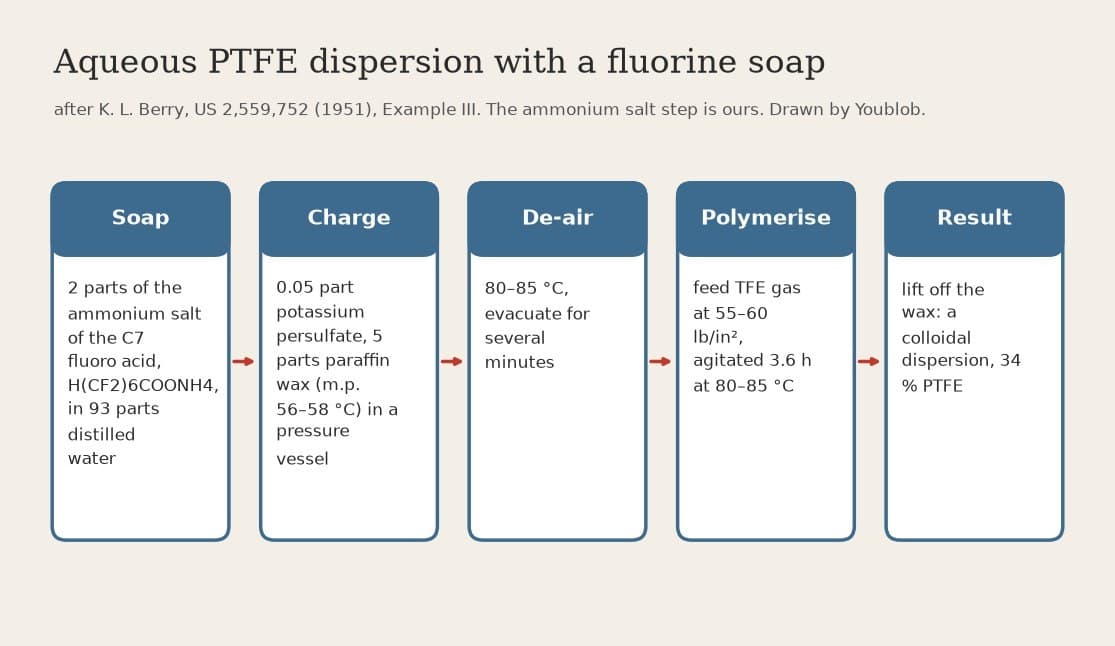
Source: J. F. Lontz (du Pont), US 2,593,583 (1952), Example 1. Lontz started from a dispersion made with disuccinic acid peroxide; ours is Berry's persulfate dispersion, diluted to his 17 %. Picture drawn by Youblob.
Intermediário
1 day
Instruções
1
1
Dilute the dispersion to 17 %
Dilute the dispersion to 17 %
Ours: stir the 34 % dispersion with an equal weight of distilled water to get 17 % solids, the strength Lontz used.
Materiais para este passo:
 Dispersão aquosa de PTFE1 part
 Água destilada1 part
Ferramentas necessárias:
 Balança de pratos
 Frascos de vidro com tampa
2
2
Set up the baffled beaker
Set up the baffled beaker
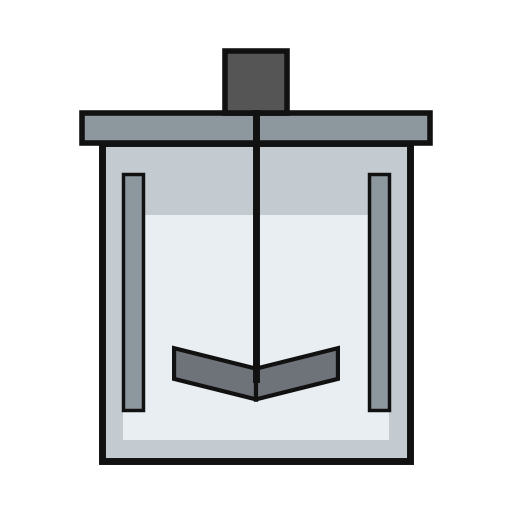
A 1-gallon stainless beaker, 6.5 in across and 7.5 in deep, with four baffles about ⅜ × 1 in hanging from the cover to within 3 in of the bottom. Stirrer: open turbine, 4 blades 1½ in high, 5 in across, reaching to within 1 in of the bottom.
Ferramentas necessárias:
 Tanque agitado com chicanas
 Agitador
3
3
Stir hard at 176 °F for 50 seconds
Stir hard at 176 °F for 50 seconds
Put in half a gallon of the 17 % dispersion and heat it to 176 °F (80 °C). Run the stirrer at 1000 rpm for 50 seconds (Lontz measured 0.72 hp per gallon). The polymer coagulates and floats, unwetted, on top.
Ferramentas necessárias:
Tanque agitado com chicanasAgitador Placa de aquecimento
 Termómetro
4
4
Wash hot, then cold
Wash hot, then cold
Pour off the water. Wash the polymer with hot water at 176 °F, then with cold water at 60 °F (16 °C), and drain.
Ferramentas necessárias:
Tanque agitado com chicanasTermómetro5
5
Dry at 230 °F for 16 hours
Dry at 230 °F for 16 hours
Spread the wet polymer on a 100-mesh screen and dry it in an oven at 230 °F (110 °C) for 16 hours. It comes out a free-flowing granular powder that passes 6–8 mesh.
Ferramentas necessárias:
 Peneira de malha metálica fina
 Estufa de secagemFrascos de vidro com tampa
Materiais
2- 1 partReferência
- 1 partReferência
Ferramentas necessárias
8- Referência
- Referência
- Referência
- Referência
- Referência
- Referência
- Referência
- Referência
Este projeto faz
Blueprints relacionados
Estes blueprints compartilham conhecimento — técnicas, materiais ou princípios
CC0 Domínio Público
Este blueprint é liberado sob CC0. Você é livre para copiar, modificar, distribuir e usar este trabalho para qualquer finalidade, sem pedir permissão.
Apoie o Maker comprando produtos através do Blueprint, onde ele ganha uma Comissão Maker definida pelos vendedores, ou crie uma nova versão deste Blueprint e inclua-o como conexão no seu próprio Blueprint para compartilhar receita.