Colaboração
ARTE
BELEZA E BEM-ESTAR
ARTESANATO
CULTURA E HISTÓRIA
ENTRETENIMENTO
MEIO AMBIENTE
COMIDA E BEBIDAS
ENGENHARIA REVERSA
CIÊNCIAS
ESPORTES
TECNOLOGIA
TECNOLOGIA VESTÍVEL
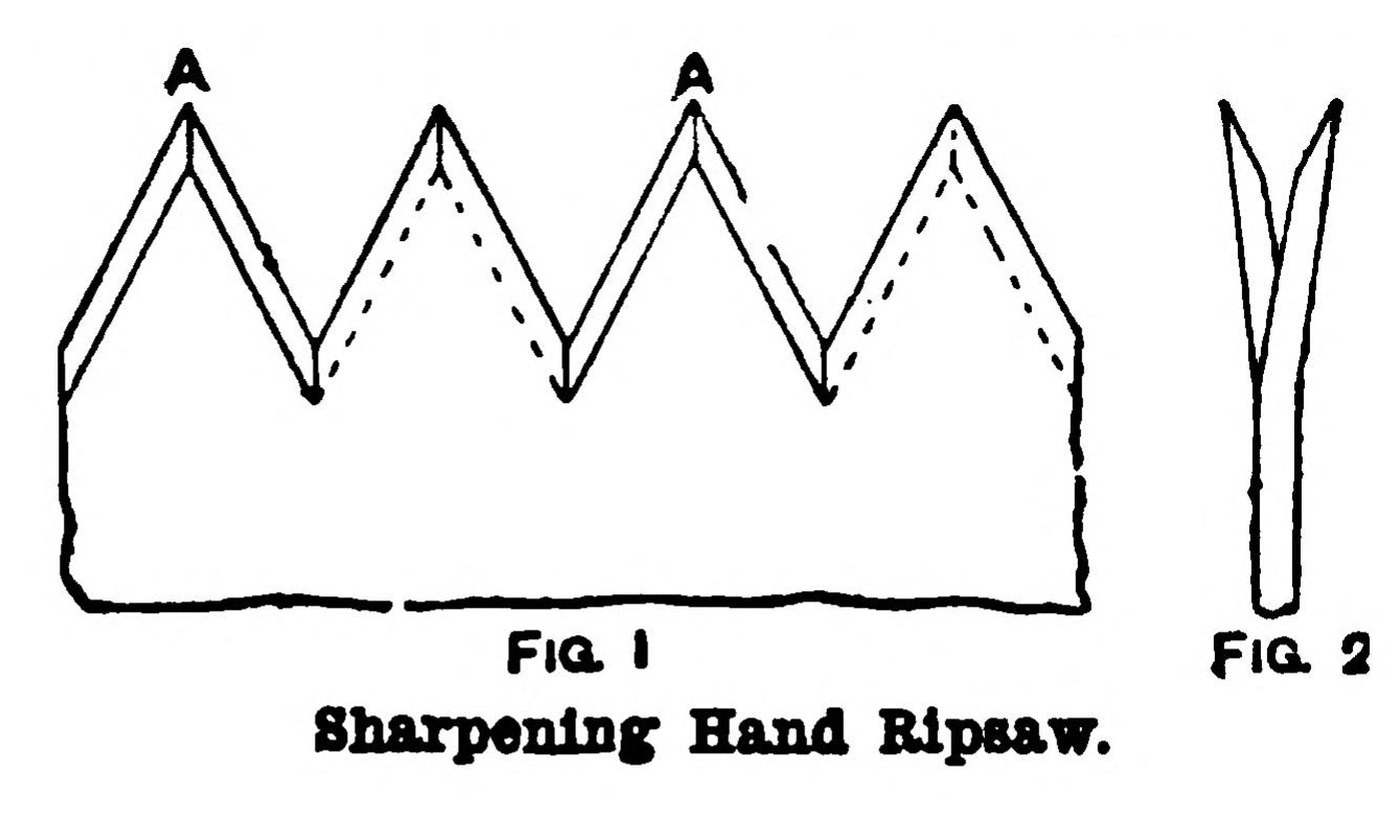


Rip Saw: Diamond-Pointed Teeth Bevelled from One Face (Cassell's Cyclopaedia, 1904)
A less common way to sharpen a hand rip saw, given in Cassell's Cyclopaedia of Mechanics (1904) as one that "answers well in actual practice". Both edges of each tooth are bevelled from the same face, so every tooth comes to a long point like a diamond-pointed wood chisel with a left and a right cutting edge, the teeth alternating from side to side of the blade. Set as usual, with the flat side of each pointed tooth turned outward. Teeth a little longer than an equilateral triangle, with a longer side slope, cut much more sweetly.
Tooth size, bevel angle and amount of set are not given; those are unknown here.
Source: P. N. Hasluck (ed.), Cassell's Cyclopaedia of Mechanics vol. V (1904), p. 122. Picture: its figs. 1 and 2.
Intermediário
An hour
Instruções
1
1
Read Cassell's
Read Cassell's
"... both edges of each tooth are bevelled from the same face, to form a long point at A (Fig. 1). In this way each successive tooth resembles a diamond-pointed wood chisel having a left and right cutting edge ..."
2
2
Clamp the saw
Clamp the saw
Clamp the hand saw in the vice with its teeth just above the jaws.
Materiais para este passo:
 Serrote de marceneiro1 hand saw
Ferramentas necessárias:
 Torno de bancada
3
3
File the long points
File the long points
File alternate teeth from one side of the blade, bevelling BOTH edges of each tooth from that same face so the tooth ends in a long point (A in Fig. 1). Turn the saw and file the other teeth the same way from the other face. Make the teeth slightly longer than an equilateral triangle and the side slope a little longer than usual, for a keener edge. The bevel angle and tooth size are not given (unknown).
Ferramentas necessárias:
 Lima para serras
 Dimensões desconhecidas
4
4
Set the teeth
Set the teeth
Give the usual set: turn the flat side of each pointed tooth outward, alternately left and right (Fig. 2), the same amount on each side. The amount is not given (unknown).
Ferramentas necessárias:
 Travador de serrasDimensões desconhecidas
5
5
History and honest limits
History and honest limits
Cassell's notes this method was "not generally adopted"; the usual rip saw has upright fronts filed with a small bevel (p. 73, the other Rip Saw blueprint).
Tooth size, bevel angle and amount of set are not given; the saw is a hand saw refiled for ripping.
Materiais
1- 1 hand sawReferência
Ferramentas necessárias
4- Referência
- Referência
- Referência
- Referência
Este projeto faz

CC0 Domínio Público
Este blueprint é liberado sob CC0. Você é livre para copiar, modificar, distribuir e usar este trabalho para qualquer finalidade, sem pedir permissão.
Apoie o Maker comprando produtos através do Blueprint, onde ele ganha uma Comissão Maker definida pelos vendedores, ou crie uma nova versão deste Blueprint e inclua-o como conexão no seu próprio Blueprint para compartilhar receita.