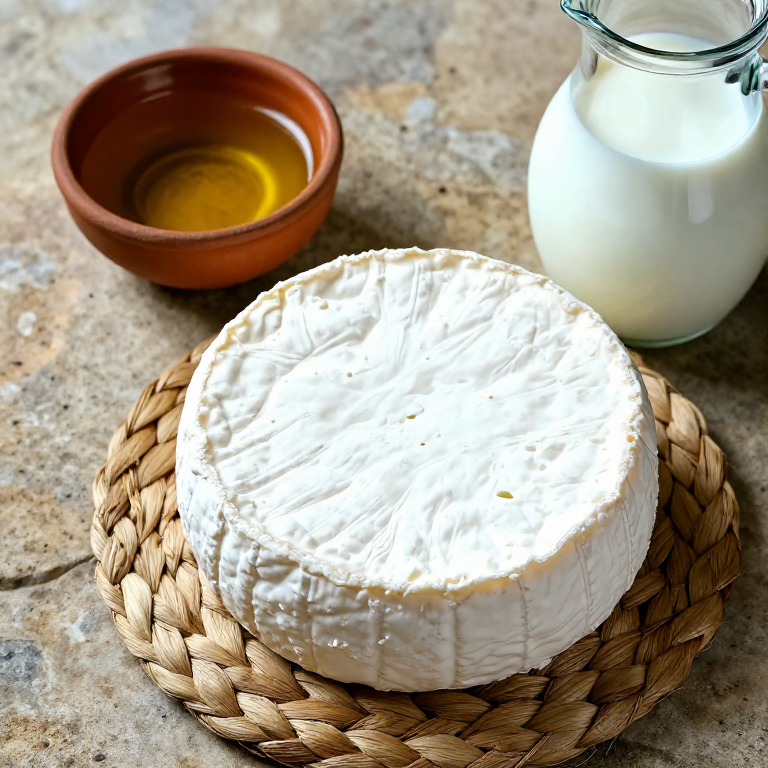


Pressing Fresh Roman Cheese (Caseus) — Simple Acid-Set Cheese
Instruções
Heat the Milk
Heat the Milk
Pour the milk into a heavy-bottomed pot and heat slowly over medium heat, stirring occasionally to prevent scorching on the bottom. Heat the milk to approximately 85-90 degrees Celsius — just below a full boil. Small bubbles will form around the edges and steam will rise vigorously, but the surface should not be at a rolling boil. Columella recommends using the freshest milk possible, ideally still warm from milking, as fresh milk coagulates more readily. Sheep's milk was the most prized for cheese-making in Roman Italy, as it has a higher fat and protein content than cow's milk, producing a richer, more flavourful cheese with a higher yield.
Materiais para este passo:
 Leite magro2 litres peça
 Vinagre de vinho60-80 ml ml
 Sal marinho fino1 teaspoon peça
Ferramentas necessárias:
 Panela grande
 Termómetro de forno
 Concha de servir
 Pano de queijo de algodão
 Escorredor
 Peso
PesoAdd the Coagulant
Add the Coagulant
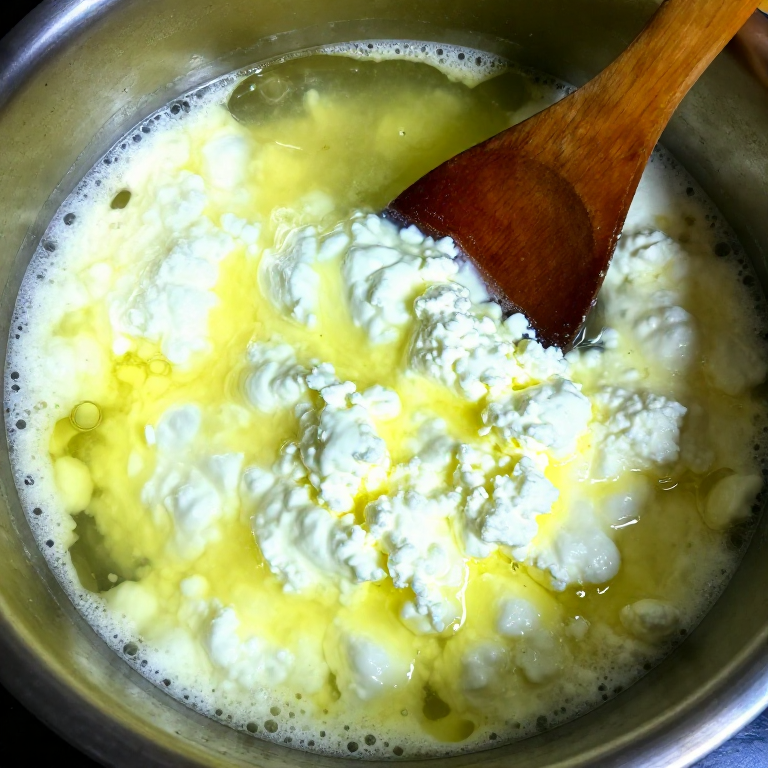
Remove the pot from the heat and immediately add the vinegar or lemon juice, stirring gently for just 5 to 10 seconds, then stop stirring and leave undisturbed. Within 1 to 3 minutes, the milk will separate into white curds (solid protein and fat) and yellowish-green whey (liquid). The acid lowers the pH of the milk below the isoelectric point of casein (approximately pH 4.6), causing the protein to denature and aggregate into curds. If separation does not occur within 5 minutes, add another tablespoon of acid and stir briefly. Columella also describes using fig-tree sap (latex from the Ficus carica branch) as a coagulant — the enzyme ficin it contains cleaves casein proteins, acting similarly to animal rennet. Allow the curds to rest undisturbed in the whey for 10 to 15 minutes to firm up.
Drain the Curds
Drain the Curds
Line a colander or perforated mould with cheesecloth or fine linen — Roman cheese-makers used woven rush baskets (forma), from which the Italian word formaggio (cheese) derives. Gently ladle the curds into the lined mould using a slotted spoon, disturbing them as little as possible to retain moisture and produce a softer cheese. Allow the whey to drain through the cloth for 15 to 30 minutes. Do not discard the whey — Romans used it as a cooking liquid, a drink for labourers, and as feed for pigs. The whey can also be re-heated to above 80 degrees Celsius to precipitate the remaining albumin proteins, producing a very small amount of whey cheese (similar to modern ricotta, which literally means re-cooked).
Salt and Press
Salt and Press
Sprinkle salt over the drained curds and gently fold it through — salt seasons the cheese and draws out additional whey, improving both flavour and keeping quality. Gather the cheesecloth around the curds and twist to form a compact round shape. Place the wrapped cheese in the mould and set a weight of 0.5 to 1 kg on top. Press for 1 to 2 hours, flipping the cheese once halfway through to ensure even pressing. The pressure expels more whey and compacts the curds into a cohesive mass. For a softer, more moist cheese (closer to ricotta), press for only 30 minutes with light weight. For a firmer cheese (closer to paneer), press for 2 hours with heavier weight. Columella describes both soft and firm fresh cheeses for different culinary purposes.
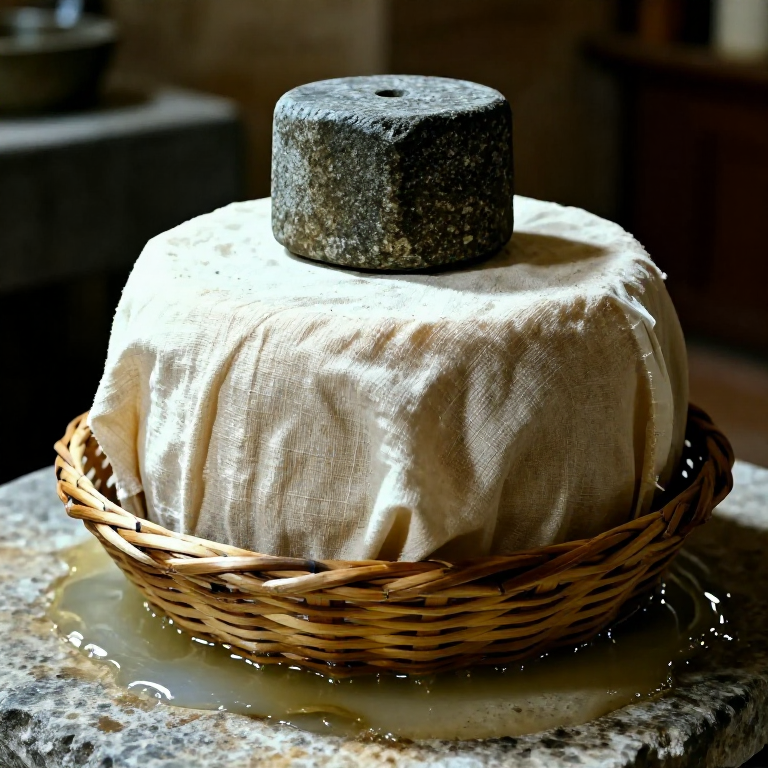
Unmould and Serve or Store
Unmould and Serve or Store
Unwrap the pressed cheese and turn it out of the mould onto a clean surface. The cheese should hold its shape as a firm, smooth disc or round, with the imprint of the cloth or basket visible on its surface. Fresh acid-set cheese has a mild, milky flavour with a slight tang from the acid. It is best consumed within three to five days, stored in a cool place covered with a damp cloth. Romans served fresh cheese drizzled with honey, sprinkled with herbs, or mixed into dishes — Apicius uses fresh cheese in patina (baked custard dishes) and in sweet cakes. For longer storage, Columella describes rubbing the cheese surface with salt daily for several days, then drying it in a shaded, breezy location to produce a harder, longer-lasting cheese suitable for grating.
Materiais
4- 2 litres peçaReferência
- 60-80 ml mlReferência
- 60-80 ml peçaReferência
- 1 teaspoon peçaReferência
Ferramentas necessárias
11- Referência
- Referência
- Referência
- Referência
- Referência
- Referência
- Referência
- Referência
- Referência
- Referência
- Referência
CC0 Domínio Público
Este blueprint é liberado sob CC0. Você é livre para copiar, modificar, distribuir e usar este trabalho para qualquer finalidade, sem pedir permissão.
Apoie o Maker comprando produtos através do Blueprint, onde ele ganha uma Comissão Maker definida pelos vendedores, ou crie uma nova versão deste Blueprint e inclua-o como conexão no seu próprio Blueprint para compartilhar receita.