

Roman Tooth Powder and Urine Mouthwash — Ancient Dental Chemistry That Actually Worked
The Romans were obsessed with dental hygiene. Wealthy Romans employed dedicated tooth-cleaning slaves, and the poet Catullus mocked a rival by noting that 'the whiter your teeth, the more urine you have drunk.' This was not poetic license — Romans genuinely used aged urine as mouthwash, and the chemistry behind it is sound: urine decomposes into ammonia (NH₃), a mild alkaline disinfectant that neutralises the acids produced by oral bacteria and whitens teeth by bleaching organic stains.
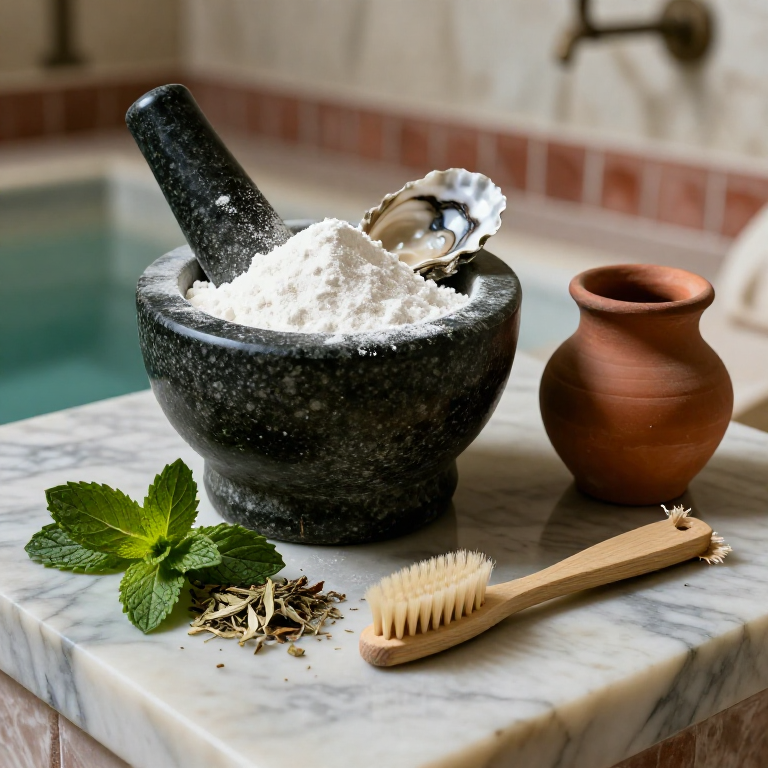
Roman tooth powder (dentifricium) was a sophisticated formulation documented by physicians Pliny the Elder, Scribonius Largus, and the Greek-Roman physician Galen. Base ingredients included crushed bone, oyster shell, or eggshell (calcium carbonate — a mild abrasive and acid neutraliser), mixed with honey (antibacterial), salt (antiseptic), ground charcoal (absorbent and whitener), and dried herbs like mint, thyme, or myrrh (flavouring and antimicrobial).
Modern dentistry confirms the Romans were on the right track. Calcium carbonate remains the primary abrasive in modern toothpaste. Ammonia-based cleaning compounds are used in industrial tooth whitening. Honey has documented antibacterial properties against Streptococcus mutans (the primary cavity-causing bacterium). The Romans lacked germ theory, but their empirical dental formulations addressed plaque, bacterial acids, and staining through mechanisms that modern science validates.
Instruções
Prepare the calcium carbonate abrasive base
Prepare the calcium carbonate abrasive base
The foundation of Roman tooth powder is calcium carbonate (CaCO₃) — a mild abrasive that physically removes plaque and food debris while neutralising the lactic acid produced by oral bacteria (the acid that causes tooth enamel to dissolve, creating cavities). The Romans obtained calcium carbonate from three sources: crushed oyster shells, crushed eggshells, or ground bone ash.
Collect clean oyster shells or eggshells and remove any organic membrane. Roast them in a fire until they are white and brittle — this burns off any remaining organic material and makes them easier to grind. Crush the roasted shells in a stone mortar and grind to the finest possible powder. Sieve through a fine cloth to remove any coarse fragments that could scratch tooth enamel. The result should be a soft, smooth white powder — essentially the same calcium carbonate used as the primary abrasive in modern toothpaste.
Ferramentas necessárias:
 Almofariz e pilão de pedra
Add charcoal powder for whitening
Add charcoal powder for whitening
Pliny the Elder recommended adding ground charcoal to tooth powder for its whitening and odour-absorbing properties. Charcoal is a porous form of carbon that adsorbs organic molecules — including the tannins and chromogens that stain teeth from wine, fruit, and food. Modern 'activated charcoal' toothpastes use the same principle, though dentists debate whether the abrasiveness outweighs the whitening benefit.
Grind hardwood charcoal (willow or vine charcoal preferred for its fine texture) to a powder as fine as the calcium carbonate base. Add approximately 1 part charcoal powder to 4 parts calcium carbonate. The resulting grey powder may seem counterintuitive for a whitening agent — but the charcoal binds to surface stains and is rinsed away, taking the discolouration with it. The Romans noted that regular charcoal tooth powder use produced visibly whiter teeth within weeks.
Materiais para este passo:
 Carvão vegetal em pedaços50 g
Add salt and herbal antimicrobials
Add salt and herbal antimicrobials
Mix fine sea salt into the powder — approximately 1 part salt to 8 parts base powder. Salt (sodium chloride) has mild antiseptic properties: it creates an osmotic environment hostile to bacteria by drawing water from their cells through their membranes. Salt mouth rinses are still recommended by modern dentists for treating mild gum infections and post-extraction healing.
For flavour and additional antimicrobial action, add dried, powdered herbs. Scribonius Largus recommended dried mint (Mentha) for breath freshening — mint contains menthol, which has documented antibacterial and anti-inflammatory properties. Myrrh resin (Commiphora myrrha) was prized for treating gum disease — modern research confirms it reduces gingival inflammation. Thyme (Thymus vulgaris) contains thymol, the active ingredient in modern Listerine mouthwash. Grind the dried herbs to powder and add approximately 1 tablespoon per cup of base powder.
Materiais para este passo:
 Folhas secas de hortelã-pimenta20 g
The urine mouthwash — ammonia chemistry
The urine mouthwash — ammonia chemistry
The most infamous element of Roman dental hygiene: gargling with aged urine. Fresh urine is slightly acidic (pH ~6) and sterile, but as it stands for several days, bacteria convert the urea (CO(NH₂)₂) to ammonia (NH₃) and carbon dioxide. The ammonia raises the pH to ~9-10, creating an alkaline solution that neutralises the acid environment in which cavity-causing bacteria thrive.
The Romans preferred Portuguese urine — Catullus specifically mentions 'Celtiberian' urine as the premium variety. This may reflect a genuine difference: diet affects urine composition, and the high-protein diet of Iberian pastoral communities may have produced urine with higher urea (and therefore ammonia) content. Aged urine was collected in public urinals (Vespasian later taxed the collectors, coining the phrase 'pecunia non olet' — money doesn't smell) and sold to laundries (fulleries) and dentists alike.
Application method — the Roman dental routine
Application method — the Roman dental routine
The Roman dental routine combined the tooth powder and mouthwash in a sequence remarkably similar to modern brushing and rinsing. Wet a finger or a frayed twig (the ancient toothbrush — a miswak or salvadora stick, whose fibrous end spreads like bristles when chewed) and dip it in the tooth powder. Rub the powder across all tooth surfaces in a circular motion, paying particular attention to the gum line where plaque accumulates.
Rinse the mouth with a swallow of diluted aged urine (approximately 1 part urine to 2 parts water), swishing vigorously for 30 seconds to 1 minute. The ammonia in the urine neutralises residual acids and bleaches surface stains. Spit and rinse with clean water. Galen recommended performing this routine twice daily — morning and evening — the same frequency modern dentists recommend. The Romans also used toothpicks (lentiscus wood picks) after meals, a practice Galen considered essential for preventing food impaction between teeth.
Modern validation and the non-urine alternatives
Modern validation and the non-urine alternatives
Modern chemistry validates the Roman approach while offering less revolting alternatives. Calcium carbonate abrasive: still the primary ingredient in most commercial toothpastes (read the label — 'dicalcium phosphate dihydrate' or 'calcium carbonate' appear in nearly every brand). Ammonia whitening: professional tooth whitening uses hydrogen peroxide or carbamide peroxide — chemically related to the ammonia pathway but far more pleasant. Salt rinse: still prescribed post-surgically. Mint, thyme, myrrh: all confirmed antimicrobials, all still used in 'natural' dental products.
The only Roman ingredient that modern dentistry firmly rejects is the urine itself — not because the chemistry was wrong (ammonia does neutralise oral acids and bleach stains) but because the infection risk from using a bodily waste product outweighs the dental benefit. Baking soda (sodium bicarbonate) provides the same alkaline pH effect without the biological hazard — and without the social consequences that Catullus described so memorably.
Materiais
3- Referência
- Referência
- 500 mlReferência
Ferramentas necessárias
1- Referência
Materiais de Blueprints conectados
Blueprints relacionados
Estes blueprints compartilham conhecimento — técnicas, materiais ou princípios

CC0 Domínio Público
Este blueprint é liberado sob CC0. Você é livre para copiar, modificar, distribuir e usar este trabalho para qualquer finalidade, sem pedir permissão.
Apoie o Maker comprando produtos através do Blueprint, onde ele ganha uma Comissão Maker definida pelos vendedores, ou crie uma nova versão deste Blueprint e inclua-o como conexão no seu próprio Blueprint para compartilhar receita.