ARTE
BELEZA E BEM-ESTAR
ARTESANATO
CULTURA E HISTÓRIA
ENTRETENIMENTO
MEIO AMBIENTE
COMIDA E BEBIDAS
ENGENHARIA REVERSA
CIÊNCIAS
ESPORTES
TECNOLOGIA
TECNOLOGIA VESTÍVEL
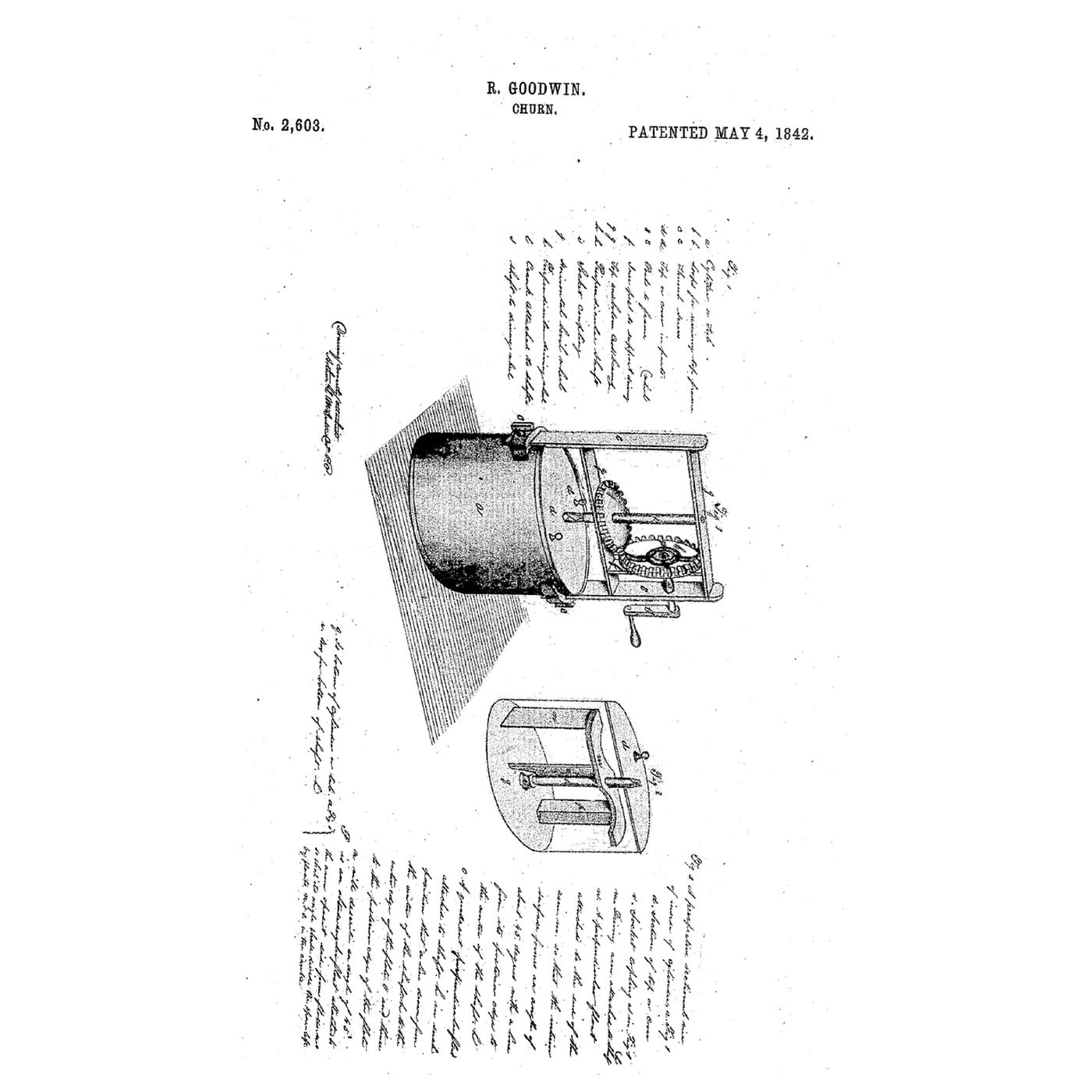


Rotary Stirring Churn: Three Floats That Stop the Cream Merely Going Round
Goodwin set out to prevent "a gyratory motion of the fluid" in a stirred churn.
Roderick Goodwin of North Bergen, New York, received US 2,603, dated 4 May 1842, for what he called "the improved rotary stirring-churn": a tub with a frame clamped on top by thumb screws, a crank turning mitred wheels and an upright shaft, and on its arm three floats. The first, at about 45°, throws the cream "inwardly toward the said lower shaft"; a curved float at the shaft throws it "back toward the sides of the churn"; a third, bent to an obtuse angle, divides the stream between them.
This rung works out the floats' push, then prints the three-float rotor, fits it to a stock pot, and makes butter.
Intermediário
About 3 hours, plus printing
Instruções
1
1
Shaft speed and float push
Shaft speed and float push
A carregar o notebook Jupyter…
2
2
Upright shafts with beaters before it
Upright shafts with beaters before it
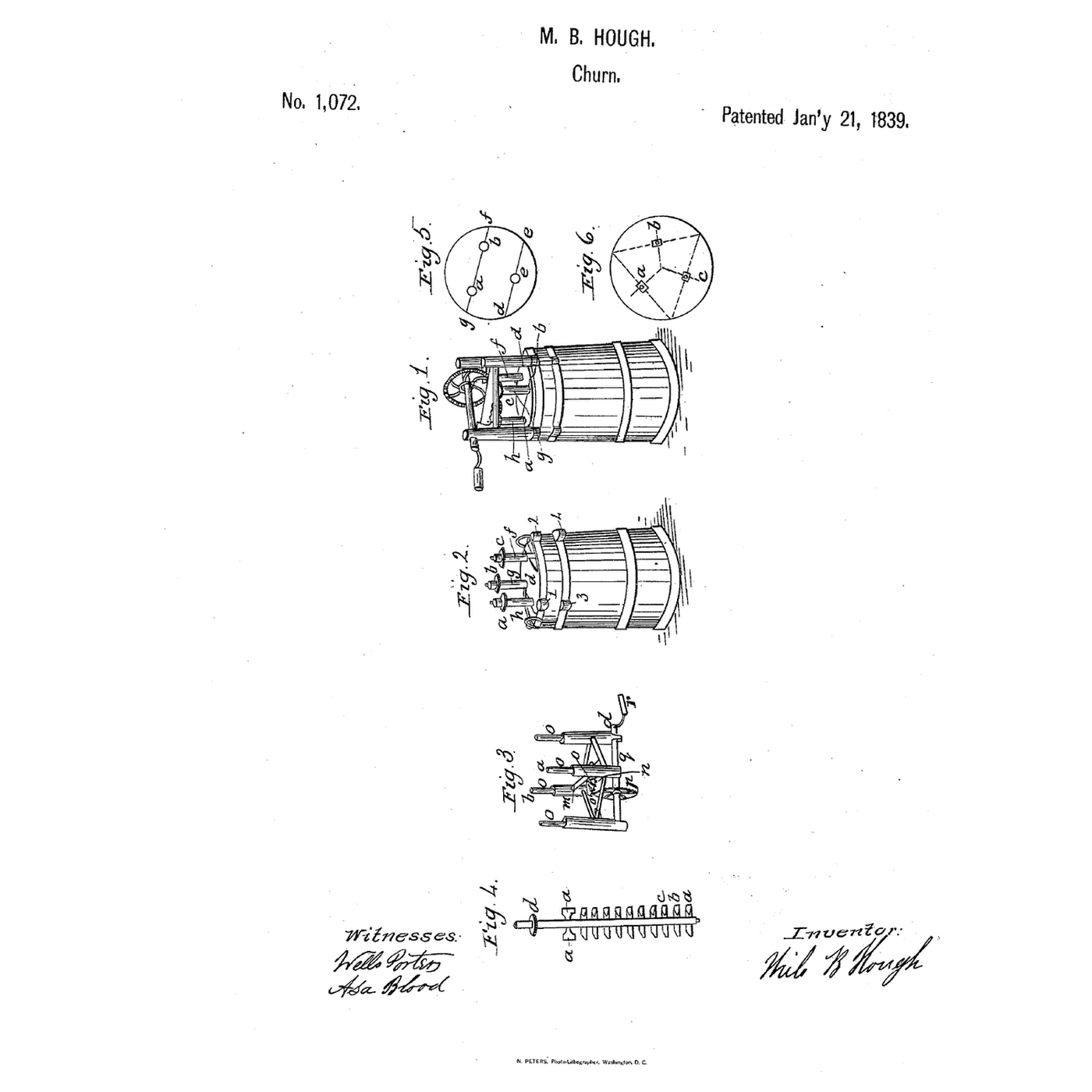
The embedded blueprint turns three upright shafts in a round churn. Goodwin uses one shaft and shapes its floats so the cream cannot simply swirl round.
3
3
Read US 2,603
Read US 2,603
"To the long end of the arm I attach firmly a perpendicular float (n, Fig. 2,) its outer edge being parallel to the sides of the churn and reaching nearly to the bottom being in width about one third of the length from the shaft to the end of the arm to which it is attached, and placed in such position that the side of the float would form an angle of about forty five degrees with a line drawn from its inner edge to the center of the lower shaft."
4
4
Print the rotor and fittings
Print the rotor and fittings
Print the rotor upside down on its arm (/uploads/blueprints/rotary-stirring-churn-floats.stl): the arm with the long 45° float, the curved float at the shaft and the angled float on the short end. Print the foot socket (/uploads/blueprints/rotary-stirring-churn-foot-socket.stl), the top bearing (/uploads/blueprints/rotary-stirring-churn-top-bearing.stl) and the crank arm (/uploads/blueprints/rotary-stirring-churn-crank-arm.stl). Print in PETG at 0.2 mm layers, 30 % infill, 4 walls; wash before first use.
Materiais para este passo:
 Filamento PETG1 peça
Ferramentas necessárias:
 Impressora 3D de filamento (FDM)
5
5
Fit the pot
Fit the pot
Bed the foot socket in the centre of a stock pot's floor with silicone. Screw the top bearing to a pine batten laid across the pot's rim, its hole over the socket. Cut a lid from plywood in two halves with a 40 mm hole where they meet, for air, as his two lids.
Materiais para este passo:
 Panela alta1 peça
 Vedante de silicone1 peça
 Tábua de pinho1 peça
 Placa de contraplacado1 peça
 Parafuso para madeira n.º 8 x 1"1 peça
Ferramentas necessárias:
 Serrote
 Serra de recortes
 Berbequim sem fios
 Jogo de brocas
 Conjunto de chaves de fendas
6
6
Shaft and crank
Shaft and crank
Cut a 10 mm square hardwood shaft from the socket to 30 mm above the bearing. Slide the rotor on so its floats clear the floor, glue it, stand the shaft in the socket and through the bearing, and glue the crank arm and a dowel handle on top.
Materiais para este passo:
 Cavilhas de madeira dura1 peça
 Cola de madeira1 peça
Ferramentas necessárias:
Serrote Lixa
Lixa7
7
The build in 3D
The build in 3D
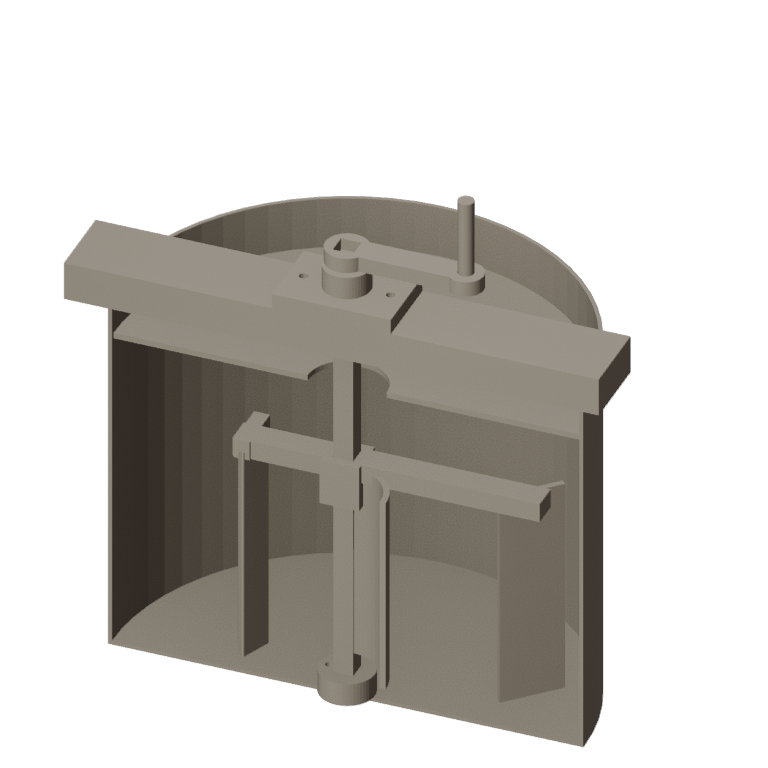
FreeCAD model of this build, not of the patent: the pot cut away to show the rotor on its square shaft — the long float at 45°, the curved float at the shaft and the angled float — with the foot socket, the batten, top bearing and crank, and half the lid.
8
8
Crank and make butter
Crank and make butter
Let the heavy cream stand until it reaches about 15 °C, checked with the thermometer. Pour in 1 litre, fit the lid halves, and crank steadily; time until the butter comes. Pour off the buttermilk, add cold water, churn a little and pour off again until it runs clear; work in a pinch of salt and weigh the butter.
Materiais para este passo:
 Natas para bater1000 ml
 Sal marinho grosso1 peça
 Água1 peça
Ferramentas necessárias:
 Termómetro de sonda permanente
 Cronómetro
 Balança digital de cozinha
 Taça grande de aço inoxidável
9
9
Floats that scrape, cream that swirls
Floats that scrape, cream that swirls
Rotary stirring churn troubleshooting.
Flow
Loading...
10
10
History and honest limits
History and honest limits
**Roderick Goodwin** of North Bergen, Genesee County, New York, received US 2,603, dated 4 May 1842. His frame's two posts went into loops on the tub, held by thumb screws, so it could be raised, lowered or taken off; the upper and lower shafts joined by a square tenon and socket; the whole could be wood, or partly wood and partly iron or other metal, and "can be separated in a moment for the purpose of cleaning." He claimed the shape, position, arrangement and relative situation of the floats on the arm.
**Honest limits.** A stock pot, a batten and printed parts stand in for his tub and frame, and our crank turns the shaft directly, without his mitred wheels. FDM prints hold food in their layer lines, so wash well and replace when worn. Your times and weights are the result.
Materiais
11- 1 peçaReferência
- 1 peçaReferência
- 1 peçaReferência
- 1 peçaReferência
- 1 peçaReferência
- Referência
- 1 peçaReferência
- 1 peçaReferência
- 1000 mlReferência
- 1 peçaReferência
- 1 peçaReferência
Ferramentas necessárias
11- Referência
- Referência
- Referência
- 1 vendor sell this, none ship to you yetReferência
- Referência
- Referência
- Referência
- Referência
- Referência
- Referência
- Referência
Ficheiros de design
1Blueprints relacionados
Estes blueprints compartilham conhecimento — técnicas, materiais ou princípios


CC0 Domínio Público
Este blueprint é liberado sob CC0. Você é livre para copiar, modificar, distribuir e usar este trabalho para qualquer finalidade, sem pedir permissão.
Apoie o Maker comprando produtos através do Blueprint, onde ele ganha uma Comissão Maker definida pelos vendedores, ou crie uma nova versão deste Blueprint e inclua-o como conexão no seu próprio Blueprint para compartilhar receita.