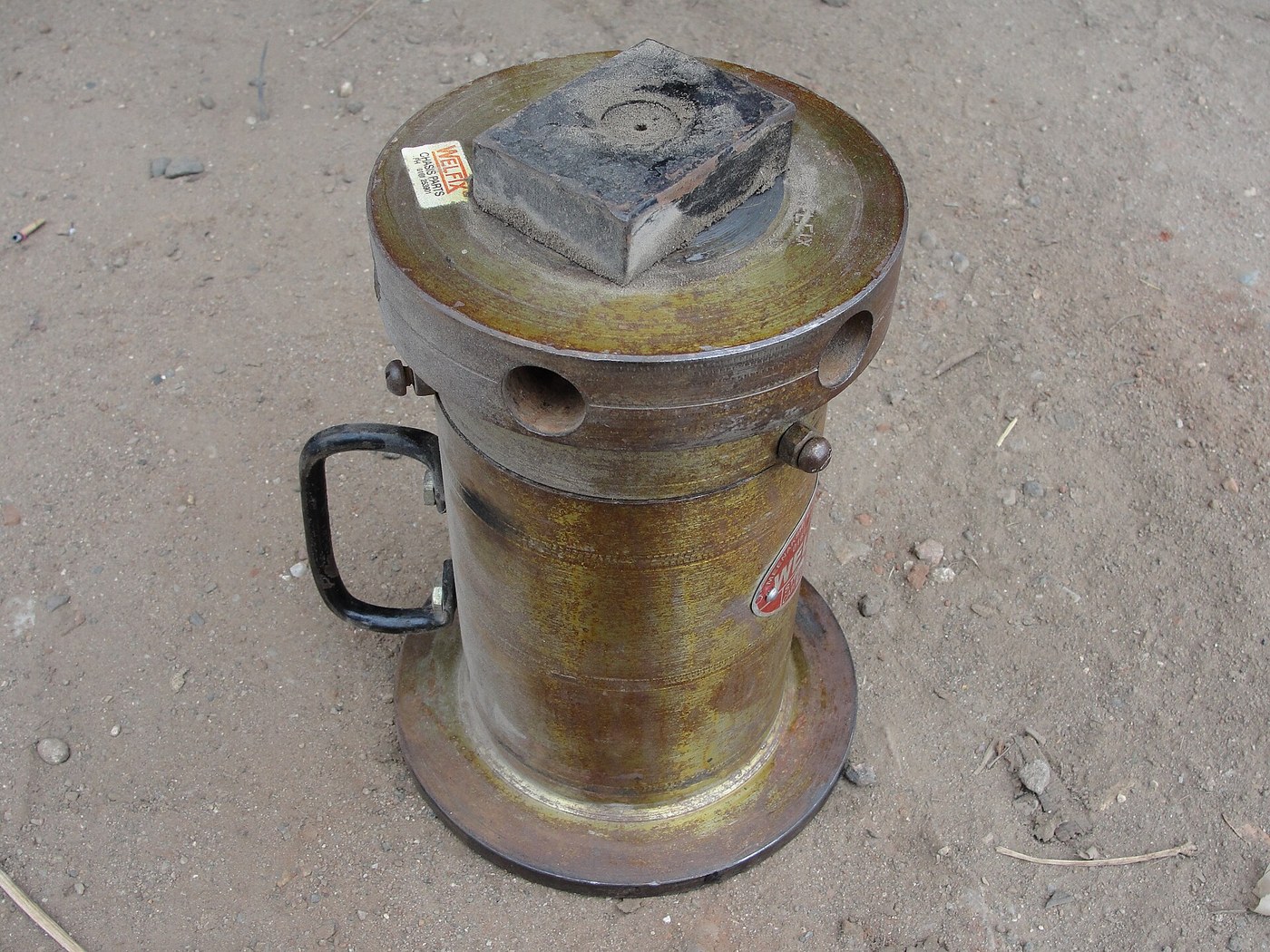


Screw Jack
Instruções
Unwrap the thread
Unwrap the thread
See that a screw is a ramp before treating it as one.
- Cut a right triangle from paper whose base is the circumference of a rod.
- Wrap it around the rod.
- The hypotenuse traces a helix — the thread.
Materiais para este passo:
 Varão roscado1 peça
 Régua1 peça
Build the jack and measure the ratio
Build the jack and measure the ratio
A threaded rod, a fixed nut, a handle and a load platform.
- Fix a nut in a rigid base and run the threaded rod through it.
- Fit a handle of measured length across the top.
- Measure the thread pitch.
Ideal mechanical advantage = 2πL ÷ pitch, where L is the handle radius.
A 300 mm handle on a 2 mm pitch gives a theoretical advantage of nearly a thousand. That number is why a jack looks absurdly effective, and why the next step matters so much.Materiais para este passo:
 Porca sextavada2 peças
 Varão de latão1 length
Measure the real advantage and find the friction
Measure the real advantage and find the friction
Compare theory against what you actually get.
- Load the platform with a known mass.
- Measure the force needed at the handle to raise it steadily.
- Actual advantage = load ÷ effort. Efficiency = actual ÷ ideal.
Materiais para este passo:
 Balança digital de cozinha1 peça
Prove it is self-locking
Prove it is self-locking
The friction you just measured as a loss is the safety feature.
- Raise the load and let go of the handle entirely.
- It stays where it is.
- Now try the same with a steep-pitch or ball-screw arrangement if you have one — it runs back down.
History and context
History and context
The screw as a lifting device is ancient — Archimedes is associated with screw principles, and screw presses for wine, oil and later printing are Roman and medieval. Turning it into a portable lifting jack needed accurate, strong threads in quantity, which is a nineteenth-century capability resting on the screw-cutting lathe and thread standards.
Its most famous use is bridges and buildings. Screw jacks lift entire structures for underpinning and moving; Chicago's buildings were jacked up several feet in the 1850s and 60s to raise the city above its swamp, and George Pullman made his reputation on that work. Thousands of jacks, each turned a fraction of a turn in sequence, move a building without cracking it.
The vehicle jack most people have met is the scissor jack, which is a screw driving a linkage — the screw supplies force and self-locking, the linkage converts horizontal motion into vertical lift and gives a compact stowed size.
Safety, stated plainly: a screw jack is a lifting device, not a support. It can be knocked off its base, the thread can strip, and the load can shift. Anything that holds a load with a person underneath should be a stand rated for it. The self-locking property makes a screw jack safer than a hydraulic one, and that is a relative statement, not a licence.
Materiais
5- 1 peçaReferência
- 1 peçaReferência
- 2 peçasReferência
- 1 lengthReferência
- Referência
Blueprints relacionados
Estes blueprints compartilham conhecimento — técnicas, materiais ou princípios
CC0 Domínio Público
Este blueprint é liberado sob CC0. Você é livre para copiar, modificar, distribuir e usar este trabalho para qualquer finalidade, sem pedir permissão.
Apoie o Maker comprando produtos através do Blueprint, onde ele ganha uma Comissão Maker definida pelos vendedores, ou crie uma nova versão deste Blueprint e inclua-o como conexão no seu próprio Blueprint para compartilhar receita.