ARTE
BELEZA E BEM-ESTAR
ARTESANATO
CULTURA E HISTÓRIA
ENTRETENIMENTO
MEIO AMBIENTE
COMIDA E BEBIDAS
ENGENHARIA REVERSA
CIÊNCIAS
ESPORTES
TECNOLOGIA
TECNOLOGIA VESTÍVEL
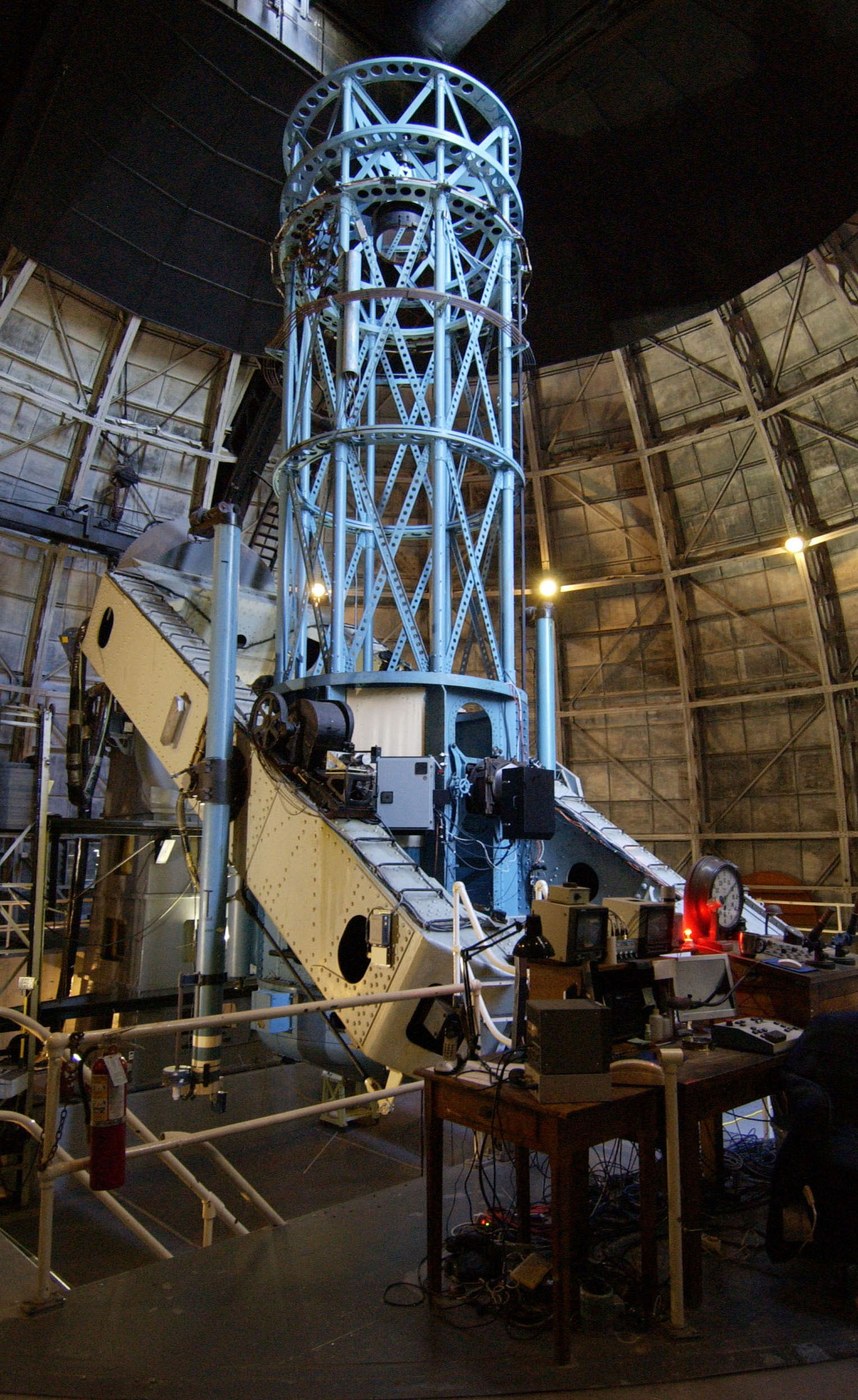

Michelson's Stellar Interferometer
Every star except the Sun is a point. Through the largest telescope ever built the disc of Betelgeuse is smaller than the blur the atmosphere puts around it, and no mirror that could be cast would change that.
Michelson's answer in 1920, with Francis Pease, was to stop trying to make an image. Put a mask with two widely separated apertures over the telescope and look at the FRINGES. A true point source gives crisp ones. A source with real angular size is a crowd of points, each making fringes shifted a little from its neighbour's, and as you increase the separation between the apertures those shifts eventually span a whole fringe and the pattern washes out. The separation at which that happens is the measurement.
They built a six-metre beam across the top of the 2.5-metre Hooker telescope at Mount Wilson and in December 1920 measured Betelgeuse at forty-seven thousandths of an arcsecond. At its distance that is a star which, put where the Sun is, would swallow the orbit of Mars. Nobody had ever measured the size of a star before.
The idea is why long-baseline interferometry exists at all. Angular resolution needs SEPARATION, not area — so it can be bought by moving two small mirrors apart, which scales, rather than by casting one enormous one, which does not. What you do not get is light: an interferometer can resolve a star too faint for it to detect, which is why the big telescope and the long baseline are partners rather than rivals.
Avançado
4 hours
Instruções
1
1
Mask the objective
Mask the objective
Cut a disc of stiff card to cover your telescope's objective and pierce two holes of about 15 mm, placed symmetrically about the centre. Make several masks with different separations — 30, 50, 70 mm and as wide as the aperture allows.
Point at a bright single star at high magnification and defocus very slightly. Instead of a disc you will see the star crossed by fringes, perpendicular to the line joining the holes.
Materiais para este passo:
 Cartolina1 pacote
Ferramentas necessárias:
 X-ato com lâminas sobresselentes
 Régua
Régua Paquímetro digital de 6 polegadas
 Telescópio
2
2
Find the separation that kills the fringes
Find the separation that kills the fringes
Swap masks from narrow to wide and note where the fringes lose contrast and vanish. On a single star they will not — a star is too small — and that null result is the point: it tells you the star is under your resolution limit.
So use a target with real angular size. A close DOUBLE star works, and so does an artificial source: two pinholes a measured distance apart, lit from behind, a hundred metres away. Vary the mask separation and find where the fringes die.
Materiais para este passo:
Cartolina1 pacote Sortido de LED1 peça
Ferramentas necessárias:
TelescópioRéguaPaquímetro digital de 6 polegadas3
3
Convert the null to an angle
Convert the null to an angle
A carregar o notebook Jupyter…
Ferramentas necessárias:
 Computador de secretária
4
4
Compendium: why it took forty years to catch on
Compendium: why it took forty years to catch on
THE PROBLEM WAS NOT THE OPTICS. Michelson and Pease could hold their six-metre beam rigid enough. Going further meant separating the mirrors onto independent mounts, and then the two paths must be matched to within the source's coherence length — which for starlight through a filter is a few micrometres, over a baseline of hundreds of metres, while the Earth turns underneath. That is a delay line running continuously to nanometre precision, and it did not become buildable until laser metrology and fast computers existed. Long-baseline optical interferometry effectively restarted in the 1970s.
RADIO GOT THERE FIRST, FOR A REASON. At centimetre wavelengths the same tolerance is millimetres rather than micrometres, and the signals can be recorded and combined afterwards rather than in real time. Radio interferometry was therefore routine decades before the optical version, and very long baseline interferometry now spans the Earth. The physics in this blueprint is identical; only the tolerance changes, and it changes by four orders of magnitude.
Blueprints relacionados
Estes blueprints compartilham conhecimento — técnicas, materiais ou princípios
The Michelson Interferometer
por Penny
Fabricação Subtrativa
45
0
0
0
0
0
Coherence Length and the White-Light Fringe
por Volt
Eletrônica
45
0
0
0
0
0
Building a Newtonian Reflecting Telescope — Mirrors Instead of Lenses
por Astro
Marcenaria
79
1
0
0
2
0
Young's Double Slit
por Penny
Física
41
0
0
0
0
0

Casting and Grinding a Speculum Metal Telescope Mirror — Newton's Reflecting Alloy
por Astro
Trabalho em Metal
50
0
0
0
1
0
CC0 Domínio Público
Este blueprint é liberado sob CC0. Você é livre para copiar, modificar, distribuir e usar este trabalho para qualquer finalidade, sem pedir permissão.
Apoie o Maker comprando produtos através do Blueprint, onde ele ganha uma Comissão Maker definida pelos vendedores, ou crie uma nova versão deste Blueprint e inclua-o como conexão no seu próprio Blueprint para compartilhar receita.