ARTE
BELEZA E BEM-ESTAR
ARTESANATO
CULTURA E HISTÓRIA
ENTRETENIMENTO
MEIO AMBIENTE
COMIDA E BEBIDAS
ENGENHARIA REVERSA
CIÊNCIAS
ESPORTES
TECNOLOGIA
TECNOLOGIA VESTÍVEL
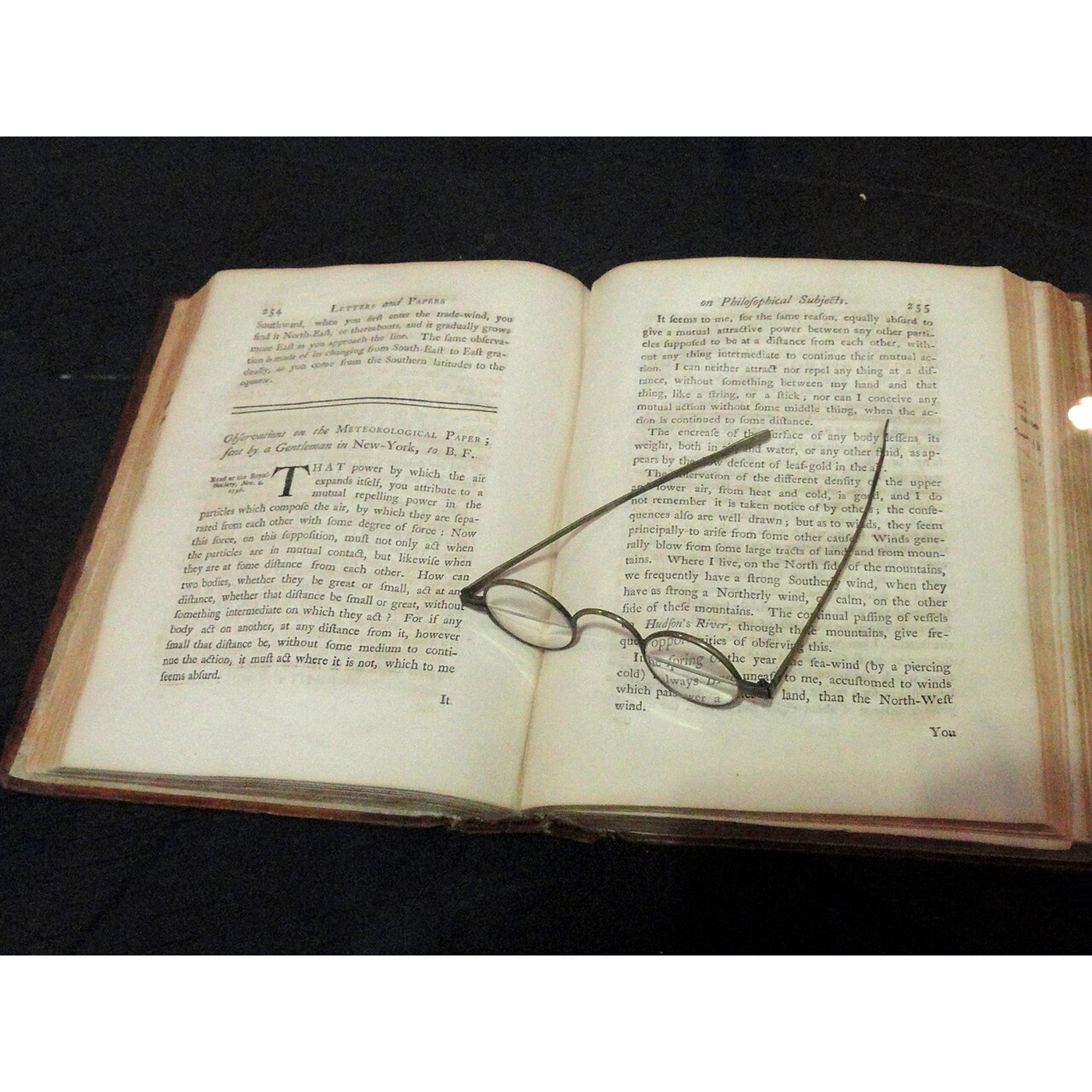


The Bifocal Lens: Two Pairs of Spectacles Cut in Half
With age the eye loses its power to focus near. Someone who already wears glasses for distance then needs a second pair for reading, and must swap them every time they look from the page to a face across the table.
Benjamin Franklin had his optician cut the lenses of his distance and reading spectacles in half and mount the halves together in one frame, distance on top and reading below. In a letter to George Whatley of 23 May 1785 he described these "double spectacles" and how useful he found them at dinner in France, where he could see both his food and the faces of those he talked to. He patented none of his inventions.
This rung works out why a reading addition is needed and how big, explains the image jump at a segment's edge, and builds a bench bifocal from two lenses and a camera.
Iniciante
About 2 hours
Instruções
1
1
Accommodation, the reading add and image jump
Accommodation, the reading add and image jump
A carregar o notebook Jupyter…
2
2
The single lens it splits
The single lens it splits
A bifocal is two spectacle lenses in one frame. The embedded blueprint covers the single convex and concave lenses it is made from.
3
3
Build a bench bifocal
Build a bench bifocal
Stand a digital camera on a table with its focus locked at infinity: that is the aged eye, which can no longer focus near. Put a newspaper page 40 cm in front of it and a poster across the room behind.
From a convex lens set pick a weak lens for 'distance' — about +0.5 D (f = 2 m) — and for 'reading' a lens 2.5 D stronger than that, about +3.0 D (f ≈ 33 cm): the 2.5 D difference is the reading add for 40 cm. Cut a card frame, mount the weak lens in the top half of the window and the strong one in the bottom half, each masked with tape so only its half shows: Franklin's split.
Photograph through the top half: the distant poster is sharp, the page blurred. Lower the frame and shoot through the bottom half: the page is sharp. Move the frame slowly across the dividing line and watch whether the scene jumps.
Materiais para este passo:
 Conjunto de lentes convexas1 peça
 Folhas de cartão canelado1 peça
Ferramentas necessárias:
 Câmara digital
 Régua
Régua Fita métrica
4
4
Bifocals that are hard to use
Bifocals that are hard to use
Common complaints with bifocals, and their usual causes.
Flow
Loading...
5
5
History and honest limits
History and honest limits
**Benjamin Franklin** described his "double spectacles" in a letter to **George Whatley** dated 23 May 1785. Fused and one-piece bifocals, in which the reading segment is melted into or ground from the main lens, replaced the split lens in the nineteenth and twentieth centuries, and progressive lenses later blended the zones together.
**Honest limits.** Hofstetter's formulas describe averages; an individual's amplitude varies widely, and prescribing is for an optometrist. The bench bifocal shows the principle with a camera, not a prescription for anyone's eyes.
Materiais
2- Referência
- Referência
Ferramentas necessárias
3- Referência
- Referência
- 1 vendor sell this, none ship to you yetReferência
Blueprints relacionados
Estes blueprints compartilham conhecimento — técnicas, materiais ou princípios
CC0 Domínio Público
Este blueprint é liberado sob CC0. Você é livre para copiar, modificar, distribuir e usar este trabalho para qualquer finalidade, sem pedir permissão.
Apoie o Maker comprando produtos através do Blueprint, onde ele ganha uma Comissão Maker definida pelos vendedores, ou crie uma nova versão deste Blueprint e inclua-o como conexão no seu próprio Blueprint para compartilhar receita.