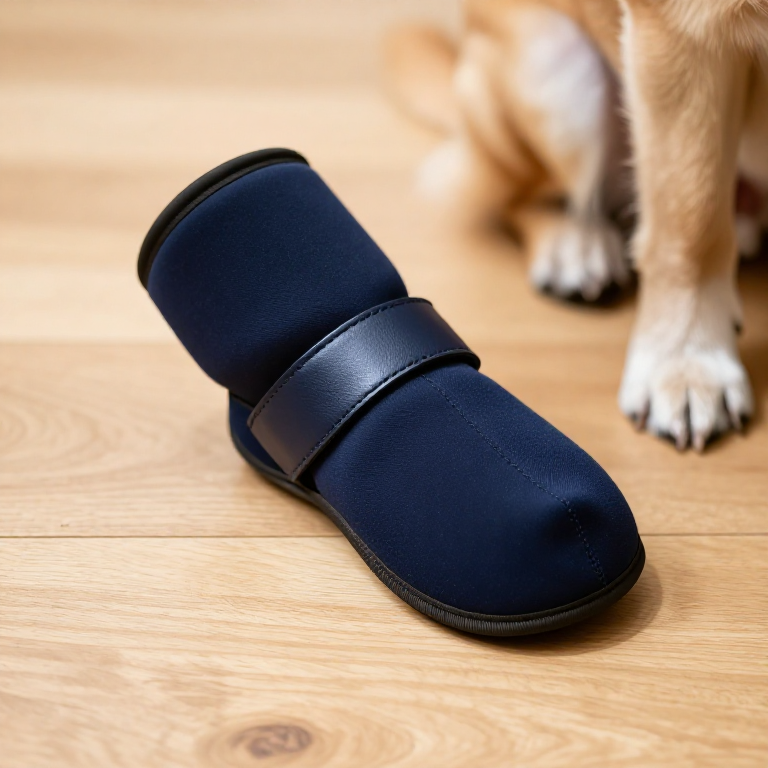


The Dog Boot
A dog's paw is tougher than people assume and vulnerable in specific, predictable ways. The pads are thick keratin over a fat pad, and they cope well with rough ground and cold. What they cope badly with is de-icing salt, which is a chemical irritant and is painful in a cracked pad; hot tarmac, which can burn pads in minutes; compacted ice balls forming between the toes of long-haired breeds; and sharp debris — glass, thorns, sharp scree.
A boot solves those. It also introduces problems of its own, and this is a design where the failure modes matter more than the construction.
The paw splays under load — it is wider standing than lifted — so a boot sized on a lifted paw is too small. It has almost no taper above the paw for a strap to grip, which is why boots come off, and why the fastening has to sit above the dewclaw and below the joint where it cannot chafe. And a dog's paws are a significant route for heat loss and for grip, both of which a boot removes.
The honest summary: boots are genuinely useful for salt, heat, injury protection and specific terrain, and unnecessary the rest of the time.
Instruções
Trace the paw under load
Trace the paw under load
Stand the dog on paper and trace around each paw while it bears weight, then trace the same paw lifted.
Compare the two outlines.
Expect the loaded outline to be noticeably wider.
Pattern from the loaded trace. Every front and rear paw differs too, so trace all four — front paws are usually larger.
Ferramentas necessárias:
 Tape Measure
 All-Weather Field Notebook (3-Pack)
Cut a flexible upper and a tough sole
Cut a flexible upper and a tough sole
Cut the upper from neoprene, which stretches and breathes a little, and a separate sole from grippy leather or rubber sheet.
Keep the sole flexible.
A stiff sole is the commonest mistake. A dog grips and balances by spreading its toes, and a rigid boot removes that — many dogs that "hate boots" are actually objecting to losing proprioception, not to the boot.
Materiais para este passo:
 Neoprene Fabric1 metro
 Goatskin Leather1 peça
Sew it inside out and turn it
Sew it inside out and turn it
Stitch the upper to the sole with the seam inside, then turn the boot the right way out.
Run a finger around the inside for any exposed seam or knot.
An internal seam ridge causes a rub that a dog cannot tell you about until it is a sore. This is the single most important construction detail in the whole build.
Materiais para este passo:
 Sewing Thread1 peça
Ferramentas necessárias:
 Sewing Machine
Fasten above the dewclaw
Fasten above the dewclaw
Fit a hook-and-loop strap positioned above the dewclaw and below the carpal joint, wide rather than narrow.
Fasten so you can slide one finger under it comfortably.
Too tight restricts circulation; too loose and it comes off in the first mud. A wide strap achieves grip at lower pressure — the same argument as the shoulder strap on a rucksack.
Materiais para este passo:
 Hook and Loop / Velcro1 metro
Introduce it properly, then test retention
Introduce it properly, then test retention
Let the dog wear one boot indoors for a few minutes with rewards, then two, then all four, over several sessions.
Only then walk outside and count how many are still on after a kilometre.
Expect losses on the first design.
A dog that has boots forced on outdoors on day one will refuse them permanently, and no amount of design fixes that.
Check the paw, not the boot
Check the paw, not the boot
After each walk, remove the boots and inspect between the toes and around the strap line for redness, damp or rubbing.
Compare a booted paw with an unbooted one after the same walk.
Expect the booted paw to be warmer and damper.
Trapped moisture is the real cost of boots — take them off indoors, dry the paws, and never leave them on for long periods.
Compendium — when boots help, and when they do not
Compendium — when boots help, and when they do not
The paw is a better-engineered structure than a boot. The digital and metacarpal pads are thick cornified epidermis over a shock-absorbing fat pad; they are among the toughest skin any mammal has and they regenerate. Dogs also have a remarkable counter-current heat exchanger in the paw — arteries running close to veins so warm blood entering is cooled by cold blood leaving, which keeps the extremity functional at low temperature while losing very little core heat. This is why healthy dogs stand on snow comfortably and why blanket claims that dogs "need" boots in winter are overstated.
Where boots genuinely earn their place. De-icing salt — an irritant that stings cracked pads and is then licked off, which is the more serious problem. Hot surfaces — asphalt in summer can reach temperatures that burn pads within a minute, and the back-of-the-hand test for five seconds is the standard check. Injury and post-surgical protection, where the boot keeps a dressing clean and dry. Sharp terrain — scree, glass, ice crust, and long-distance work such as sled racing, where booties are standard equipment and are changed frequently. Outside those cases a boot mostly adds risk.
The costs are real and are usually underestimated. Boots reduce grip on smooth floors, reduce the proprioceptive feedback a dog uses to place its feet, trap moisture and heat, and can chafe at the strap line. A boot lost on a walk is litter. And a dog wearing boots on hot tarmac is still standing on a surface hot enough to be a problem — the boot addresses the pad and not the decision to walk there.
Alternatives worth knowing. Paw wax forms a barrier against salt and snowballing, is far better tolerated, and needs reapplying. Trimming the hair between the pads prevents ice balls in long-coated breeds and costs nothing. Rinsing paws in lukewarm water after a salted pavement removes the irritant entirely. For most dogs and most winters, trimming and rinsing outperform boots.
Welfare notes. Introduce gradually and with rewards; a dog that high-steps or freezes is telling you the fit or the stiffness is wrong. Check for rubbing after every use. Never leave boots on unsupervised or for long periods. And a paw injury, a persistent limp, or cracked and bleeding pads is a vet's problem, not a maker's — this blueprint makes protective equipment, not treatment.
Materiais
4- 1 metroReferência
- 1 peçaReferência
- 1 peçaReferência
- 1 metroReferência
Ferramentas necessárias
3- 1 vendor sell this, none ship to you yetReferência
- Referência
- Referência
Materiais de Blueprints conectados


Blueprints relacionados
Estes blueprints compartilham conhecimento — técnicas, materiais ou princípios

CC0 Domínio Público
Este blueprint é liberado sob CC0. Você é livre para copiar, modificar, distribuir e usar este trabalho para qualquer finalidade, sem pedir permissão.
Apoie o Maker comprando produtos através do Blueprint, onde ele ganha uma Comissão Maker definida pelos vendedores, ou crie uma nova versão deste Blueprint e inclua-o como conexão no seu próprio Blueprint para compartilhar receita.