ARTE
BELEZA E BEM-ESTAR
ARTESANATO
CULTURA E HISTÓRIA
ENTRETENIMENTO
MEIO AMBIENTE
COMIDA E BEBIDAS
ENGENHARIA REVERSA
CIÊNCIAS
ESPORTES
TECNOLOGIA
TECNOLOGIA VESTÍVEL
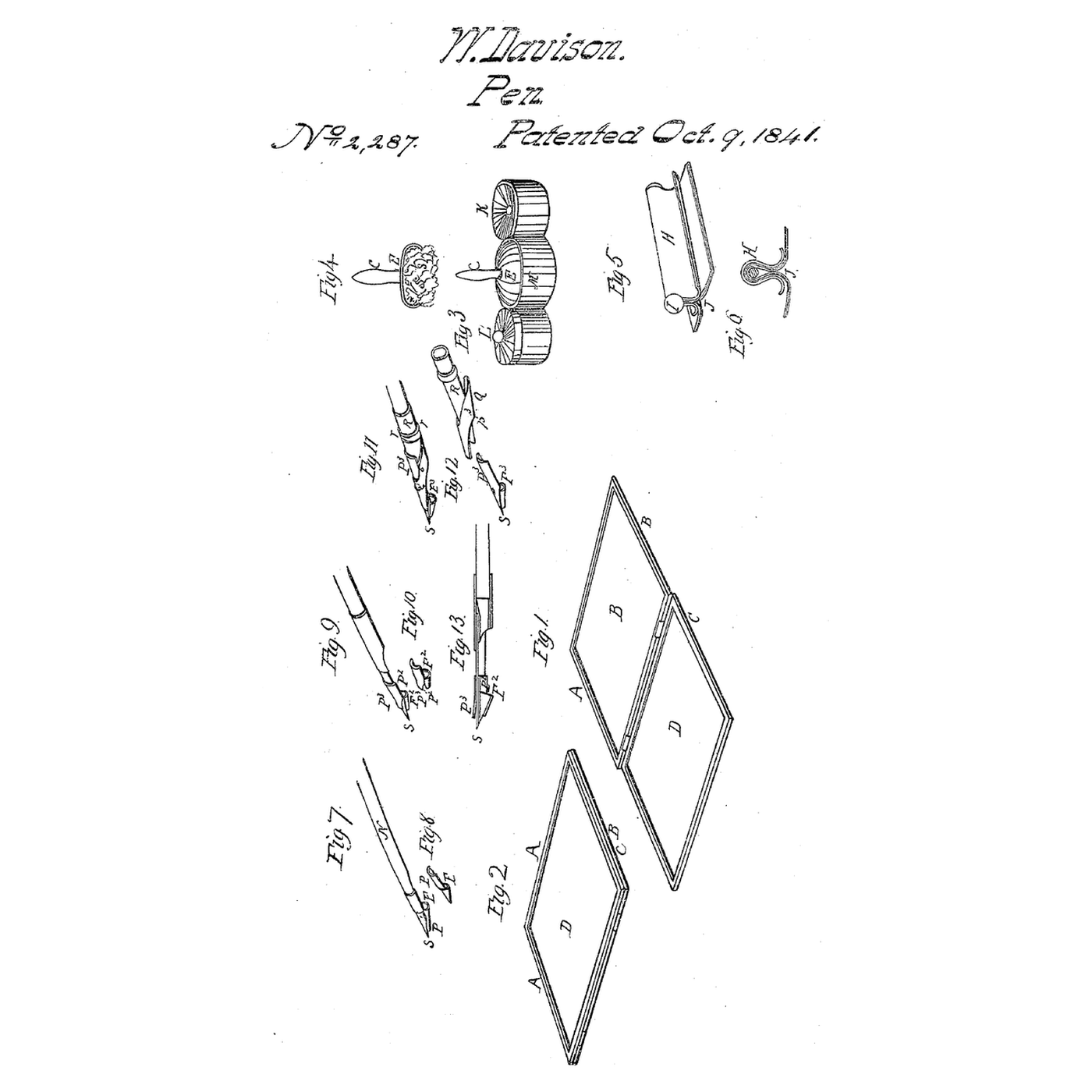


The Fountain-Sheath Pen: A Reservoir Clipped to the Nib, for Writing on Ground Glass
A pupil copying writing exercises dips the pen for every few letters, blots the page, and uses up a copy book.
William Davison of Baltimore, Maryland, received US 2,287, dated 9 October 1841, for teaching writing on "the surface of ground glass with a pen of peculiar construction prepared with fine chalk", over copies laid in a hinged metal frame, "with a pen with which the ink is laid upon the glass being of a new and peculiar construction making the finest hair as well as the boldest line and having attached to it a fountain of ink which fountain being in the form of a funnel, which when filled, is effected at every dip of the pen answers for a page of writing". The fountain's plate lies in the nib's concave side, so the ink runs down the split as the nib writes.
This rung works out how the narrow gap holds the ink, then bends a brass fountain onto a steel dip nib, and writes on chalked ground glass over a copy.
Intermediário
About 4 hours
Instruções
1
1
The narrow gap
The narrow gap
A carregar o notebook Jupyter…
2
2
The pen before it
The pen before it
The embedded blueprint cuts a quill pen, dipped every few letters. Davison attaches a fountain to a metallic or quill pen so one dip writes a page.
3
3
Read US 2,287
Read US 2,287
"The fountain pen used upon the guide or upon paper represented by Figs. 7 and 8 is made in the following manner. From a funnel shaped fountain F extends a segment plate P which is folded over on the back on either side so as to form a sheath or socket into which the pen is inserted which is pushed down until the nib comes below the lower end of the fountain and until the latter comes against the split of the pen"
"The ink flows in the act of writing by which it is regulated in its descent, causing it to flow faster or slower according to the movement of the nib."
4
4
Make the fountain and write on glass
Make the fountain and write on glass
**Fountain.** Cut a strip of brass shim 12 × 30 mm. Roll one end round a pencil into a small open funnel, and leave the rest as a flat tongue. Curve the tongue to the concave side of a steel dip nib, and fold its edges over the nib's back as a sheath, so the funnel's lower end sits just above the nib's split and the tongue lies about 0.2 mm from it.
**Guide.** Rub one face of a glass sheet with fine abrasive paper and water until it is evenly frosted. Lay a copy of writing exercises under it on a board. Dampen the frosted face and rub a little fine chalk over it, then rub it dry.
**Test.** Dip the pen once, filling the funnel, and write on the glass, counting the letters before the ink runs out. Do the same with the plain nib. Wash the glass and write again.
Materiais para este passo:
 Chapa fina de latão (para palhetas)1 peça
 Tinta da China1 peça
 Placa de vidro1 peça
 Lixa1 peça
 Giz de marcação1 peça
 Papel1 peça
Ferramentas necessárias:
 Conjunto de aparos de caligrafia
 Tesoura de chapa
 Alicate de bico chato
 Alicate de bicos redondos
 Lápis
Lápis Jogo de apalpa-folgas
 Luvas de trabalho em couro
5
5
A fountain that floods, starves or scratches
A fountain that floods, starves or scratches
Fountain-sheath pen troubleshooting.
Flow
Loading...
6
6
History and honest limits
History and honest limits
**William Davison** of Baltimore, Maryland, received US 2,287, dated 9 October 1841. His guide was a thin brass back hinged to a frame holding ground glass about one-fourteenth of an inch thick; he also described a sponge holder, an inkstand with cups for ink, water and sponge, a drier with a roller and cloth, and pens with a second plate forming a sheath. He did not claim reservoirs on metallic pens as such, but combining the reservoir with the pen's concave side in a separate sheath, with the guide, chalk, sponge holder and drier.
**Honest limits.** A brass-shim fountain on a bought dip nib stands in for his brazed plates, and home-frosted glass for his. The notebook uses the ideal parallel-plate rise; its values are examples. Your letters per dip are the result.
Materiais
6- Referência
- 1 peçaReferência
- 1 peçaReferência
- 1 peçaReferência
- 1 peçaReferência
- 1 peçaReferência
Ferramentas necessárias
7- Referência
- Referência
- Referência
- Referência
- 1 vendor sell this, none ship to you yetReferência
- Referência
- Referência
Blueprints relacionados
Estes blueprints compartilham conhecimento — técnicas, materiais ou princípios



CC0 Domínio Público
Este blueprint é liberado sob CC0. Você é livre para copiar, modificar, distribuir e usar este trabalho para qualquer finalidade, sem pedir permissão.
Apoie o Maker comprando produtos através do Blueprint, onde ele ganha uma Comissão Maker definida pelos vendedores, ou crie uma nova versão deste Blueprint e inclua-o como conexão no seu próprio Blueprint para compartilhar receita.