ARTE
BELEZA E BEM-ESTAR
ARTESANATO
CULTURA E HISTÓRIA
ENTRETENIMENTO
MEIO AMBIENTE
COMIDA E BEBIDAS
ENGENHARIA REVERSA
CIÊNCIAS
ESPORTES
TECNOLOGIA
TECNOLOGIA VESTÍVEL


The Gyratory Crusher: A Machine With No Idle Half-Stroke
A jaw crusher spends half of every stroke doing nothing. It closes, it breaks stone, and then it opens again — and during the opening it is only carrying its own weight.
The gyratory removes that half. Its crushing head is a cone hung from a pivot at the top, with its foot swung round a small circle by an eccentric. The cone never spins. It leans, by a fraction of a degree, and the lean walks round the machine once per revolution, so the gap is closing somewhere at every instant.
The bigger prize is geometric. A jaw lets crushed stone out across its width; a gyratory lets it out round a complete circle. That is why the primary crusher at the head of a large mine is a gyratory, and why the jaw has never been displaced from the small quarry.
Avançado
About 3 hours
Instruções
1
1
Make the motion with a pencil before you believe it
Make the motion with a pencil before you believe it
Take a length of dowel. Hold the top end still between finger and thumb — that is the spider bearing — and move the bottom end slowly round a small circle on the bench.
Watch the middle of the dowel. It is not rotating: a mark drawn down one side stays facing the same way. The rod is leaning, and the direction of the lean is what travels round.
Now hold a ring of card round the lower half of the dowel, concentric with the circle the foot is describing. As you carry the foot round, the gap between dowel and card closes at one point and opens diametrically opposite, and the closing point travels round the ring once per turn of the foot.
That is the whole machine. The dowel is the main shaft with its mantle, the card ring is the concave liner in the shell, and the thing going round the bench is the eccentric.
Do this before reading further. The gyratory is the machine people most often describe wrongly, and they describe it wrongly because they assume the head spins.
Materiais para este passo:
 Cavilha de madeira1 peça
 Tábua de pinho1 peça
Ferramentas necessárias:
 Régua
 Transferidor
2
2
Count the open edge
Count the open edge
A carregar o notebook Jupyter…
3
3
The eccentric bushing, which is the machine
The eccentric bushing, which is the machine
Everything about a gyratory's reliability is decided at the bottom of the shaft.
The foot of the main shaft sits inside an **eccentric bushing** — a sleeve whose bore is offset from its outside diameter. Turn the sleeve and the shaft's foot is carried round a circle equal to twice the offset. The crushing reaction from every stone in the chamber arrives at that sleeve.
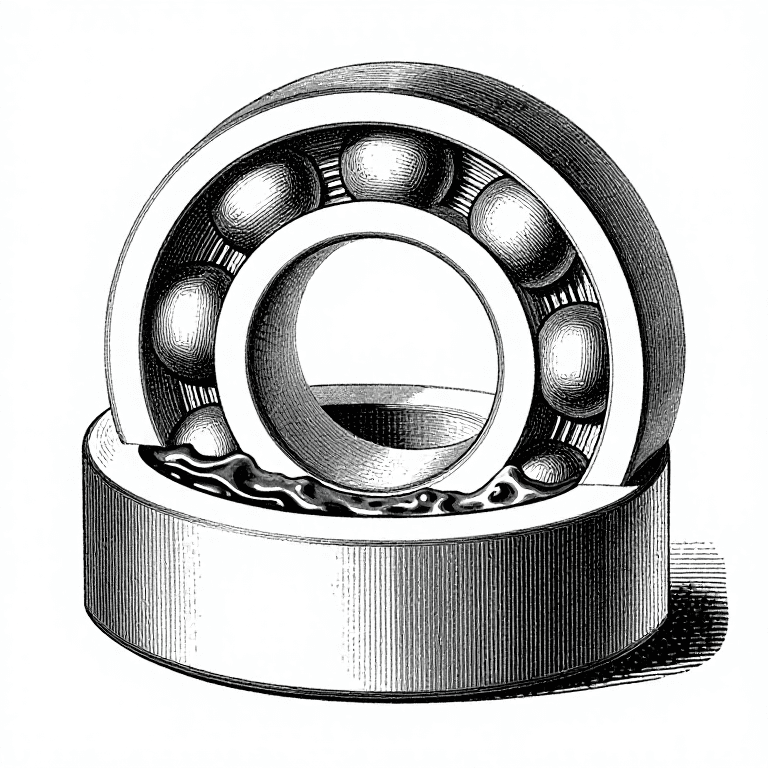
It is a plain bearing, not a rolling one, and it is deliberately so: a rolling element under shock load brinells its races, while a plain bearing with a wedge of oil between shaft and bush takes a shock as a pressure spike in the film. That is the whole argument, and it is the same argument that put white metal in a steam engine's big end.
Which means the oil is not maintenance, it is a structural component. Check before every run: oil level, oil temperature, and the colour coming back. Bright flakes in the return oil are bushing material and the machine is already damaged.
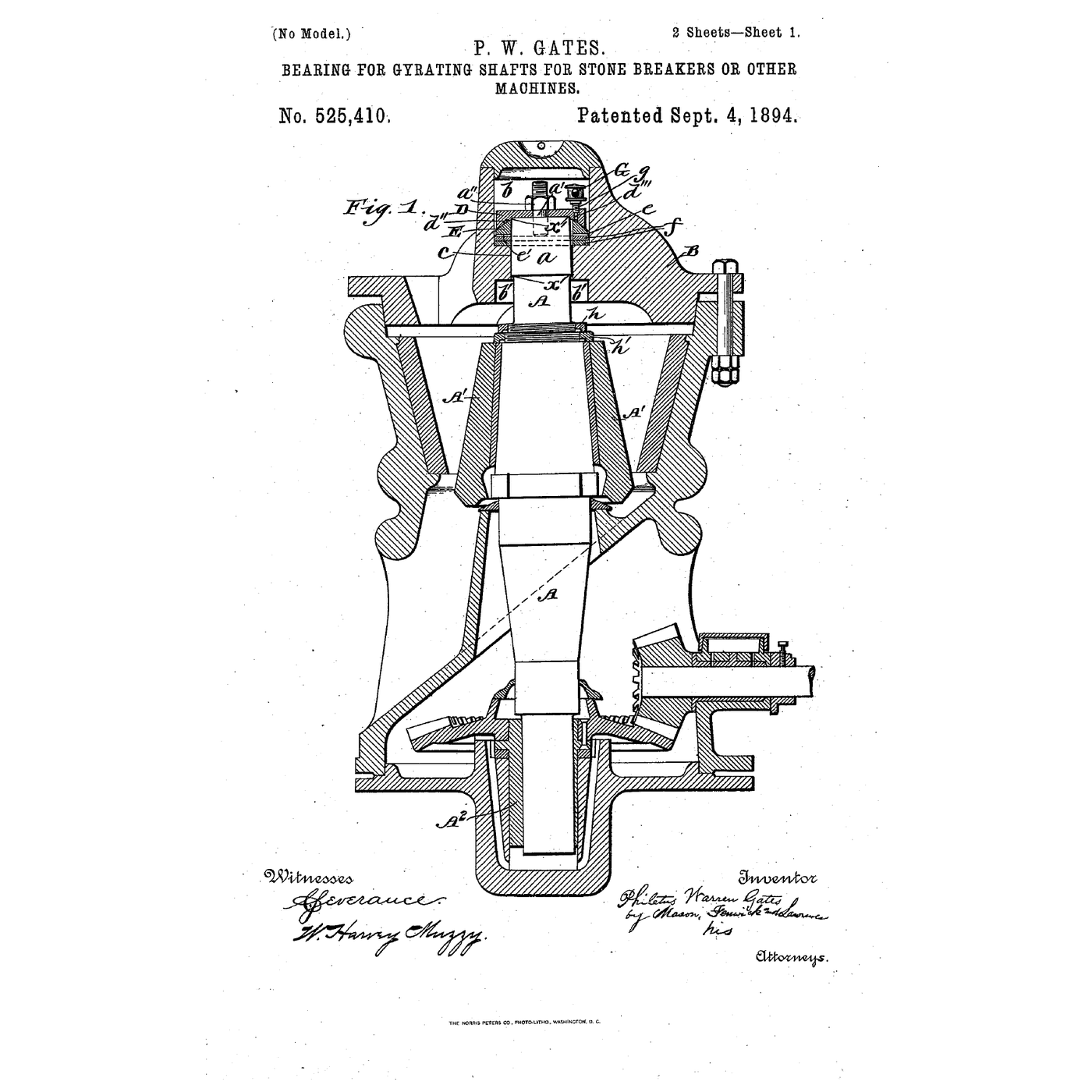
Gates' own patent is about this bearing and about nothing else. The gyratory principle was already in several earlier machines; what was missing until 1894 was a way to carry a gyrating shaft that survived.
Materiais para este passo:
 Chumaceira de apoio (KP08)1 peça
 Sortido de rolamentos1 peça
Ferramentas necessárias:
 Conjunto de chaves de boca
 Jogo de chaves Allen
 Paquímetro digital de 6 polegadas
 Conjunto de extratores de rolamentos
 Luvas de trabalho em couro
4
4
Where the stroke is largest, and why that is the right way round
Where the stroke is largest, and why that is the right way round
A carregar o notebook Jupyter…
5
5
Mantle and concave: the wear parts are the crusher
Mantle and concave: the wear parts are the crusher
The cone carries a replaceable **mantle** and the shell carries replaceable **concave** segments. Both are austenitic manganese steel, and the reason is worth knowing because it is not obvious.
Manganese steel arrives soft — softer than mild steel — and work-hardens dramatically at the surface under impact while staying tough underneath. So a new liner is not at its best on the first day; it hardens into its job. A liner that has been run on a light, trickling feed never gets the impact it needs, stays soft, and wears out faster than one that was worked properly.
That is the same lesson as the jaw's choke feed, arriving from a different direction: **a crusher run lightly is not being treated gently, it is being worn out.**
Inspect wear by profile, not by eye. Take a template — a strip of card cut to the new profile — and offer it up at several points round the circumference. A liner wears unevenly, and the place it is thinnest is not where you happen to look first. When the profile has changed enough that the chamber is no longer parallel at the discharge, the product size has already drifted, whatever the setting says.
Materiais para este passo:
 Placa de desgaste em aço ao manganês2 peças
Ferramentas necessárias:
Paquímetro digital de 6 polegadas Fita métricaRéguaLuvas de trabalho em couro
 Óculos de segurança transparentes
6
6
History and context
History and context
**US 525,410, 'Bearing for Gyrating Shafts for Stone Breakers or Other Machines', P. W. Gates, granted 4 September 1894.**
Philetus W. Gates is credited with patenting the gyratory crusher in 1881; the number for that earlier patent could not be verified from any source reachable here, so none is asserted. What is verified is the 1894 bearing patent above, read from its own first page, and it happens to be the right thing to point at: gyratory *layouts* had been proposed since the 1860s and the thing that stopped them working was carrying the shaft.
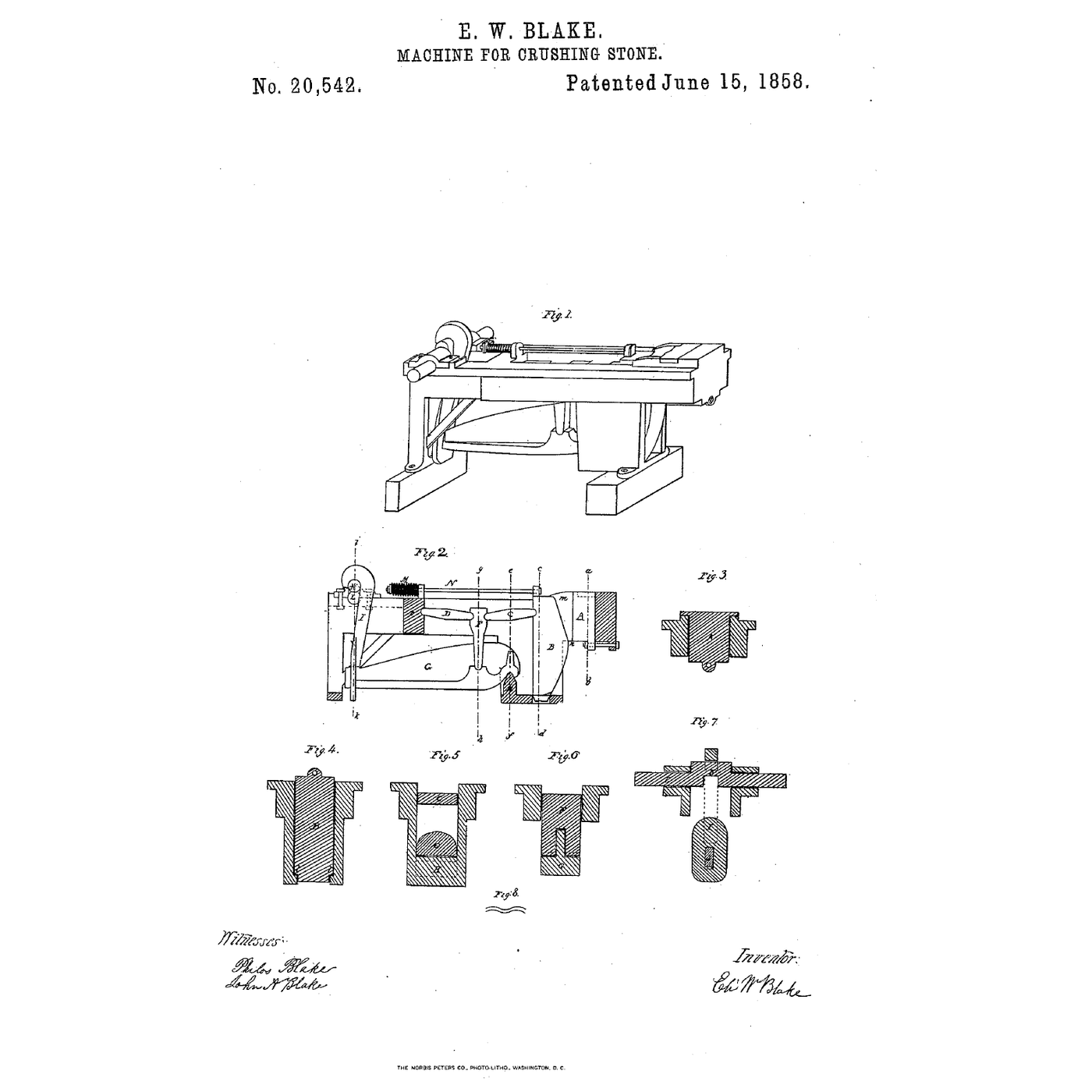
The competition between the two machines was settled in public. In 1883 Blake challenged Gates to crush nine cubic yards of stone; the Gates machine is reported to have finished about forty minutes sooner. The result is consistent with the arithmetic in step 2, which is the reason to mention it at all.
**Honest limits.** A gyratory needs headroom — it is fed from above, and a plant is built around that. It is a poor choice for a sticky or clay-bearing feed, which packs the chamber where a jaw would shed it. Its reduction ratio is no better than a jaw's: it is a capacity machine, not a fineness machine. And a liner change is a day of work with a crane, against an hour with a jaw's plates.
Materiais
5- 1 peçaReferência
- 1 peçaReferência
- Referência
- Sortido de rolamentos10% de comissão1 peçaReferência
- Referência
Ferramentas necessárias
9- Referência
- Referência
- Referência
- Referência
- Referência
- Conjunto de extratores de rolamentos10% de comissãoReferência
- Referência
- 1 vendor sell this, none ship to you yetReferência
- Referência
Blueprints relacionados
Estes blueprints compartilham conhecimento — técnicas, materiais ou princípios

CC0 Domínio Público
Este blueprint é liberado sob CC0. Você é livre para copiar, modificar, distribuir e usar este trabalho para qualquer finalidade, sem pedir permissão.
Apoie o Maker comprando produtos através do Blueprint, onde ele ganha uma Comissão Maker definida pelos vendedores, ou crie uma nova versão deste Blueprint e inclua-o como conexão no seu próprio Blueprint para compartilhar receita.