ARTE
BELEZA E BEM-ESTAR
ARTESANATO
CULTURA E HISTÓRIA
ENTRETENIMENTO
MEIO AMBIENTE
COMIDA E BEBIDAS
ENGENHARIA REVERSA
CIÊNCIAS
ESPORTES
TECNOLOGIA
TECNOLOGIA VESTÍVEL
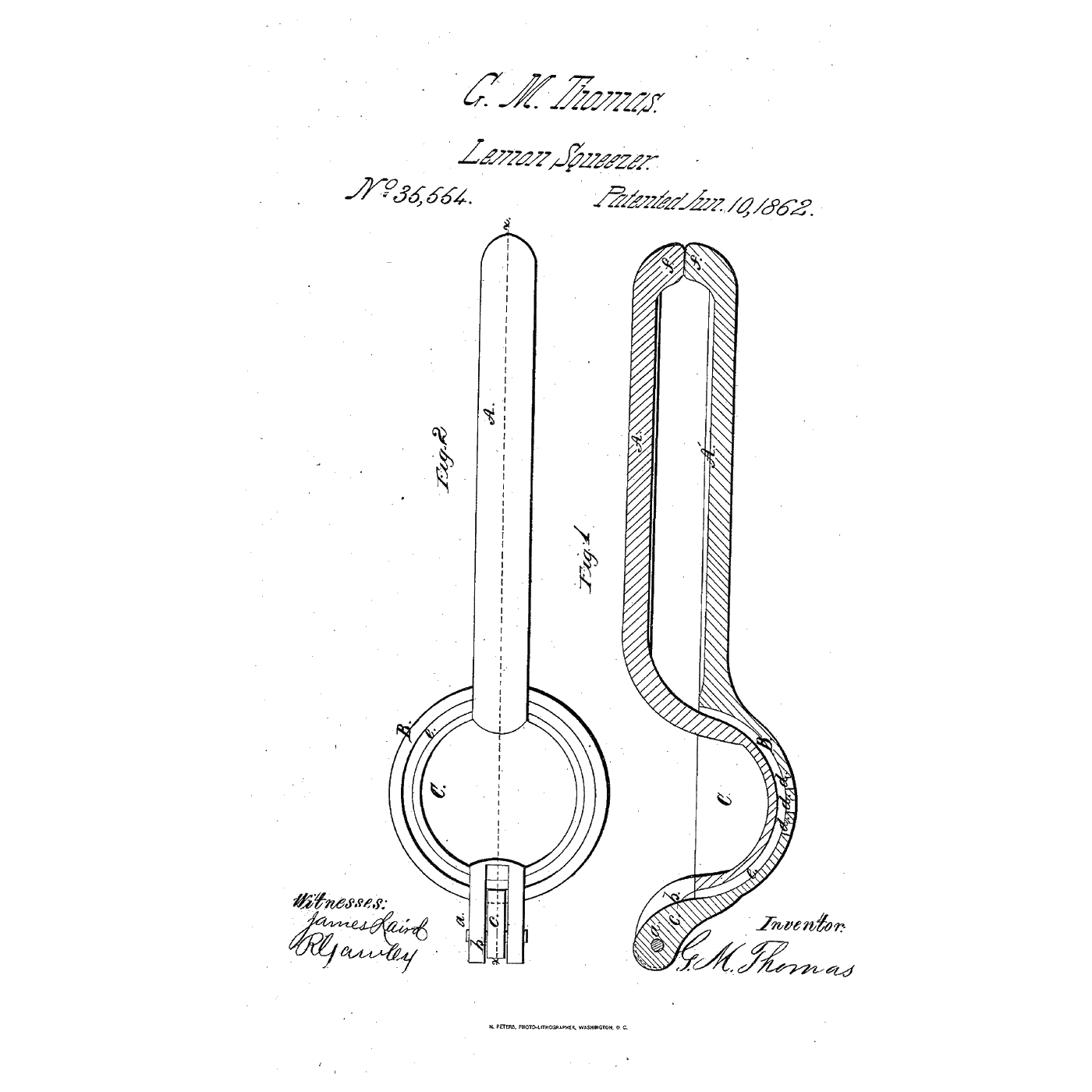


The Hinged-Bowl Lemon Squeezer: Two Cast Handles, One Bowl Inside the Other
The wooden lemon squeezers of the day soon soaked up stale juice and smelled of it.
George M. Thomas of New York received US 35,554, dated 10 June 1862, for "constructing the squeezer of cast metal and of such form or in such a manner that a very durable, economical, and light implement for the purpose is obtained, and one that may be manipulated or operated with greater facility than the ordinary kinds in general use." Two handles are pinned together at their front ends; the lower carries a perforated bowl, the upper a smaller half-sphere that fits inside it with a space between; the half lemon is put in the lower bowl and the handles are pressed together. The lower bowl hangs below its handle, so the squeezer can rest on a glass.
This rung works out the force of the handles, with a work check, then makes the squeezer from flat bar, a tin cup and a hardwood dome and squeezes lemons with it.
Intermediário
About 4 hours
Instruções
1
1
Force at the bowls
Force at the bowls
A carregar o notebook Jupyter…
2
2
A squeezer before it
A squeezer before it
The embedded blueprint presses the lemon on a cone under a lever-driven cap. Thomas puts the bowl and its half-sphere on the two handles themselves.
3
3
Read US 35,554
Read US 35,554
"The lower handle, A′, is provided with a bowl, B, of semispherical form, and perforated at its bottom, as shown at d in Fig. 1. The inner surface of the bowl B is enameled, or should be, in order to prevent oxidation. The bowl B and handle A′ are cast in one piece, and the bowl projects below the handle, the latter being on a level or in the same plane with the upper edge of the former."
"The lemon is squeezed by being divided, as usual, and one-half at a time placed in the bowl B, and forcing the bowl C down upon it by pressing the handles A A′ together."
4
4
Make the squeezer and press lemons
Make the squeezer and press lemons
**Handles.** Cut two 25 cm lengths of 20 × 5 mm mild steel flat bar. Drill both 1 cm from one end for an M6 pivot bolt, and bend the other ends slightly apart as the stops f.
**Lower bowl.** Cut the bottom 3 cm off a clean tin can about 7 cm across, punch holes in its base with a nail, and rivet its rim to the lower handle 5 cm behind the pivot so it hangs below.
**Upper dome.** Rasp a hardwood block into a half-sphere that fits inside the cup with about 5 mm to spare, and screw it to the upper handle opposite the cup.
**Test.** Bolt the handles together. Halve a lemon, put one half cut side down in the cup over a glass, and press the handles together, reading your squeeze with the spring scale hooked on the handles' ends. Weigh the juice, and compare with a half squeezed by hand.
Materiais para este passo:
 Barra chata de aço macio0.5 metro
 Lata1 peça
 Bloco de madeira dura1 peça
 Parafusos para madeira2 peças
 Rebites cegos4 peças
 Sortido de parafusos sextavados1 peça
 Porca sextavada1 peça
 Limão2 peças
Ferramentas necessárias:
 Serra de arco para metais
 Berbequim sem fios
 Jogo de brocas
 Limas (lima de mão)
 Torno de bancada
 Tesoura de chapa
 Pregos
 Martelo
 Kit de rebitadora
 Grosa
Grosa Conjunto de chaves de fendas
 Chave inglesa
 Faca de cozinha
 Balança digital de cozinha
 Dinamómetro (balança de mola)
 Copo
Copo Luvas de trabalho em couro
5
5
A squeezer that sprays, slips or leaves juice
A squeezer that sprays, slips or leaves juice
Hinged-bowl lemon squeezer troubleshooting.
Flow
Loading...
6
6
History and honest limits
History and honest limits
**George M. Thomas** of New York, New York, received US 35,554, dated 10 June 1862. His handles A A′ were joined by a fulcrum pin a through a slot b in the upper handle, the bowl C was cast with the upper handle and smaller than B to leave a space e, and the handles' ends were curved at f as stops. He thought cast iron, japanned, the best material, and did not claim a cast-metal squeezer as such, but one with two handles on a fulcrum pin and bowls fitting one within the other below the handles.
**Honest limits.** Flat bar, a tin cup and a hardwood dome stand in for his cast-iron handles and bowls. The notebook ignores friction; its forces and lengths are examples. Your juice weights are the result.
Materiais
8- 0.5 metroReferência
- 1 peçaReferência
- 1 peçaReferência
- 2 peçasReferência
- 4 peçasReferência
- Referência
- 1 peçaReferência
- 2 peçasReferência
Ferramentas necessárias
17- Referência
- 1 vendor sell this, none ship to you yetReferência
- Referência
- Referência
- Referência
- Referência
- Referência
- Referência
- Referência
- Referência
- Referência
- Referência
- Referência
- Referência
- Referência
- Referência
- Referência
Blueprints relacionados
Estes blueprints compartilham conhecimento — técnicas, materiais ou princípios



CC0 Domínio Público
Este blueprint é liberado sob CC0. Você é livre para copiar, modificar, distribuir e usar este trabalho para qualquer finalidade, sem pedir permissão.
Apoie o Maker comprando produtos através do Blueprint, onde ele ganha uma Comissão Maker definida pelos vendedores, ou crie uma nova versão deste Blueprint e inclua-o como conexão no seu próprio Blueprint para compartilhar receita.