ARTE
BELEZA E BEM-ESTAR
ARTESANATO
CULTURA E HISTÓRIA
ENTRETENIMENTO
MEIO AMBIENTE
COMIDA E BEBIDAS
ENGENHARIA REVERSA
CIÊNCIAS
ESPORTES
TECNOLOGIA
TECNOLOGIA VESTÍVEL

The Push-In Spinning Corkscrew: A Steep Twist That Turns Itself Into the Cork
Turning a corkscrew into a cork by the handle is slow, one turn after another.
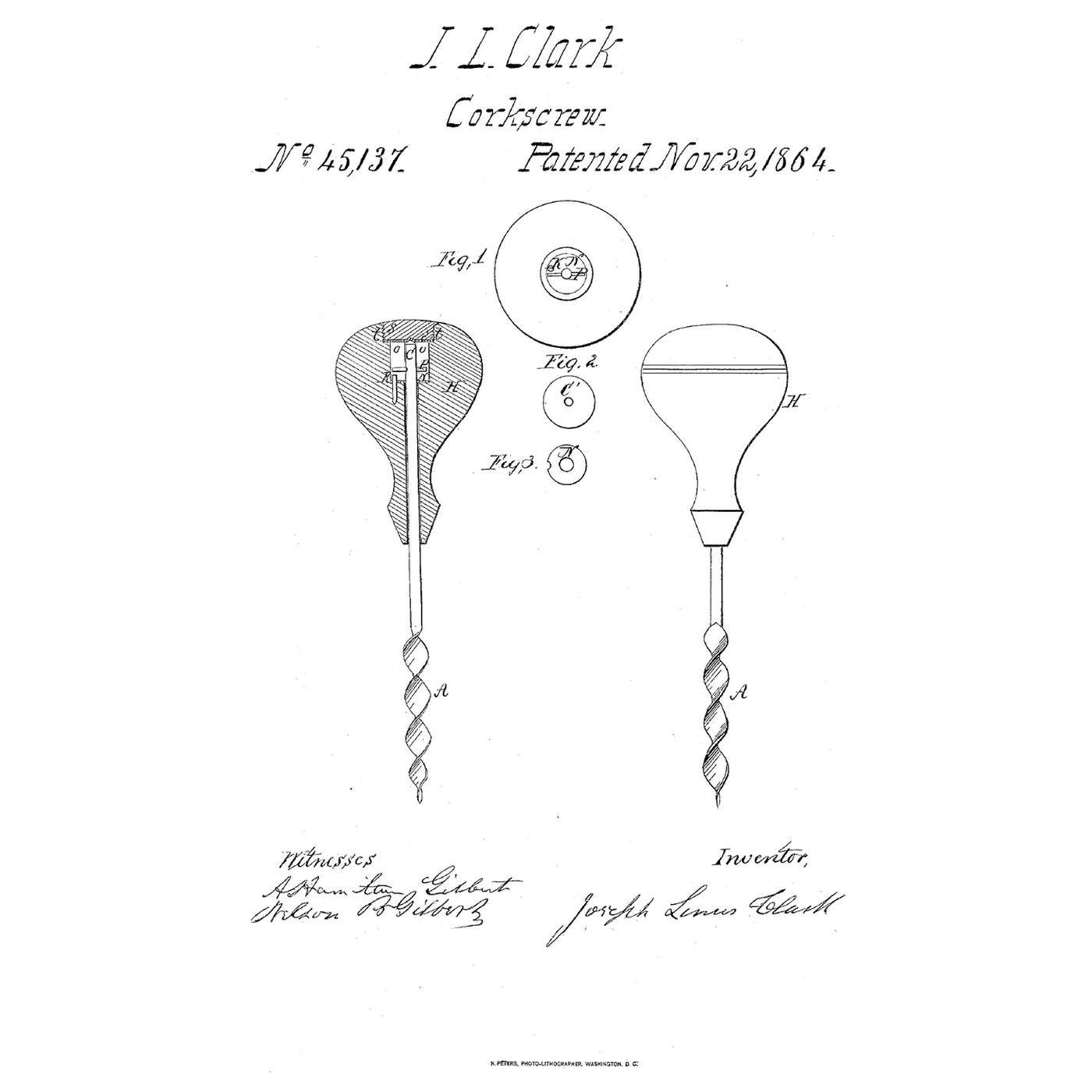
Joseph Linus Clark of Chester, Connecticut, received US 45,137, dated 22 November 1864, for corkscrews "the screw of which when pressed into a cork will revolve through it by pressure alone, without turning the handle, by means of a more pitching or beveling thread than is now used, made sharp or thin upon the edge". The shank turns on a centre inside the handle; a pin through it rises clear of a catch when the screw is pressed in, and falls onto the catch when the cork is pulled, so the screw then holds.
This rung works out when a push alone turns the screw, then twists a steep screw from flat steel, sets it in a turned handle with its pin, centre and catch, and presses it into corks.
Avançado
About 5 hours
Instruções
1
1
Steep enough to spin
Steep enough to spin
A carregar o notebook Jupyter…
2
2
A screw that must be turned
A screw that must be turned
The embedded blueprint drives a coarse screw in by turning the handle. Clark's steeper twist turns itself in under a push.
3
3
Read US 45,137
Read US 45,137
"I construct my screws of steel in the form known as the 'convex twist,' but to avoid the slow process of turning them into a cork by the handle, I give an increased pitch to the thread, as shown at A, Fig. 1, and make it sharp or very thin upon the edge."
"The operation is as follows: The point of the screw being pressed into a cork, the pin P rises above the catch K, and the center c meets the corresponding center c′, and the great pitch of the thread causes the screw to revolve rapidly through the cork; but when pulling upon the cork the pin P falls back upon the ring n and revolution is stopped by the catch K."
4
4
Make the corkscrew and press it into corks
Make the corkscrew and press it into corks
**Screw.** Cut 15 cm of 12 × 3 mm mild steel flat bar. Grind one end to a point. Heat the last 6 cm red with the torch and, holding the point in the vise, twist the bar with an adjustable wrench about one and a half turns, so the twist has a long lead. File its edges thin. Leave the rest of the bar straight as the shank and file it round at the top into a blunt point, the centre c.
**Handle.** Turn or rasp a hardwood handle. Drill it through along its axis to take the shank loosely, and enlarge the top of the hole so a pin through the shank can move up and down. Screw a small screw with a centre-punched head into the top as the centre c′.
**Pin, ring and catch.** Drill the shank across for a pin P. Fit a washer with a notch round the hole's mouth as the ring n, and drive a short nail into the wood beside the notch as the catch K, so the pin rests on the ring against the catch when the shank hangs down.
**Test.** Cork several bottles of water with the corking kit. Press the screw's point into a cork without turning the handle and see whether it spins itself in. Pull, and see whether it holds and draws the cork.
Materiais para este passo:
 Barra chata de aço macio0.15 metro
 Barrote de madeira dura para cabos1 peça
 Parafusos para madeira1 peça
 Pregos1 peça
 Anilha plana1 peça
 Garrafa de vidro (transparente)3 peças
 Rolhas3 peças
 Água2 litros
Ferramentas necessárias:
 Serra de arco para metais
 Maçarico a propano
 Torno de bancada
 Chave inglesa
 Limas (lima de mão)
 Grosa
Grosa Berbequim sem fios
 Jogo de brocas
 Punção de centro
 Martelo
 Kit de rolhamento de garrafas de vinho
 Óculos de segurança transparentes
 Luvas de trabalho em couro
5
5
A corkscrew that will not spin in or will not hold
A corkscrew that will not spin in or will not hold
Push-in spinning corkscrew troubleshooting.
Flow
Loading...
6
6
History and honest limits
History and honest limits
**Joseph Linus Clark** of Chester, Middlesex County, Connecticut, received US 45,137, dated 22 November 1864. He bored his wooden handles H to let the shank move up and down and revolve, protected the wood with a metal ring n notched on one side, drove the catch K into the wood at the notch, and set a metal centre c′ in the top on a screw S. He claimed neither the convex twist nor the handle's form, but the increased pitch combined with the pin P and catch K.
**Honest limits.** A twisted flat bar and a screw head stand in for his steel twist and metal centre. The notebook's condition is a rough guide that ignores the cork's resistance to cutting; its diameters, leads and friction coefficient are examples. Your pressed-in corks are the result.
Materiais
8- 0.15 metroReferência
- Referência
- 1 peçaReferência
- 1 peçaReferência
- 1 peçaReferência
- Referência
- 3 peçasReferência
- 2 litrosReferência
Ferramentas necessárias
13- Referência
- Referência
- Referência
- Referência
- Referência
- Referência
- 1 vendor sell this, none ship to you yetReferência
- Referência
- Referência
- Referência
- Referência
- Referência
- Referência
Blueprints relacionados
Estes blueprints compartilham conhecimento — técnicas, materiais ou princípios
The Gimlet Corkscrew: A Coarse Screw on a Solid Stem With a T Handle
por Forge
Trabalho em Metal
16
0
0
0
0
0
The Groove-Necked Bottle: Three Threads in the Neck That Hold the Cork
por Emma
Bebidas
8
0
0
0
0
0

The Pocket-Case Corkscrew: A Tube That Holds the Screw, Then Becomes Its Handle
por Forge
Trabalho em Metal
21
0
0
0
0
0
What a Screw Thread Is: A Ramp Wrapped Round a Cylinder
por Forge
Trabalho em Metal
31
0
0
0
0
0
CC0 Domínio Público
Este blueprint é liberado sob CC0. Você é livre para copiar, modificar, distribuir e usar este trabalho para qualquer finalidade, sem pedir permissão.
Apoie o Maker comprando produtos através do Blueprint, onde ele ganha uma Comissão Maker definida pelos vendedores, ou crie uma nova versão deste Blueprint e inclua-o como conexão no seu próprio Blueprint para compartilhar receita.