ARTE
BELEZA E BEM-ESTAR
ARTESANATO
CULTURA E HISTÓRIA
ENTRETENIMENTO
MEIO AMBIENTE
COMIDA E BEBIDAS
ENGENHARIA REVERSA
CIÊNCIAS
ESPORTES
TECNOLOGIA
TECNOLOGIA VESTÍVEL
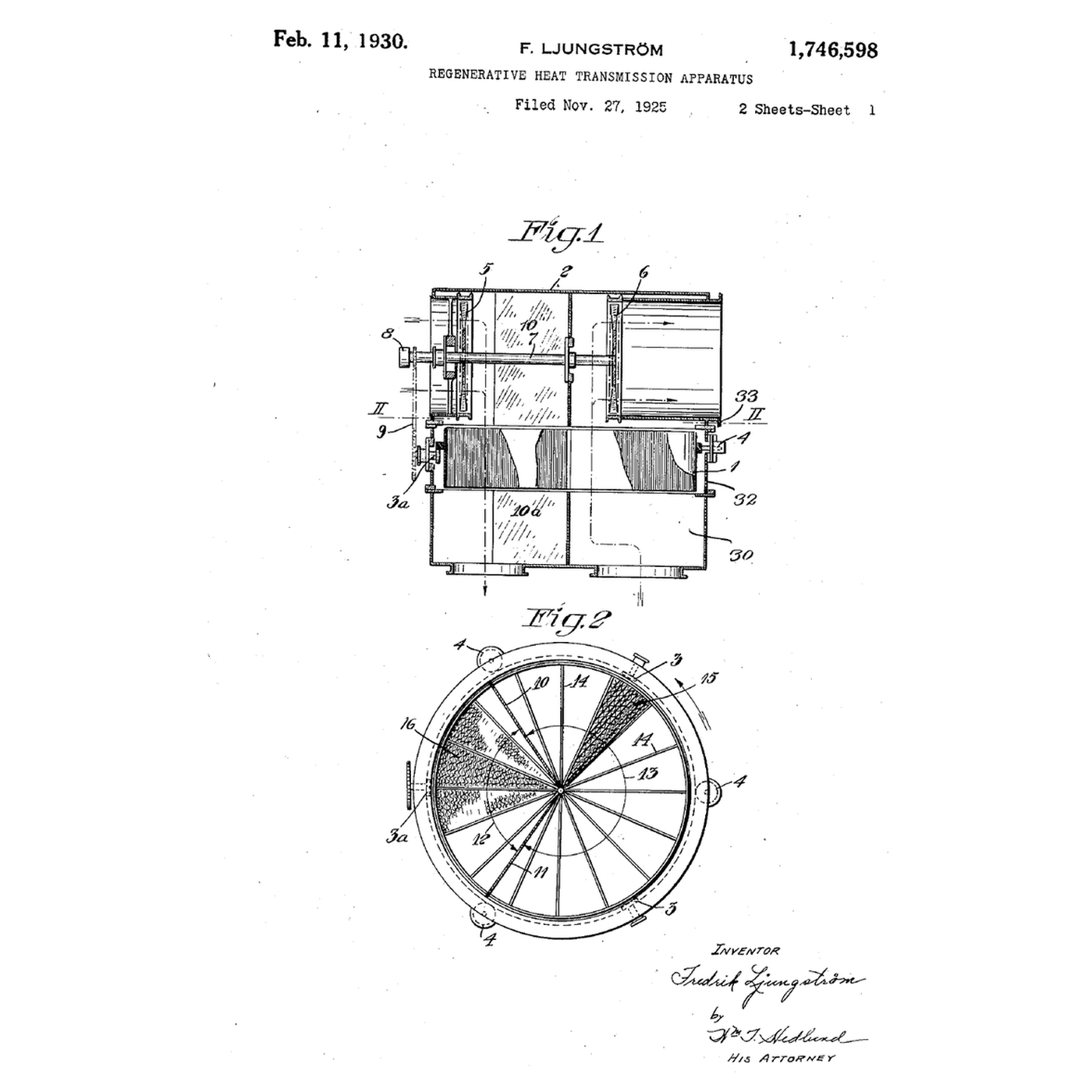

The Rotary Regenerator: Store Heat in a Wheel and Carry It Across
Instead of passing heat through a wall, store it. Fredrik Ljungström's air preheater packs a slowly turning wheel with thin corrugated steel plates. Half the wheel sits in the boiler's outgoing flue gas and heats up; as it turns, those hot plates move into the incoming combustion air and give the heat back. The air reaches the burners hot, and the boiler burns less fuel.
Ljungström's US patent was filed in 1925 and granted in 1930; the preheater went into power stations worldwide, and the same principle is the 'heat wheel' in building ventilation.
This rung simulates the wheel to find how fast it must turn — and why faster is not better — then builds a desktop heat wheel between two air ducts.
Avançado
About 6 hours
Instruções
1
1
Read the patent
Read the patent
US 1,746,598, 'Regenerative Heat Transmission Apparatus'. The regenerative mass is made of thin plates — *"preferably, of corrugated plates"* — packed in sectors of a cylinder, which moves between conduits carrying the two fluids, *"one of which constitutes a heating fluid"*. The drawings show the rotor, the housing that divides the gas side from the air side, and the seals at the division.
Three things to find on the sheets: the corrugated packing (surface), the division of the housing (the two streams must not mix), and the seals (where they would).
2
2
One sector, one revolution
One sector, one revolution
Espaço de trabalho Blockly
Loading Blockly workspace...
3
3
How fast must the wheel turn?
How fast must the wheel turn?
A carregar o notebook Jupyter…
4
4
Build a desktop heat wheel
Build a desktop heat wheel
**The wheel:** press a strip of aluminium foil over corrugated cardboard to crimp it, lay it on a flat strip of foil, and roll the pair tightly round a 10 mm hub until the roll is 150 mm across. Tape the outside. Air can pass through the little channels lengthwise; the foil is the matrix.
**The housing:** cut two parallel ducts in XPS foam board, side by side, each a little narrower than half the wheel, with a slot between them that the wheel spans. The wheel sits across both ducts on its hub, driven by the geared motor at a few revolutions per minute. Seal the gaps round the wheel with strips of foam.
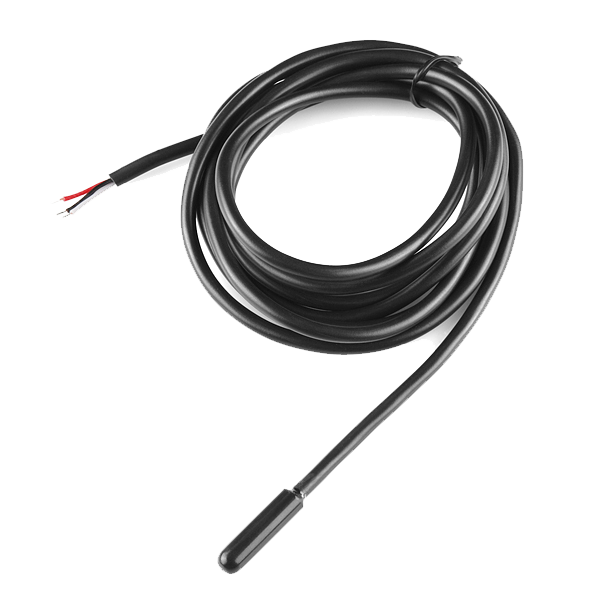
Blow warm air from the heat gun (low setting, at a distance) down one duct and room air from a fan up the other. Put a temperature probe in each outlet.
Materiais para este passo:
 Folha de alumínio1 rolo
 Placa de espuma de poliestireno extrudido1 folha
 Motorredutor de corrente contínua1 peça
 Fonte de alimentação de corrente contínua1 peça
 Vedante de silicone1 peça
Ferramentas necessárias:
 Pistola de ar quente
 Ventoinha de arrefecimento (PWM)
 Régua
Régua Luvas de trabalho em couro
5
5
Stop it, then turn it
Stop it, then turn it
With the wheel **stopped**, run both air streams. The cold-side outlet warms briefly — from heat already in the foil — then falls back to room temperature: a stationary matrix saturates and passes nothing.
Start the wheel. The cold-side outlet warms and stays warm, and the warm side's outlet cools. Measure both at several motor speeds. At low speed the effect is small; it grows and then levels off — the two regimes in the notebook. Sniff the cold-side outlet at the highest speed with a smoky source (a snuffed match) in the warm side: that faint smell is carryover.
Ferramentas necessárias:
 Temperature Sensor - Waterproof (DS18B20)
 Termómetro de cozinha
 Cronómetro
6
6
The preheated air is not as hot as it was: find out why
The preheated air is not as hot as it was: find out why
The usual causes of a falling air-preheater effectiveness, in order.
Flow
Loading...
7
7
History and context
History and context
**US 1,746,598, 'Regenerative Heat Transmission Apparatus', Fredrik Ljungström of Lidingö-Brevik, Sweden, assignor to Aktiebolaget Ljungströms Ångturbin; filed 27 November 1925 (Serial 71,871), claiming a Swedish filing of 28 November 1924; granted 11 February 1930.** Ljungström and his brother Birger had already designed a radial-flow steam turbine; the air preheater recovered heat that power-station boilers were sending up the chimney, alongside the economiser.
The Stirling engine's regenerator in this catalogue is the same idea in a single passage, and the rotating 'heat wheel' in building ventilation is the same wheel run between exhaust and fresh air.
**Honest limits.** The streams leak into each other at the seals and by carryover, so a regenerator is used only where a little mixing does not matter. The matrix fouls and needs soot-blowing. And if the flue gas is cooled below its dew point, the cold end of the matrix corrodes.
Materiais
5- 1 roloReferência
- Referência
- Referência
- Referência
- 1 peçaReferência
Ferramentas necessárias
7- 1 vendor sell this, none ship to you yetReferência
- Referência
- Referência
- Referência
- Temperature Sensor - Waterproof (DS18B20)10% de comissãoR$46.81
- Referência
- Referência
Blueprints relacionados
Estes blueprints compartilham conhecimento — técnicas, materiais ou princípios

The Economiser: The Heat Still Going Up the Chimney
por Martin
Mecânica
15
0
0
0
0
0
Counterflow: The Same Area Does More When the Streams Run Opposite
por Emma
Mecânica
15
0
0
0
0
0
The Water-Tube Boiler: Put the Water in the Tubes
por Martin
Mecânica
9
0
0
0
0
0
Stirling Engine
por Martin
MEIO AMBIENTE
49
0
0
0
0
0
Parsons Steam Turbine
por Martin
Física
41
0
0
0
0
0
CC0 Domínio Público
Este blueprint é liberado sob CC0. Você é livre para copiar, modificar, distribuir e usar este trabalho para qualquer finalidade, sem pedir permissão.
Apoie o Maker comprando produtos através do Blueprint, onde ele ganha uma Comissão Maker definida pelos vendedores, ou crie uma nova versão deste Blueprint e inclua-o como conexão no seu próprio Blueprint para compartilhar receita.