ARTE
BELEZA E BEM-ESTAR
ARTESANATO
CULTURA E HISTÓRIA
ENTRETENIMENTO
MEIO AMBIENTE
COMIDA E BEBIDAS
ENGENHARIA REVERSA
CIÊNCIAS
ESPORTES
TECNOLOGIA
TECNOLOGIA VESTÍVEL
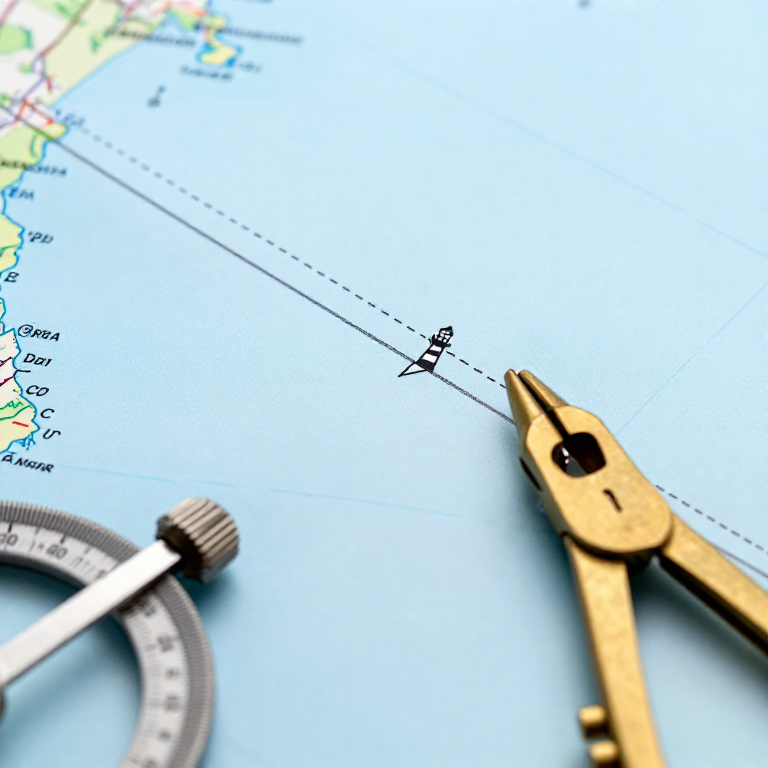


The Running Fix: A Position from One Object
Two landmarks give you a position immediately: take a bearing on each, draw both lines, and you are where they cross. Along most coasts, most of the time, you can only see one.
The running fix solves it with time. Take a bearing on the single object, run on for a known course and distance, and take a second bearing on the SAME object. Then transfer the first bearing line forward by exactly the distance and direction you ran, and where the transferred line crosses the second bearing is your position.
It is dead reckoning and observation working together, and it inherits the weaknesses of both — the transfer is only as good as your run, so a running fix is never quite as trustworthy as a proper fix. Knowing by how much, and in which direction, is what makes it safe to use.
Intermediário
1 day
Instruções
1
1
Choose an object you can identify beyond doubt
Choose an object you can identify beyond doubt
A lighthouse, a church spire, a distinctive headland — something charted, unmistakable, and still visible after the run.
The commonest catastrophic error in coastal navigation is a confidently taken bearing on the wrong object: two similar headlands, two chimneys, a light misidentified at night. Check the characteristic of a light before trusting it, and if there is any doubt at all, say so in the log and treat the fix as an estimate.
Ferramentas necessárias:
 Binóculos
2
2
Take the first bearing and note the time and log
Take the first bearing and note the time and log
Sight the object, read the bearing, and write it down with the exact time and the log reading in the same breath.
The three belong together, because the transfer depends on knowing precisely how far you ran between the two bearings. A bearing without its time is not usable in a running fix at all. Take three readings and average them if the boat is moving about — a bearing taken from a lurching deck can easily be five degrees out.
Ferramentas necessárias:
 Bússola
 Cronómetro
3
3
Run on, and change the geometry
Run on, and change the geometry
Hold a steady course and speed, and wait until the bearing has changed by at least thirty degrees — sixty is better.
The two lines must cross at a decent angle or the fix is worthless: at a shallow crossing, a small bearing error slides the intersection a long way along the lines. This is the same angle-of-cut problem as the plane table rung, and it has the same answer — be patient, and let the geometry improve before taking the second sight.
Ferramentas necessárias:
BússolaCronómetro4
4
Transfer the first line by the run made good
Transfer the first line by the run made good
Draw the first bearing. Then from any point on it, lay off the course and distance actually run — including the tidal stream — and draw a new line parallel to the first through that point. Label it as transferred, with both times.
The transfer must use the ground track, not the water track. Ignoring the stream here is the commonest way a running fix comes out wrong, and it fails in the direction of the stream, which near a headland is exactly where you least want to be pushed.
Materiais para este passo:
 Papel milimétrico10 peças
Ferramentas necessárias:
 Transferidor
 Régua
Régua5
5
How good is the fix, and the special cases worth knowing
How good is the fix, and the special cases worth knowing
A carregar o notebook Jupyter…
Ferramentas necessárias:
Transferidor6
6
Label it as a running fix, and treat it as one
Label it as a running fix, and treat it as one
Mark the position 'R Fix' with the time, not 'Fix'. On a chart they look identical and they are not equally trustworthy.
The convention exists so that whoever reads the chart — including you, later — knows how much weight to give it. When a running fix disagrees with the depth sounder, believe the sounder. When it disagrees with a two-object fix, believe the fix.
Materiais
1- 10 peçasReferência
Blueprints relacionados
Estes blueprints compartilham conhecimento — técnicas, materiais ou princípios




CC0 Domínio Público
Este blueprint é liberado sob CC0. Você é livre para copiar, modificar, distribuir e usar este trabalho para qualquer finalidade, sem pedir permissão.
Apoie o Maker comprando produtos através do Blueprint, onde ele ganha uma Comissão Maker definida pelos vendedores, ou crie uma nova versão deste Blueprint e inclua-o como conexão no seu próprio Blueprint para compartilhar receita.