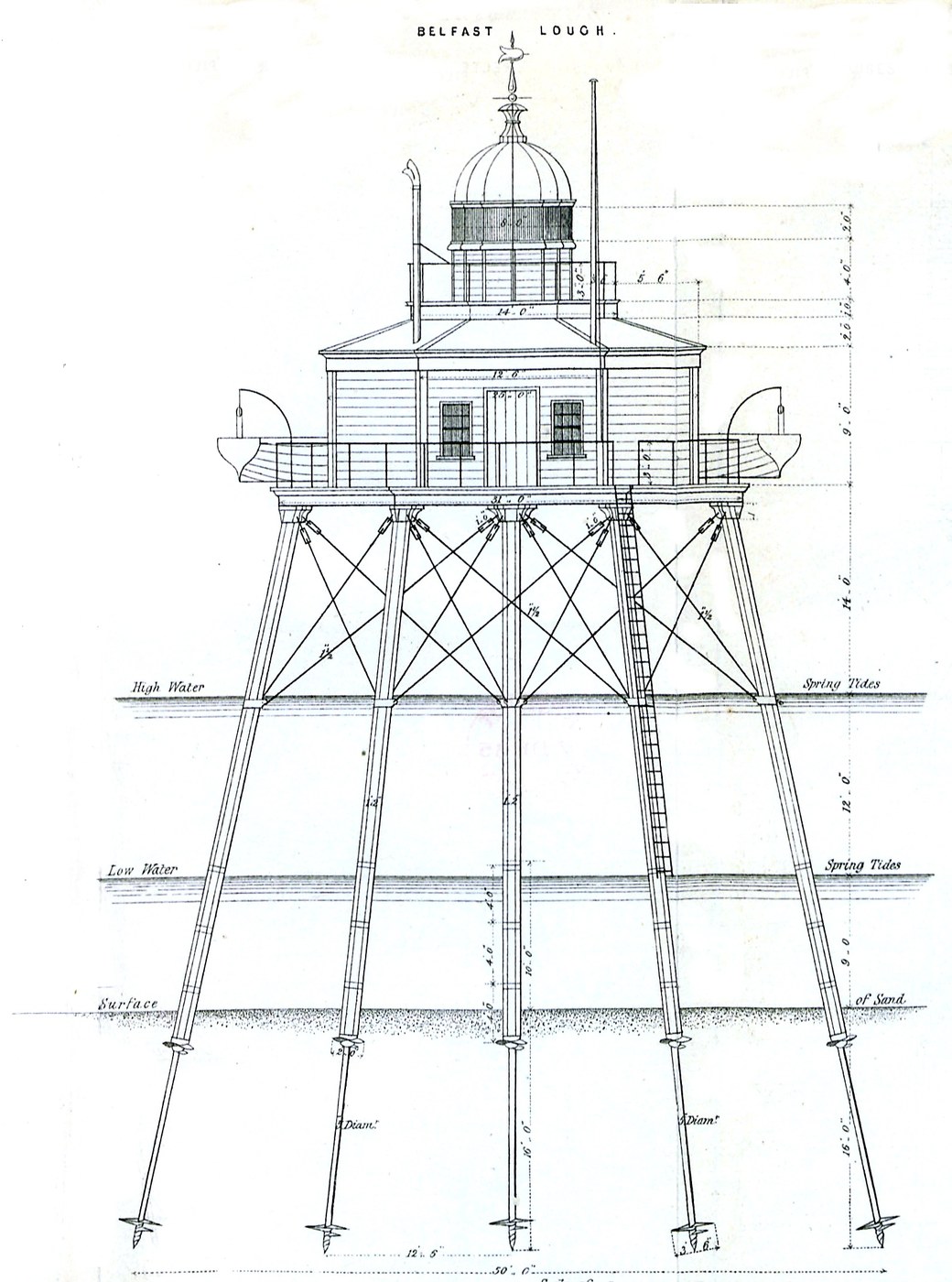


The Screw Pile
Hammering a pile into sand under water is close to useless. The blow shakes the ground, the sand around the pile loses its grip, and the pile that went in easily comes out just as easily on the next storm surge. A lighthouse on a sandbank needs the opposite of a driven pile: something that resists being pulled up as well as pushed down, installed without shaking the ground it depends on.
Alexander Mitchell, a Belfast engineer who had been blind since his twenties, patented the answer in 1833. Put a broad helix — a single wide screw flight, cast in iron — on the foot of the pile, and turn it in. The helix does two things at once. Rotation becomes axial travel, so a team on a capstan can generate enormous downward force with no impact at all. And once it is down, that broad flight bears on a large plate of undisturbed soil above it as well as below, so the pile resists uplift.
At the Maplin Sands lighthouse in the Thames estuary, work began in 1838 using nine of Mitchell's piles: 20-foot piles with cast-iron screws four feet in diameter, turned into the sand by men walking a capstan keyed to the pile head.
⚠ Maplin was started first but was not finished first. Maplin Sands was first lit in 1841. The Wyre Light at Fleetwood, begun on 15 November 1839, was first lit on 6 June 1840 — so Wyre, not Maplin, was the first screw-pile lighthouse to show a light.
Make a screw pile at bench scale and pull it back out. Then try the same with a plain rod.
Instruções
Cut and form the helix
Cut and form the helix
Cut a disc of thin mild steel about six times the rod diameter. Cut out the centre to fit the rod, then cut one radial slit from edge to centre.
Open the slit and twist the disc into a single-turn helix — one edge rises as the other falls.
The pitch you set here is the distance the pile travels per turn, and it must be the same all the way round or the pile will wander as it goes in.
Materiais para este passo:
 Varão de aço macio1 peça
 Cantoneira de aço macio1 peça
Ferramentas necessárias:
 Serra de arco para metais
Fix the helix and make a turning bar
Fix the helix and make a turning bar
Fix the helix near the foot of the rod, square to the axis. Cross-drill the top of the rod and fit a bar through it as a capstan handle.
Check by eye down the axis: the helix must run true, with no wobble.
A helix that is not square to the rod screws the pile in crooked, and every turn makes it worse.
Ferramentas necessárias:
 Sargento de barra
Screw it in and count the turns
Screw it in and count the turns
Prepare a deep bucket of saturated sand. Set the pile upright and turn the bar steadily, keeping it vertical.
Record penetration every five turns.
Compare the depth gained per turn against the pitch you formed in step 1. Expect it to be less — the difference is the soil being displaced and disturbed rather than the pile simply threading into it.
Materiais para este passo:
 Areia grossa (construção/olaria)10 kg
Ferramentas necessárias:
 Fita métrica
Measure uplift resistance against a plain rod
Measure uplift resistance against a plain rod
Hook a spring scale to the pile head and pull vertically until it moves. Record the force.
Repeat with a plain rod of the same diameter pushed to the same depth in a freshly made bed.
Expect the screw pile to need many times the force. The plain rod resists only by friction along its shaft; the helix has to lift a whole column of soil above it.
Ferramentas necessárias:
 Dinamómetro (balança de mola)
Test it in the wrong ground
Test it in the wrong ground
Repeat the installation in coarse gravel, and again in very soft saturated silt or mud.
Expect the gravel to jam or deform the helix and the silt to let it turn almost freely with little holding power gained.
A screw pile is a soft-ground tool with a narrow window. It needs ground soft enough to accept the flight and firm enough to grip it, which is exactly the sand and stiff clay of an estuary bank — and is why Mitchell's invention solved lighthouses on sandbanks and not foundations in general.
Ferramentas necessárias:
Dinamómetro (balança de mola)Relate torque to capacity
Relate torque to capacity
Fit a longer bar and note, roughly, the effort needed on the last few turns. Then pull the pile out and record the uplift force again.
Repeat for two or three depths and plot final installation effort against uplift capacity.
Expect them to track each other: the harder it was to turn in, the harder it is to pull out.
That relationship is not a curiosity. Modern helical-pile practice accepts piles on installation torque, exactly as driven piles are accepted on set — the machine measures the ground while it works.
Ferramentas necessárias:
Dinamómetro (balança de mola) Papel milimétrico
History & Context
History & Context
Alexander Mitchell (1780-1868) was blind for most of his working life, having lost his sight in his twenties, and worked from models and from descriptions given to him by his son and his workmen. He was a brickmaker in Belfast before he was an engineer. The screw pile is his, patented in 1833, and it solved a problem that had genuinely defeated masonry: there is no way to build a stone lighthouse on a sandbank, so mudflats and shoals — which is to say the places ships actually run aground — could not be lit.
The Maplin Sands piles were four feet across at the flight and twenty feet long, and they went in without a single hammer blow: men walked a capstan keyed onto the pile head, and the helix pulled the pile down. Work began in 1838. But the popular claim that Maplin was the first screw-pile lighthouse is wrong on the light: the Wyre Light at Fleetwood was started later, on 15 November 1839, and was first lit on 6 June 1840, while Maplin was not lit until 1841. Maplin was first begun; Wyre was first lit. Both statements get printed as "the first", and only one of them is about a working lighthouse.
The design then travelled and multiplied. Screw-pile lighthouses became the standard answer for shoal water on both sides of the Atlantic, and above all in Chesapeake Bay, where dozens were built — cottages on iron legs, standing directly over the shoal they warned about. Many were later destroyed not by storms but by winter ice floes shearing the legs, a load case the design was never good at.
The idea came back. Screw piles fell out of fashion once powerful driving and boring rigs made conventional piling cheap, and returned in the late twentieth century as helical piles, now installed by hydraulic torque heads and used for underpinning, transmission towers, solar arrays and anything needing uplift resistance. The modern versions have several smaller helices rather than one huge one, and are accepted on measured installation torque. The mechanism is unchanged: rotation instead of impact, and a bearing plate that works in both directions.
The honest limits. The helix must be installed into ground that will grip it, and coarse gravel or cobbles will simply wreck it. Installation disturbs a cylinder of soil around the shaft, so a pile screwed in, backed out and screwed in again is materially weaker than one that went in once. Corrosion attacks iron continuously in salt water and tidal splash zones, and it is worst exactly at the waterline where the section is most needed. And on a slender iron leg, the design load case is usually sideways — wave, ice and current — not the weight of the structure at all.
Materiais
3- 1 peçaReferência
- 1 peçaReferência
- Referência
Ferramentas necessárias
5- Referência
- Referência
- 1 vendor sell this, none ship to you yetReferência
- Referência
- Referência
Materiais de Blueprints conectados

Blueprints relacionados
Estes blueprints compartilham conhecimento — técnicas, materiais ou princípios


CC0 Domínio Público
Este blueprint é liberado sob CC0. Você é livre para copiar, modificar, distribuir e usar este trabalho para qualquer finalidade, sem pedir permissão.
Apoie o Maker comprando produtos através do Blueprint, onde ele ganha uma Comissão Maker definida pelos vendedores, ou crie uma nova versão deste Blueprint e inclua-o como conexão no seu próprio Blueprint para compartilhar receita.