ARTE
BELEZA E BEM-ESTAR
ARTESANATO
CULTURA E HISTÓRIA
ENTRETENIMENTO
MEIO AMBIENTE
COMIDA E BEBIDAS
ENGENHARIA REVERSA
CIÊNCIAS
ESPORTES
TECNOLOGIA
TECNOLOGIA VESTÍVEL


The Self-Winding Chalk-Line Reel: A Coil Spring That Reels the Line Back
Winding a carpenter's chalk line back by hand after every snap wastes time and leaves the line in a tangle.
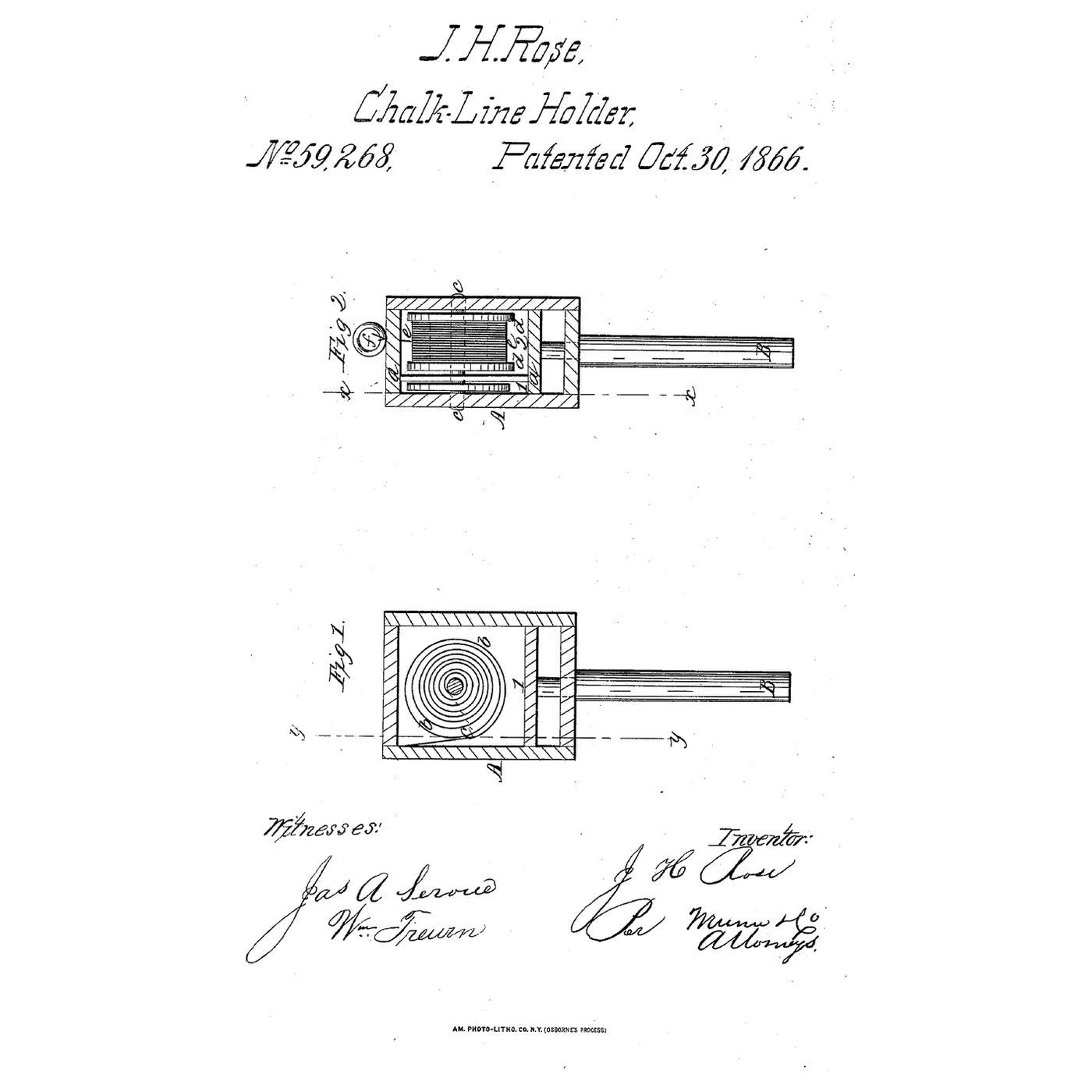
Jonathan H. Rose of Mount Sterling, Illinois, received US 59,268, dated 30 October 1866, for a chalk-line winder "by means of a self-acting coil-spring, which, with the reel, is inclosed in a small hand-box, thereby furnishing a convenient and useful instrument for a workman, saving much time in winding the chalk-line and keeping clean and in good order, always ready for use." Drawing the line out winds the spring; letting it go, "the spring will draw the chalk-line back into the box".
This rung works out how many turns the spring must hold, then builds the box with a coiled spring-steel spring and times the line reeling back.
Intermediário
About 3 hours
Instruções
1
1
Turns the spring must store
Turns the spring must store
A carregar o notebook Jupyter…
2
2
The spring that does the work
The spring that does the work
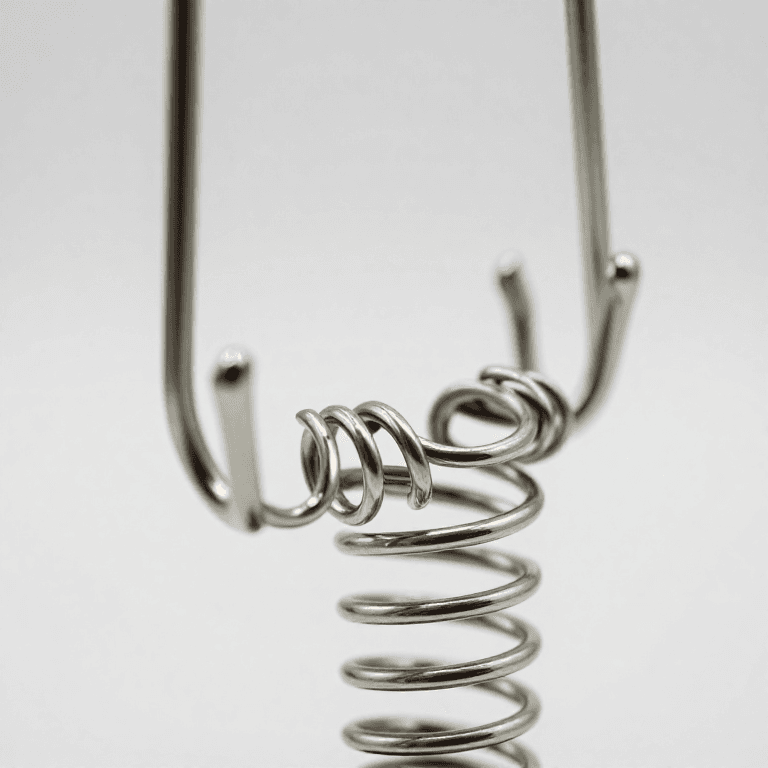
The embedded blueprint explains how a spring's proportions set its force. Rose's flat coil spring has to store a turn for every loop of line drawn out.
3
3
Read US 59,268
Read US 59,268
"A represents a small flat rectangular wooden box, with a handle, B, at one end. The box is divided into two compartments by a thin partition, a a. A narrow compartment, No. 1, contains a long flat coil-spring, b b, the outer end of which is fastened to one side of the box, as shown in Fig. 1, and the other or central end of the spring to a spindle, c c, running through the center of the partition a a".
"The chalk-line is placed upon the reel so that when it is wound up the coil-spring b is fully expanded, and when it is drawn out for use by the holding-ring f the spring will be contracted or closed around the spindle c c by the turning of the spindle".
4
4
Build the reel and time the rewind
Build the reel and time the rewind
**Box.** From plywood make a box 12 × 12 × 5 cm inside with a thin partition dividing it into a 1.5 cm and a 3.5 cm compartment, and glue a dowel handle to one end. Drill a 6 mm hole through the partition's centre and both sides for the spindle.
**Spring.** Coil 1.2 m of spring steel strip into a flat spiral, fix its outer end to the narrow compartment's wall with a screw, and its inner end into a slot sawn in a 6 mm dowel spindle.
**Reel.** Glue two 8 cm plywood discs to the spindle in the wide compartment, 1 cm apart. Wind 2 m of cotton twine on it with the spring relaxed, thread the end out through a small hole, and tie on a ring. Put marking chalk in the wide compartment.
**Test.** Pull the line out 1 m and 2 m, counting the reel's turns through the hole, and let go; time the rewind with the stopwatch. Compare the turns with the notebook, and snap a chalk line with it.
Materiais para este passo:
 Placa de contraplacado1 peça
 Cavilhas de madeira dura0.2 metro
 Fita de aço-mola1 peça
 Parafusos para madeira4 peças
 Cola de madeira10 ml
 Cordel de algodão2 metros
 Giz de marcação30 g
Ferramentas necessárias:
 Serrote
 Serra de recortes
 Conjunto de serras-copo
 Berbequim sem fios
 Jogo de brocas
 Alicate de bico chato
 Conjunto de chaves de fendas
 Cronómetro
 Régua
Régua Cordão de marcar
 Luvas de trabalho em couro
 Óculos de segurança transparentes
5
5
A reel that will not rewind, jams or springs back violently
A reel that will not rewind, jams or springs back violently
Self-winding chalk-line reel troubleshooting.
Flow
Loading...
6
6
History and honest limits
History and honest limits
**Jonathan H. Rose** of Mount Sterling, Brown County, Illinois, signed US 59,268 on 14 July 1866; it is dated 30 October 1866. His claim is the coil spring, spindle and reel combined with the partitioned box and handle.
**Honest limits.** A plywood box and a hand-coiled strip of spring steel stand in for his wooden box and long flat coil spring, and the line is short to suit that spring. The notebook ignores the line's thickness building up on the reel; its lengths and radii are examples. Your turn counts and times are the result.
Materiais
7- 1 peçaReferência
- 0.2 metroReferência
- 1 peçaReferência
- 4 peçasReferência
- 10 mlReferência
- 2 metrosReferência
- 30 gReferência
Ferramentas necessárias
12- Referência
- Referência
- Referência
- 1 vendor sell this, none ship to you yetReferência
- Referência
- Referência
- Referência
- Referência
- Referência
- Referência
- Referência
- Referência
Blueprints relacionados
Estes blueprints compartilham conhecimento — técnicas, materiais ou princípios



CC0 Domínio Público
Este blueprint é liberado sob CC0. Você é livre para copiar, modificar, distribuir e usar este trabalho para qualquer finalidade, sem pedir permissão.
Apoie o Maker comprando produtos através do Blueprint, onde ele ganha uma Comissão Maker definida pelos vendedores, ou crie uma nova versão deste Blueprint e inclua-o como conexão no seu próprio Blueprint para compartilhar receita.