ARTE
BELEZA E BEM-ESTAR
ARTESANATO
CULTURA E HISTÓRIA
ENTRETENIMENTO
MEIO AMBIENTE
COMIDA E BEBIDAS
ENGENHARIA REVERSA
CIÊNCIAS
ESPORTES
TECNOLOGIA
TECNOLOGIA VESTÍVEL
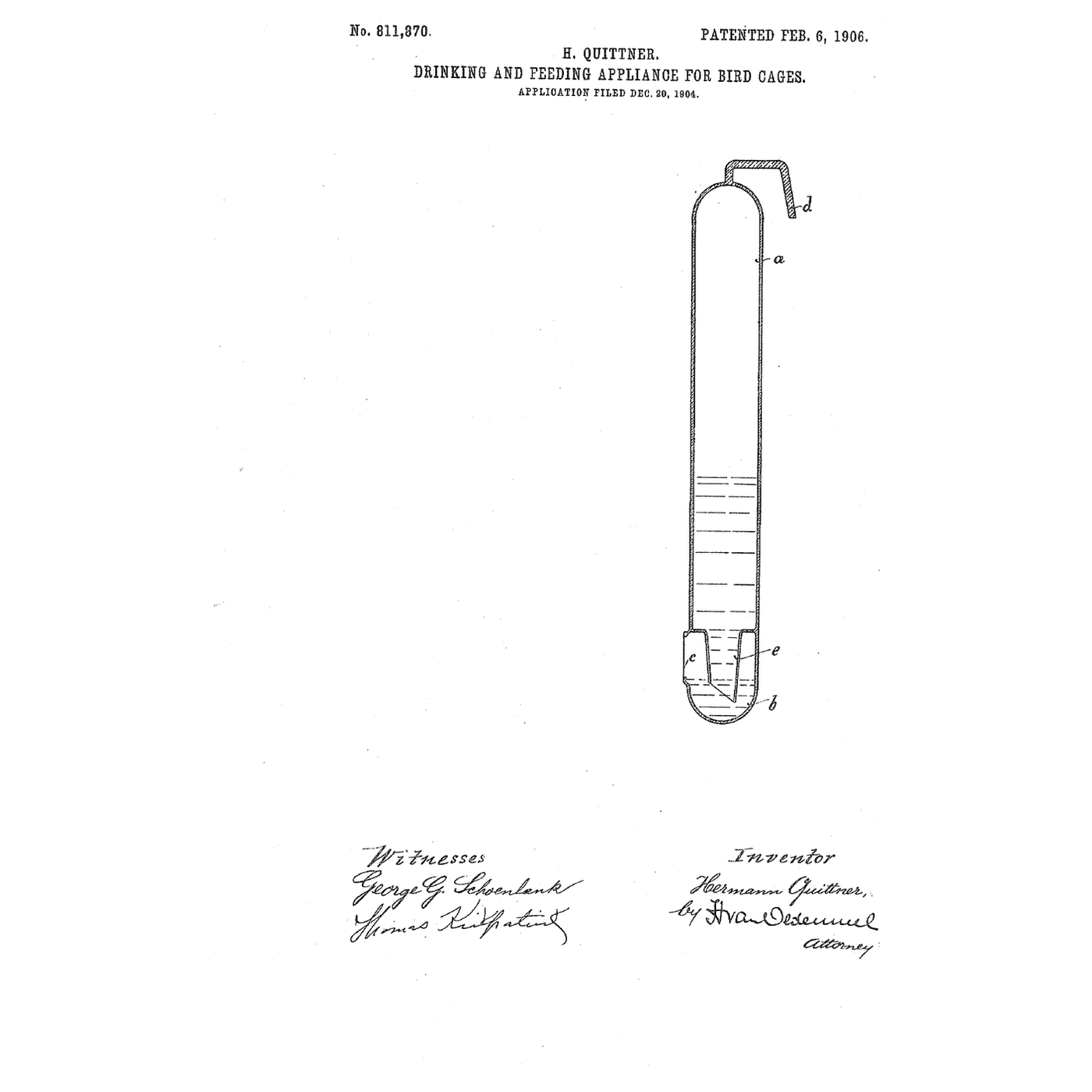


The Siphon Bird Waterer: An Oblique Cut That Lets the Air In
A drinker that refills itself keeps a caged bird in water for days, but only if it actually refills.
Hermann Quittner of Berlin received US 811,870, dated 6 February 1906, for a drinking appliance for bird-cages "made on the principle of a common siphon barometer": a closed tube whose upper part is the reservoir and lower part the basin, joined by a small tube. Its lower end is cut obliquely, so that air bubbles in and the basin refills as the bird drinks, where a square-cut tube could hold the water back.
This rung works out how far surface tension can hold the water back, then builds two drinkers, one square-cut and one oblique, and compares them.
Iniciante
About 2 hours
Instruções
1
1
How far a meniscus holds
How far a meniscus holds
A carregar o notebook Jupyter…
2
2
Air holds the water up
Air holds the water up
The embedded blueprint shows the air's pressure holding water up in a closed glass. Quittner's reservoir is held up the same way until the bird lets air in.
3
3
Read US 811,870
Read US 811,870
"My invention relates to drinking and feeding appliances designed for bird-cages and made on the principle of a common siphon barometer".
In earlier drinkers the small tube was "cut square—that is to say, at right angles to the axis of the tube—which has the disadvantage that by the action of the vacuum formed in the upper part of the vessel on the one hand and the outer air-pressure on the other hand the water is kept in equilibrium, so that the feeding-basin may be emptied without water being allowed to flow from the reservoir."
"For the purpose of insuring the outflow from the reservoir to the feeding-basin b in proportion to the removal of water from the latter by the bird the bottom end of the aforesaid small tube is cut obliquely for facilitating the entrance of air-bubbles."
4
4
Build two drinkers and compare them
Build two drinkers and compare them
Cut two 20 cm lengths of clear acrylic tube. Close the bottom of each with a rubber stopper. With a hacksaw and knife, cut a window 2 cm high in the side of each tube, just above the bottom stopper: this is the basin.
Drill a hole through a second stopper for each tube and push a 3 cm length of vinyl tubing through it. Cut the lower end of one tubing square and the other at about 45°. Push each stopper up the tube until it sits just above the window, tubing pointing down into the basin: this is the partition.
Stand the tubes upright, fill each reservoir from the top and close it with a third stopper. Draw 1 mL at a time from each basin with the pipette, and note after each draw whether bubbles rise and the basin refills.
Materiais para este passo:
 Tubo acrílico (transparente)1 peça
 Rolhas de borracha6 peças
 Tubo de vinil transparente1 peça
 Água200 ml
Ferramentas necessárias:
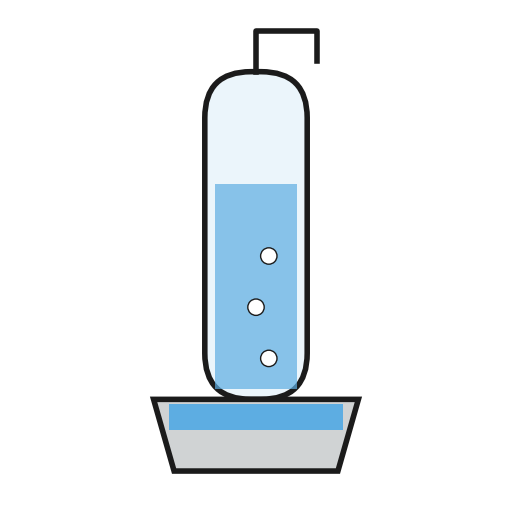 Bebedouro para pássaros
 Serra de arco para metais
 X-ato com lâminas sobresselentes
 Berbequim sem fios
 Jogo de brocas
 Lima para metal
 Pipeta de vidro
 Régua
Régua5
5
A drinker that floods, stalls or leaks
A drinker that floods, stalls or leaks
Siphon waterer troubleshooting.
Flow
Loading...
6
6
History and honest limits
History and honest limits
**Hermann Quittner** of Berlin filed US 811,870 on 20 December 1904; it was patented 6 February 1906. He hung the tube in the cage by a hook at its top, and noted the same appliance could hold seed, which settles to its own slope in the basin.
**Honest limits.** The notebook gives the holding height of a round opening only; an oblique cut exposes its upper edge first, so air gets in sooner, but the notebook does not model that shape. Tube sizes are examples. Your two drinkers are the measurement.
Materiais
4- Referência
- 6 peçasReferência
- Referência
- 200 mlReferência
Ferramentas necessárias
8- Referência
- Referência
- Referência
- 1 vendor sell this, none ship to you yetReferência
- Referência
- Referência
- Referência
- Referência
Blueprints relacionados
Estes blueprints compartilham conhecimento — técnicas, materiais ou princípios


CC0 Domínio Público
Este blueprint é liberado sob CC0. Você é livre para copiar, modificar, distribuir e usar este trabalho para qualquer finalidade, sem pedir permissão.
Apoie o Maker comprando produtos através do Blueprint, onde ele ganha uma Comissão Maker definida pelos vendedores, ou crie uma nova versão deste Blueprint e inclua-o como conexão no seu próprio Blueprint para compartilhar receita.