ARTE
BELEZA E BEM-ESTAR
ARTESANATO
CULTURA E HISTÓRIA
ENTRETENIMENTO
MEIO AMBIENTE
COMIDA E BEBIDAS
ENGENHARIA REVERSA
CIÊNCIAS
ESPORTES
TECNOLOGIA
TECNOLOGIA VESTÍVEL
Youblob (generated from this blueprint's notebook) · CC0

The Spool Valve: Steering Oil With a Sliding Rod
A pump makes flow and a cylinder makes force. Between them sits the valve that decides where the oil goes: to one end of the cylinder, to the other, or back to the tank. In almost every hydraulic machine that valve is a **spool**: a ground steel rod with raised lands, sliding in a bore with five ports — pressure, tank, two work ports, and a second tank.
Slide the spool one way and pressure goes to port A while B drains; slide it the other way and the roles swap; centre it and the ports are blocked or joined, depending on the spool's centre. The edges of the lands are orifices, so the spool also meters how fast.
This rung works out the metering, the choice between open and closed centre, and builds a transparent spool valve that shows the oil paths in coloured water.
Intermediário
About 4 hours
Instruções
1
1
Metering edges and the centre condition
Metering edges and the centre condition
A carregar o notebook Jupyter…
2
2
Each land edge is a throttle
Each land edge is a throttle
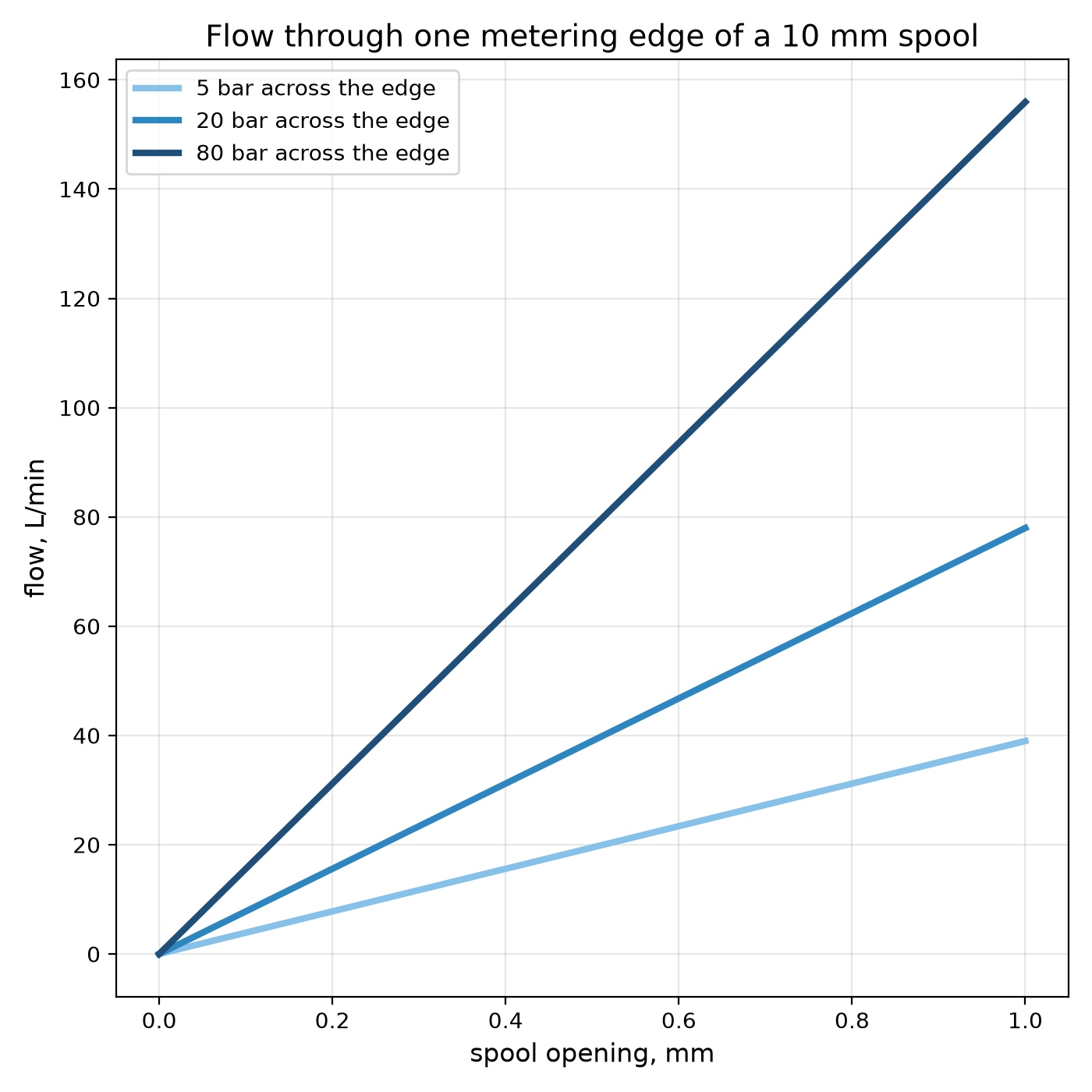
The spool meters flow the way any restriction does. The embedded blueprint shows how flow through a restriction depends on its area and the pressure across it.
3
3
Build a clear spool valve
Build a clear spool valve
Take 150 mm of clear acrylic tube with a smooth 20 mm bore. Drill five 6 mm holes in a line along one side, 20 mm apart, and glue a hose barb over each: from one end, **T**, **A**, **P**, **B**, **T**.
3D-print a spool: a 10 mm shaft carrying three lands, each 12 mm long with an O-ring groove, spaced so that when the spool is centred the middle land exactly covers **P** and the outer lands cover **A** and **B**. Fit O-rings sized to seal lightly in the bore. A handle on one end, a stop on the other.
Connect **P** to a garden hose through a ball valve, the two **T** ports to a bucket, and **A** and **B** to the two ports of the double-acting cylinder, or to two clear tubes standing up so you can see which one fills.
Materiais para este passo:
 Tubo acrílico (transparente)1 peça
 Sortido de acessórios para tubo de PVC1 peça
 Sortido de anéis de vedação1 peça
 Tubo de silicone2 metros
 Válvula direcional1 peça
Ferramentas necessárias:
 Impressora 3D de filamento (FDM)
 Filamento PETG
 Berbequim sem fios
 Jogo de brocas
 Paquímetro digital de 6 polegadas
 Pistola de cola quente
 Balde
Balde4
4
The three positions
The three positions
Espaço de trabalho Blockly
Loading Blockly workspace...
5
5
Run it with coloured water
Run it with coloured water
Add food colouring to a bucket feeding a small submersible pump, or tint the hose supply with a dye injector, so the flow shows in the clear bore.
Centre the spool and open the supply: nothing moves, and the supply hose stiffens — that is a closed centre. Slide the spool slowly one way: first a thread of colour as the edge just cracks open, then a full stream into **A** while **B** drains to **T**. Slide it the other way and watch the paths swap.
Then turn the middle land down on a second printed spool so that, centred, it leaves a gap round **P**: now the supply runs straight through to **T** at the centre. That is an open centre.
Materiais para este passo:
 Corante alimentar (corante para visualização de escoamento)1 peça
 Água20 litros
Ferramentas necessárias:
 Bomba de água submersível
 Cronómetro
6
6
A valve that will not control the load
A valve that will not control the load
Directional valve faults, in the order to check them.
Flow
Loading...
7
7
Context and honest limits
Context and honest limits
Spool valves go back to the steam age — slide valves on engines, piston valves on locomotives — and became the standard directional valve of oil hydraulics. Their symbols and port letters (P, T, A, B) are now standardised, so a circuit diagram from any maker reads the same way.
**Honest limits.** A spool always leaks a little through its clearance, so it cannot hold a load for long; a check valve does that. Flow through the edges also pushes on the spool (flow forces), which is why large valves are moved by pilot pressure rather than by hand. The printed model with O-rings shows the paths, not the metering: real spools seal by a micrometre clearance, not by rubber.
Materiais
7- Referência
- Referência
- Referência
- 2 metrosReferência
- 1 peçaReferência
- Referência
- 20 litrosReferência
Ferramentas necessárias
9- Referência
- Referência
- 1 vendor sell this, none ship to you yetReferência
- Referência
- Referência
- Referência
- Referência
- Referência
- Referência
Blueprints relacionados
Estes blueprints compartilham conhecimento — técnicas, materiais ou princípios
Throttling: Letting Some of It Past
por Emma
Mecânica
3
0
0
0
0
0
Orifice Plate Meter
por Emma
TECNOLOGIA
37
0
0
0
0
0
One Way Only: The Check Valve and the Bang It Makes
por Martin
Ferramentas
6
0
0
0
0
0
Safety Relief Valve
por Penny
TECNOLOGIA
41
0
0
0
0
0
O-Ring Seal
por Mary
Trabalho em Metal
49
0
0
0
0
0
Hydraulic Accumulator
por Emma
Trabalho em Metal
34
0
0
0
1
0
CC0 Domínio Público
Este blueprint é liberado sob CC0. Você é livre para copiar, modificar, distribuir e usar este trabalho para qualquer finalidade, sem pedir permissão.
Apoie o Maker comprando produtos através do Blueprint, onde ele ganha uma Comissão Maker definida pelos vendedores, ou crie uma nova versão deste Blueprint e inclua-o como conexão no seu próprio Blueprint para compartilhar receita.