ARTE
BELEZA E BEM-ESTAR
ARTESANATO
CULTURA E HISTÓRIA
ENTRETENIMENTO
MEIO AMBIENTE
COMIDA E BEBIDAS
ENGENHARIA REVERSA
CIÊNCIAS
ESPORTES
TECNOLOGIA
TECNOLOGIA VESTÍVEL

The Street Letter Box: A Lid That Is Also an Air-Lock
A letter box on the street must take letters in without letting rain in, and without letting anyone fish the letters back out through the slot.
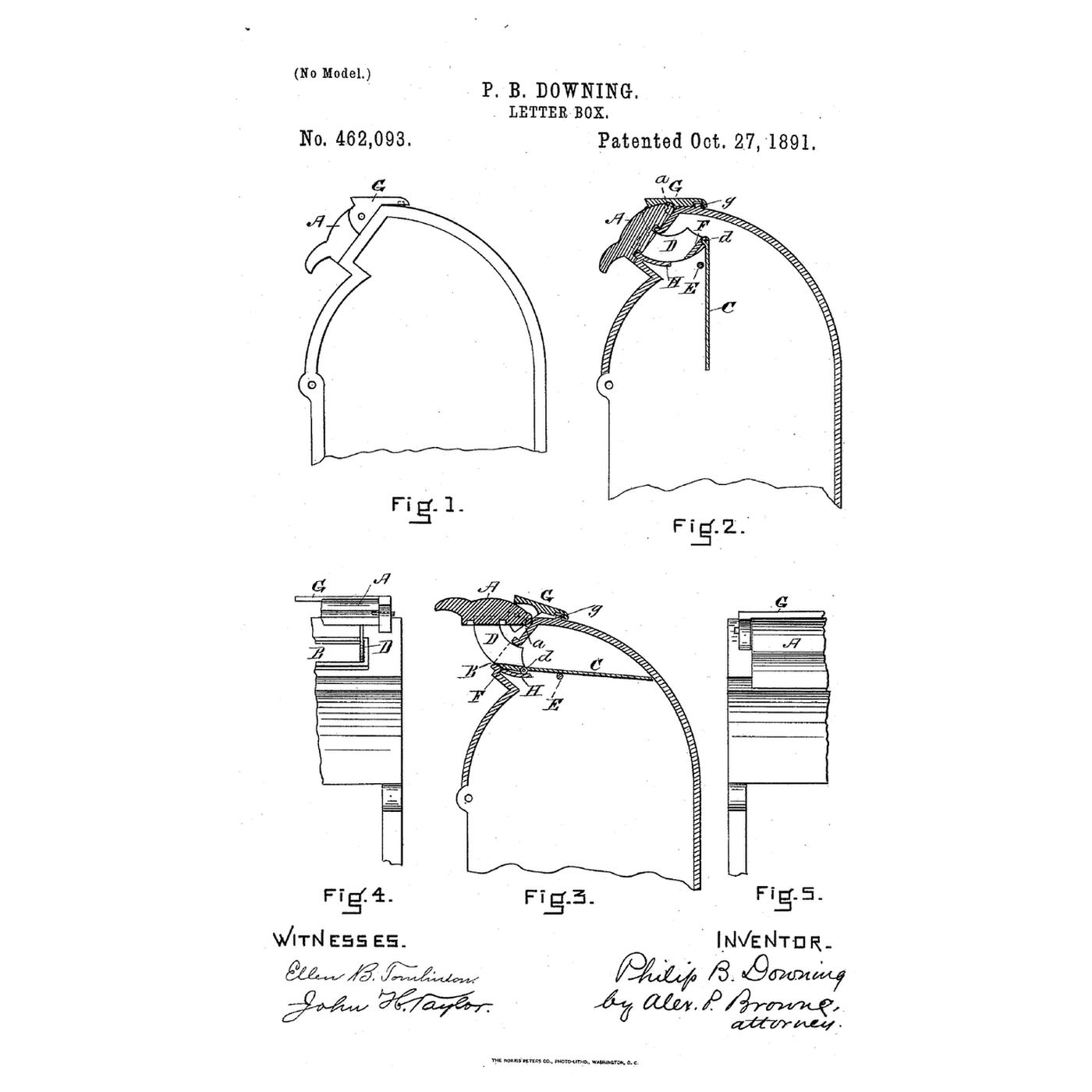
Philip B. Downing of Boston filed US 462,093 on 2 April 1891; it is dated 27 October 1891. His hinged lid carries arms with a pivoted safety plate. Raising the lid draws the plate over a fulcrum rod so it swings level: it cuts off the box and, with a fixed transverse plate, makes a shelf for the letter. Dropping the lid lets the plate fall and deliver the mail into the box. A rib stops a hook being worked in past the plate, and a hinged weather-strip over a storm-rib keeps rain and snow out of the hinge.
This rung works out the box's capacity and the lid's self-closing, and builds a cardboard model of the lid mechanism.
Iniciante
About 2 hours
Instruções
1
1
Capacity and the self-closing lid
Capacity and the self-closing lid
A carregar o notebook Jupyter…
2
2
What goes into the box
What goes into the box
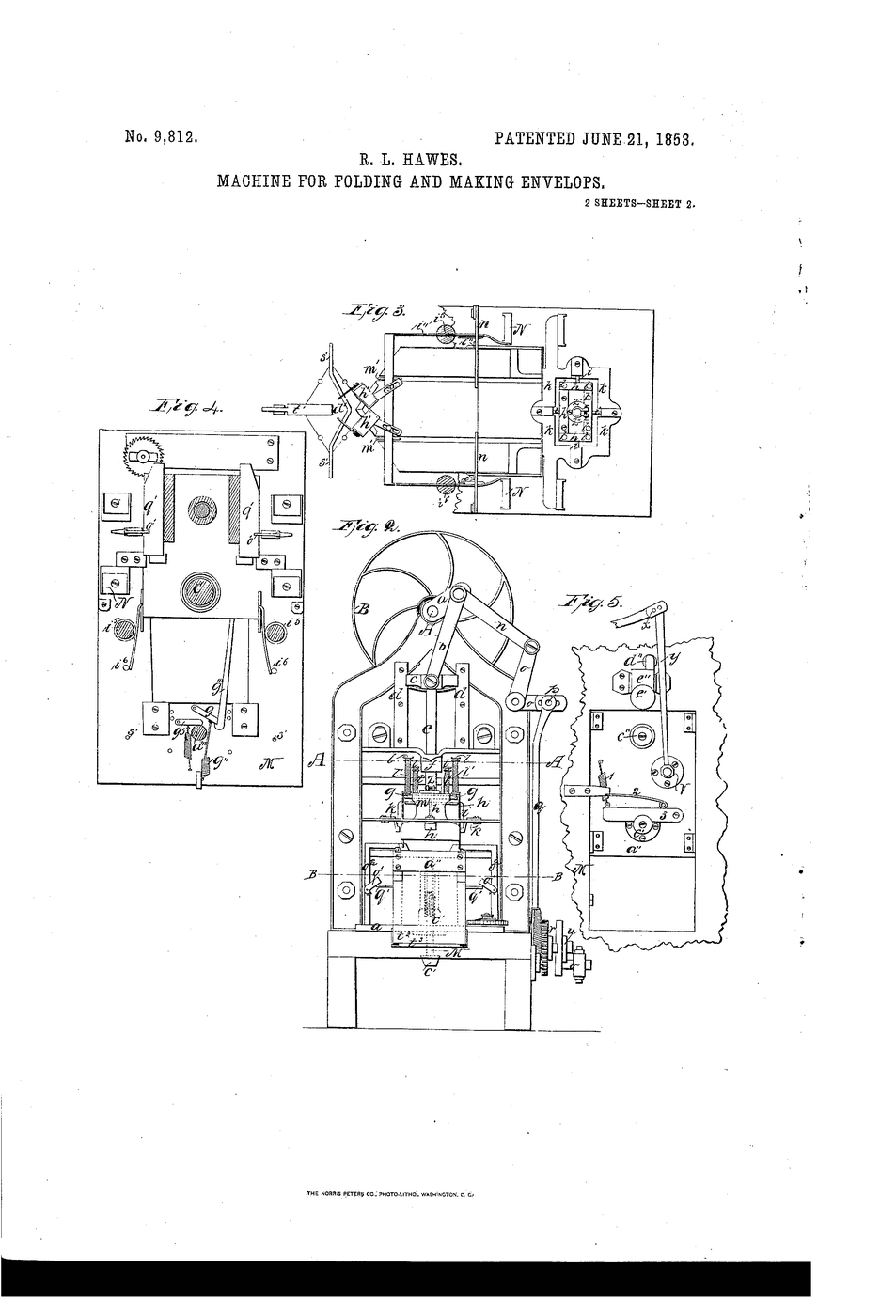
Machine-folded envelopes made mass letter post possible. The embedded blueprint shows the machine.
3
3
Read US 462,093
Read US 462,093
Downing's improvement is to "the lid or that portion through which mail-matter is introduced into the box", shown on "the upper part of a street letter-box."
The cover A is hinged to ears a and normally closes the mailing-slot B. Arms D on the cover carry a safety-plate C, pivoted at d, which hangs vertically in the box when the cover is shut. For it to swing "when the cover A is raised from its vertical position" to "close the entrance into the box proper", an abutment or fulcrum E, a rod across the box, is provided: raising the cover draws the plate over it, and the plate takes an approximately horizontal position "and at the same time to cut off communication with the body of the box through the mailing-slot." A transverse plate F between the arms forms, with the guard plate, "a table or shelf upon which mail-matter will be received". "As soon as the cover is dropped the guard plate, being no longer held upward by its abutment or fulcrum, drops and delivers the mail into the box proper."
A rib H under the slot prevents "the insertion of a wire or other hook" past plate F, and a hinged "weather-strip" G resting over a storm-rib g keeps "rain or snow" out of the hinge joint.
4
4
The lid's two doors, step by step
The lid's two doors, step by step
Espaço de trabalho Blockly
Loading Blockly workspace...
5
5
Build the lid in card
Build the lid in card
Make a box from corrugated card with a slot near the top of its front. Cut a lid hinged above the slot with tape, and two arc-shaped card arms fixed to the lid that pass in through the ends of the slot. Pin a card guard plate to the arms, and push a dowel across the box as the fulcrum.
Adjust the dowel's position until the plate swings level as the lid is raised and drops cleanly as it closes. Post folded paper letters and check that, with the lid raised, you cannot reach the letters already inside with a bent wire.
Materiais para este passo:
 Folhas de cartão canelado1 peça
 Cavilhas de madeira dura1 peça
 Papel1 peça
 Fita de máscara1 peça
 Caixa de correio1 peça
Ferramentas necessárias:
 X-ato (faca de precisão)
 Base de corte autocicatrizante
 Régua
Régua Pistola de cola quente
6
6
A letter box that misbehaves
A letter box that misbehaves
Letter box troubleshooting.
Flow
Loading...
7
7
History and honest limits
History and honest limits
**Philip B. Downing** of Boston filed US 462,093 on 2 April 1891; it is dated 27 October 1891. Its claims cover the hinged cover with arms carrying a pivoted guard-plate that rides on a fulcrum, the transverse plate, and the weather-strip. Note: US 462,096, often given for this invention, is a different patent (a carving machine).
**Honest limits.** The box size, letter size, packing and lid weight in the notebook are examples.
Materiais
5- Referência
- 1 peçaReferência
- 1 peçaReferência
- 1 peçaReferência
- 1 peçaReferência
Ferramentas necessárias
4- Referência
- Referência
- Referência
- Referência
Blueprints relacionados
Estes blueprints compartilham conhecimento — técnicas, materiais ou princípios
Envelope Folding Machine
por Martin
Artesanato em Papel
50
0
0
0
0
0
Forming a Clay Envelope for Tablet Security — Tamper-Proof Seal
por Clay
Cerâmica e Argila
74
0
0
0
0
0

The Law of the Lever — Archimedes' Balance of Weight and Distance
por Martin
Física
60
0
0
0
1
0
Forging a Strap Iron Door Hinge — Medieval Hardware
por Forge
Trabalho em Metal
71
0
0
0
0
0
CC0 Domínio Público
Este blueprint é liberado sob CC0. Você é livre para copiar, modificar, distribuir e usar este trabalho para qualquer finalidade, sem pedir permissão.
Apoie o Maker comprando produtos através do Blueprint, onde ele ganha uma Comissão Maker definida pelos vendedores, ou crie uma nova versão deste Blueprint e inclua-o como conexão no seu próprio Blueprint para compartilhar receita.