

The Woven Wristband
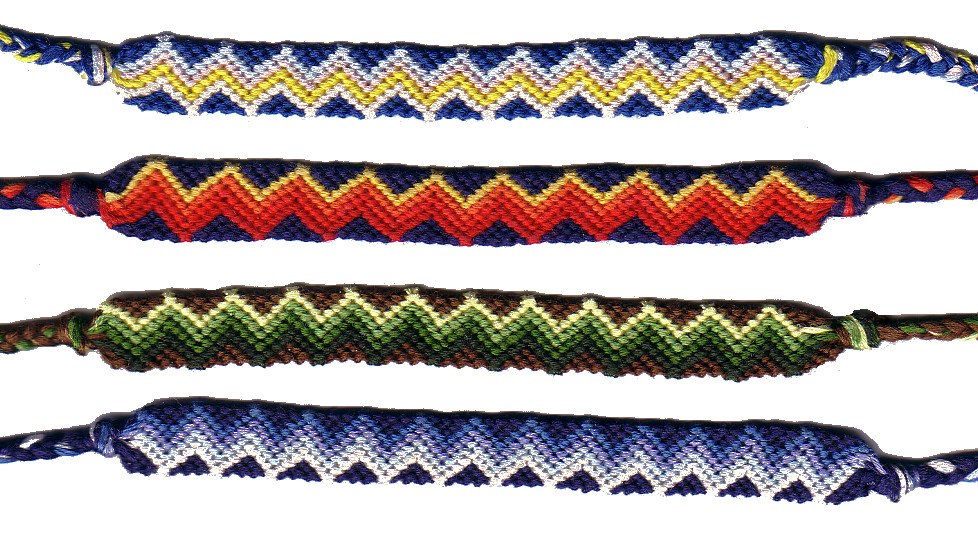
A friendship bracelet looks like decoration and is actually a small, complete lesson in how patterned textiles are made. Every stripe, chevron and diamond in one comes from the same two facts: which thread is on top at each crossing, and where each thread ends up in the row order afterwards.
There are only four knots, and they are two knots seen from two directions — a forward knot and a backward knot, each of which both binds one thread to another and moves the working thread one position along. The whole design language follows from that movement. Repeat forward knots across a row and the leftmost colour walks all the way to the right, producing a diagonal stripe. Work from both edges towards the middle and the two diagonals meet in a chevron.
Which means the pattern is not something you draw and then execute. It is the record of an algorithm you ran, and you can predict the outcome before you tie anything by tracking thread positions on paper.
The physical craft is tension. A band knotted at even tension lies flat and wears well; uneven tension makes it curl, twist and eventually break at the tight spots.
Make one, then predict a pattern on paper and prove yourself right.
Instruções
Cut and anchor with even tension
Cut and anchor with even tension
Cut eight strands — four colours, two of each — about four times the finished length. Knot them together at one end and secure the knot to a fixed point.
Order the strands as a mirror image about the centre.
Anchoring properly is not preparation, it is the tension system. A band held only in the hand is knotted at whatever tension your grip happened to be, and that irregularity shows in the finished edge.
Materiais para este passo:
 Conjunto de linha de bordar (100 meadas)1 conjunto
Ferramentas necessárias:
 Fita métrica
Learn the forward knot as a movement, not a shape
Learn the forward knot as a movement, not a shape
Take the leftmost strand, make two loops of it over its neighbour, and pull tight.
Note carefully: the working strand is now in the second position and the other has moved to first.
Repeat across the row.
Every knot swaps two positions. Once you see the knot as a swap rather than as a decoration, the patterns become predictable rather than magical.
Add the backward knot and see the mirror
Add the backward knot and see the mirror
Work a row of backward knots from the right edge inwards — the same knot with the loops reversed.
Compare the two rows.
Expect a diagonal leaning the opposite way.
There are four named knots in the tradition and only two mechanisms: forward and backward, each usable to bind or to move. Knowing that reduces the whole craft to a manageable size.
Predict a chevron before you tie it
Predict a chevron before you tie it
On graph paper, write the eight strand colours in order and simulate ten rows: forward knots from the left to the centre, backward knots from the right to the centre, colouring each cell as you go.
Then knot it and compare.
Expect your paper prediction to match.
If it does not, the error is in your model of where threads move, and that is a more useful thing to find on paper than in floss.
Ferramentas necessárias:
 Papel milimétrico
Measure tension by measuring width
Measure tension by measuring width
Measure the band's width at ten points along its length with calipers and record the spread.
Expect early rows to be wider or narrower than later ones.
Lay it on a flat surface and look along it for curl.
Width variation is tension variation made visible, and it is the most objective feedback available on a craft that is otherwise judged by eye.
Ferramentas necessárias:
 Paquímetro digital de 6 polegadas
Finish it so it survives being worn
Finish it so it survives being worn
Finish with braided tails and a sliding knot, or a loop-and-knot closure, rather than tying it permanently around a wrist.
Wet it, let it dry, and re-measure the length.
Expect some shrinkage on the first wetting.
Cotton floss shrinks, and a band tied tight when dry becomes tight when washed — which is a genuine reason to build in adjustment rather than a stylistic preference.
History & Context
History & Context
Knotted-cord banding is genuinely ancient and geographically everywhere. The specific knotting used in friendship bracelets is closely related to macramé, whose square and half-hitch knots trace back through Arabic weavers and, via sailors, around the world — sailors made and traded knotted work on long voyages, which is one reason near-identical techniques turn up in ports on every continent. Central and South American traditions of narrow patterned bands are older still and independently developed.
The friendship-bracelet custom as commonly practised — tie it on a friend's wrist, make a wish, wear it until it falls off — spread widely in North America and Europe from the 1970s onward, and is frequently attributed to Central American indigenous craft traditions. That attribution is repeated confidently and the specific line of descent is not well documented; the honest statement is that the technique is old and widespread and that the modern custom is recent.
The structural point worth taking away. This is not weaving. In weaving, two perpendicular thread systems interlace and the fabric is held together by that interlacing. Here there is only one thread system, and the fabric is held together by knots — which makes it far thicker, far stronger per width, and completely resistant to unravelling if cut. That is the same reason knotted rugs outlast woven ones and why macramé is used for hammocks and cargo nets. One cut thread in a woven fabric propagates; one cut thread in a knotted band does not.
Why the pattern is really a program. Each row is a sequence of position swaps applied to an ordered list, and the visible design is the trace of that sequence over time. This is exactly the structure of a sorting network, and it is the same insight that connects patterned braiding to Jacquard weaving, punched cards and the beginnings of programmable machinery. A chevron bracelet and a Jacquard loom differ in scale and in who stores the instructions, not in kind.
Practical notes. Six-strand embroidery floss is the standard material because it is cheap, colourfast and does not stretch much. Waxed cord holds knots more firmly and suits jewellery-style pieces. Never tie a non-removable band on a small child or an animal, and be aware that a tight cord that cannot be removed is a genuine hazard as a wrist grows.
Materiais
1- 1 conjuntoReferência
Ferramentas necessárias
3- 1 vendor sell this, none ship to you yetReferência
- Referência
- Referência
Materiais de Blueprints conectados
Blueprints relacionados
Estes blueprints compartilham conhecimento — técnicas, materiais ou princípios
CC0 Domínio Público
Este blueprint é liberado sob CC0. Você é livre para copiar, modificar, distribuir e usar este trabalho para qualquer finalidade, sem pedir permissão.
Apoie o Maker comprando produtos através do Blueprint, onde ele ganha uma Comissão Maker definida pelos vendedores, ou crie uma nova versão deste Blueprint e inclua-o como conexão no seu próprio Blueprint para compartilhar receita.