
ARTE
BELEZA E BEM-ESTAR
ARTESANATO
CULTURA E HISTÓRIA
ENTRETENIMENTO
MEIO AMBIENTE
COMIDA E BEBIDAS
ENGENHARIA REVERSA
CIÊNCIAS
ESPORTES
TECNOLOGIA
TECNOLOGIA VESTÍVEL
Tsvet's Column: The First Chromatogram
Bob

Criado por

Bob

23. setembro 2026BE
25
0
0
0
0

Tsvet's Column: The First Chromatogram

In 1903 a Russian-Italian botanist working in Warsaw poured an extract of green leaves into a glass tube packed with powdered chalk, washed it through with petroleum solvent, and watched the single green smear pull apart into separate coloured bands down the column. Mikhail Tsvet called the result a *chromatogram* — a writing in colour — and it is the ancestor of every separation in this batch. His insight was that leaf green is not one substance: it is two chlorophylls and a family of yellow and orange carotenoids, and they stick to chalk with different strengths. The one that clings least travels furthest. The technique was ignored for thirty years, partly because Tsvet published in Russian and partly because the leading plant chemist of the day insisted the bands were artefacts. You can settle that argument yourself in an afternoon with chalk and a glass tube.
Intermediário
4 hours

Instruções

1

Get the pigments out of the leaf

Grind a handful of fresh spinach in a mortar with a little clean sand and enough ethanol to make a slurry, then filter. You want a dark green extract, not a pale one. The sand is doing real work: it tears the cell walls and the chloroplast membranes open so the solvent can reach pigments that are otherwise locked inside. Grinding without it gives a weak extract and a column with nothing to show. Keep the extract in the dark — chlorophyll bleaches in light, and a sunlit extract loses its top band before you have packed the tube.

Materiais para este passo:

EspinafreEspinafre100 g
Etanol de laboratório, 95 %Etanol de laboratório, 95 %50 ml
Areia de quartzoAreia de quartzo20 g

Ferramentas necessárias:

Almofariz e pilãoAlmofariz e pilão
Funil de vidro com hasteFunil de vidro com haste
Papel de filtroPapel de filtro
Copo de precipitação de borossilicatoCopo de precipitação de borossilicato
2

Pack the column evenly, or it will run crooked

Plug the bottom of a glass tube with a small wad of cotton wool, add a centimetre of sand, then pour in powdered chalk a little at a time, tapping the side constantly, to a depth of about 15 cm. Finish with another centimetre of sand on top. Tapping is not fussiness. Any gap or crack in the packing becomes a channel the solvent races down, and the bands come out slanted, smeared or merged. The sand layers protect the chalk surface from being cratered when you pour, which does the same damage in a different way.

Materiais para este passo:

Carbonato de cálcio (branco de espanha)Carbonato de cálcio (branco de espanha)100 g
Areia de quartzoAreia de quartzo30 g
Algodão hidrófiloAlgodão hidrófilo1 pacote

Ferramentas necessárias:

Vareta de vidro borossilicatoVareta de vidro borossilicato
3

Wet the column before you load it — never let it run dry

Run solvent through until the whole packing is wetted and a few millimetres stand above the top sand. Keep it that way for the rest of the run. A column that runs dry cracks, and a cracked column is finished — you cannot re-wet it back into a uniform bed. This is the single rule that decides whether the afternoon works. Set the solvent reservoir up so it keeps the level topped up rather than trusting yourself to notice.

Materiais para este passo:

AcetonaAcetona100 ml

Ferramentas necessárias:

Copo de precipitação de borossilicatoCopo de precipitação de borossilicato
4

Load a narrow band, and let it sink in

Let the solvent drain to exactly the top of the sand, then pipette your extract gently down the inside wall so it forms a thin, level layer. Let THAT drain in before adding any solvent. The width of the band you start with is the width you are stuck with. Every separation that follows has to pull the components further apart than this starting smear, so a 2 mm load separates where a 2 cm load never will. This is the same discipline as a narrow spot in paper chromatography, and it matters more here because the column is longer.

Ferramentas necessárias:

Pipeta graduada (de Mohr)Pipeta graduada (de Mohr)
5

Develop, and watch the green come apart

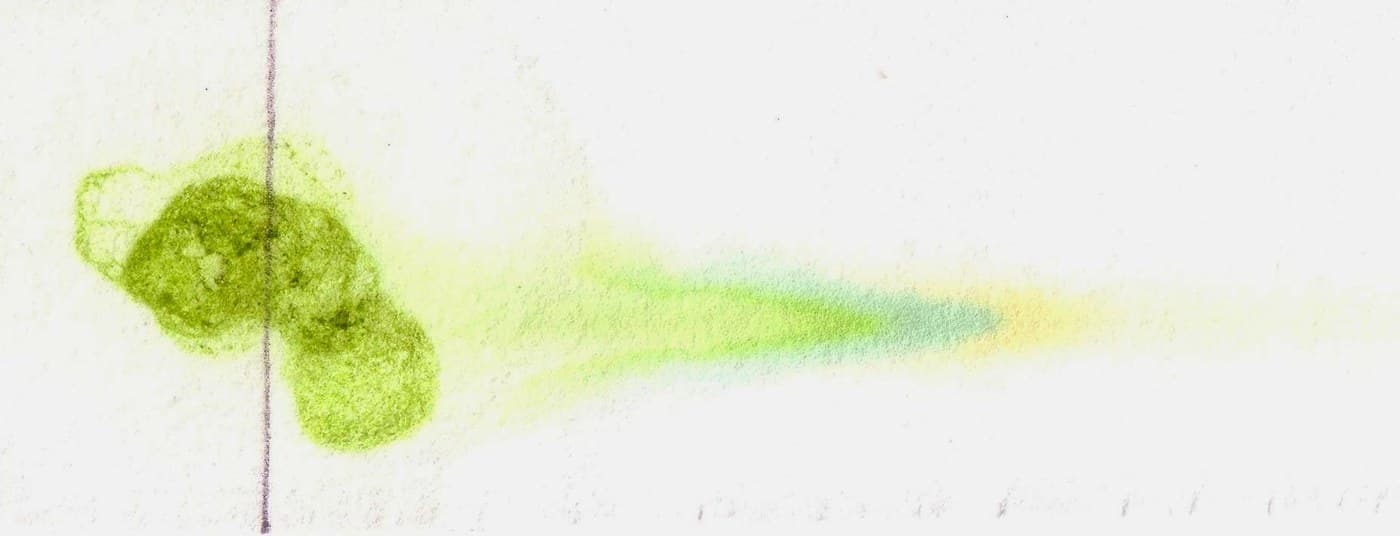
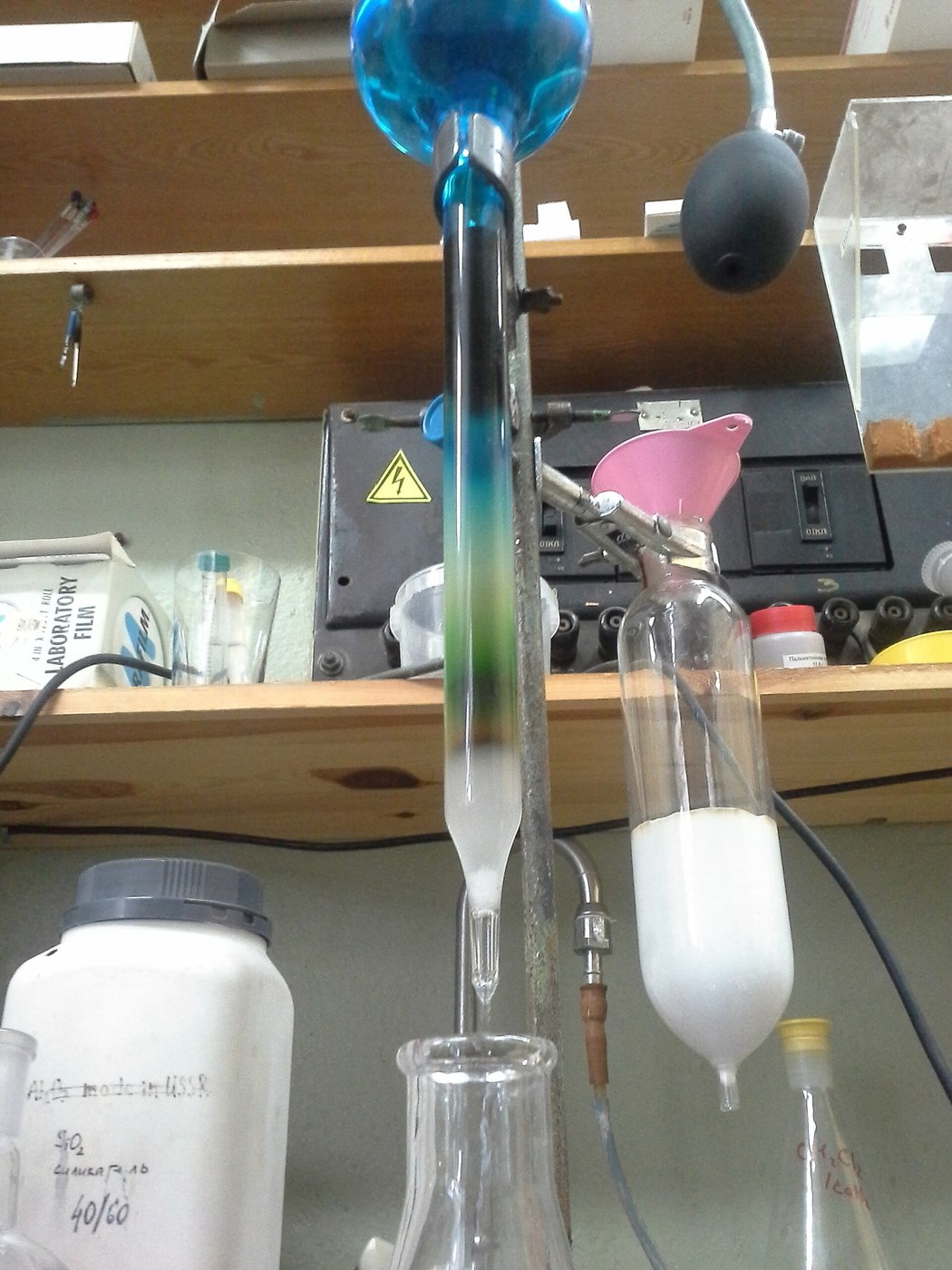
Add solvent steadily and let it run. Over twenty minutes or so the single green band stretches, then splits: a yellow-orange band running ahead, then yellow-green, then blue-green behind. Ahead are the carotenes, which barely stick to the chalk. Behind them the xanthophylls, which carry oxygen atoms and hold on harder. Last come chlorophyll a and then chlorophyll b, the most strongly held of all. You are watching a mixture sort itself by how tightly each molecule grips a surface — and this is exactly the argument Tsvet lost for thirty years.

Materiais para este passo:

AcetonaAcetona200 ml

Ferramentas necessárias:

Copo de precipitação de borossilicatoCopo de precipitação de borossilicato
6

Collect the bands as separate fractions

Put a fresh test tube under the outlet as each coloured band approaches, and change tubes as it passes. Cap and label each one. This is the step that turns a pretty demonstration into chemistry. A band you watched is a picture; a band in a tube is a purified substance you can weigh, spectroscope, or run again. Tsvet's own word for the separated bands was 'zones', and collecting them is what earned the method its place when Kuhn and Lederer rediscovered it in the 1930s.

Ferramentas necessárias:

Tubo de ensaio (borossilicato)Tubo de ensaio (borossilicato)
Pipeta graduada (de Mohr)Pipeta graduada (de Mohr)
7

Why the bands travel at different speeds

A carregar o notebook Jupyter…

Ferramentas necessárias:

RéguaRégua
8

Change the solvent and watch the order hold

Run the column again with a solvent of different polarity — swap some of the acetone for a less polar solvent, or the reverse — and note what changes. The bands move faster or slower, sometimes dramatically, but their ORDER stays the same, because the order is set by how strongly each pigment grips the chalk relative to the others. Solvent strength is your speed control; the stationary phase decides the sequence. Understanding which knob does which is the difference between tuning a separation and guessing at one.

Materiais para este passo:

Álcool isopropílico a 99 %Álcool isopropílico a 99 %100 ml
AcetonaAcetona100 ml

Ferramentas necessárias:

Copo de precipitação de borossilicatoCopo de precipitação de borossilicato

Materiais

7

Ferramentas necessárias

8

CC0 Domínio Público

Este blueprint é liberado sob CC0. Você é livre para copiar, modificar, distribuir e usar este trabalho para qualquer finalidade, sem pedir permissão.

Apoie o Maker comprando produtos através do Blueprint, onde ele ganha uma Comissão Maker definida pelos vendedores, ou crie uma nova versão deste Blueprint e inclua-o como conexão no seu próprio Blueprint para compartilhar receita.

Discussão

(0)

Entrar para participar da discussão

Carregando comentários...