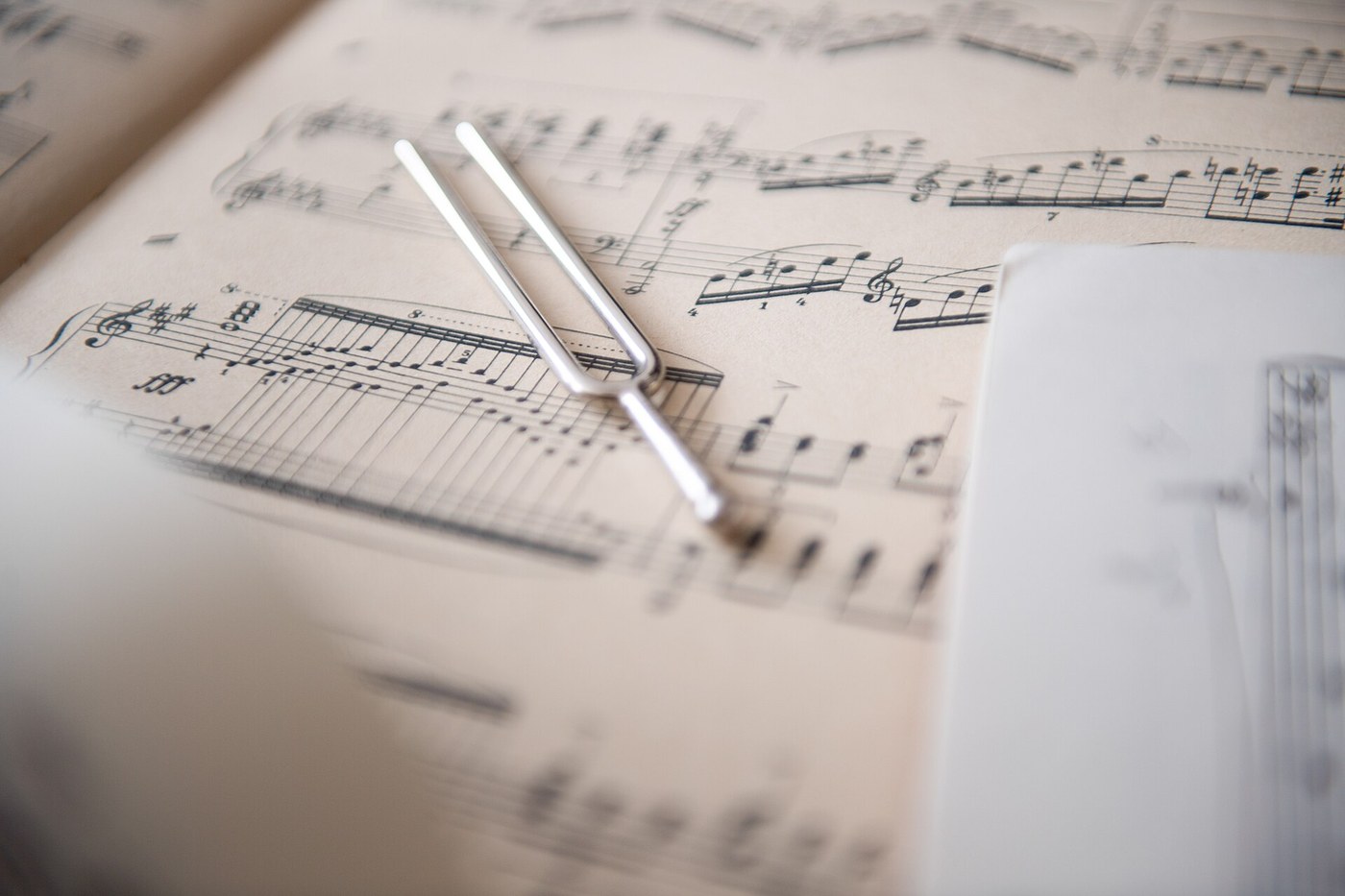


Tuning Fork
Instruções
Hear what a pure tone is
Hear what a pure tone is
Compare a fork against something with a rich spectrum.
- Strike a tuning fork and listen as it decays.
- Strike a metal bar, a glass and a stretched string in turn.
- Note which sounds have an obvious clang or shimmer.
Materiais para este passo:
 Fita de aço-mola1 strip
Find the quiet direction
Find the quiet direction
A ringing fork does not radiate sound equally in all directions.
- Strike the fork and hold it near your ear.
- Rotate it slowly about its own long axis.
- Listen for the positions where it nearly disappears.
Show that the handle carries the energy
Show that the handle carries the energy
A fork alone is quiet; coupled to a surface it is loud.
- Strike the fork and hold it in mid-air — note how faint it is.
- Now press the handle base firmly onto a table.
- Compare loudness and how long the tone lasts.
Change the pitch and find the law
Change the pitch and find the law
Frequency is set by geometry and material, and you can move it.
- Add a small blob of putty near the tip of each prong.
- Listen — the pitch falls.
- Now file a little from the tips instead: the pitch rises. File near the base: it falls.
History and context
History and context
John Shore (c.1662-1752) was a trumpeter and lutenist in the service of Purcell and later Handel, and is credited with the tuning fork in 1711. He reportedly called it his pitchfork. It replaced the pitch pipe, which was cheaper but whose pitch changes with temperature, humidity and how hard you blow.
The fork exposed a problem it could not solve. Once a stable physical reference existed, it became obvious that different cities tuned to different pitches — surviving forks from the eighteenth and nineteenth centuries scatter widely, and A could differ by nearly a semitone between one opera house and another. Singers travelled and suffered. France legislated a diapason normal of A=435 Hz in 1859, and the modern A=440 Hz standard was agreed internationally only in the twentieth century. A good measuring instrument does not create agreement; it makes disagreement visible.
Beyond music: Hermann von Helmholtz used tuning forks with resonators to analyse the composition of sounds and vowels. Rinne and Weber tests in medicine still use forks to distinguish conduction deafness from nerve deafness by comparing hearing through air and through bone. Quartz watches use exactly this shape — a tiny quartz tuning fork, etched to vibrate at 32,768 Hz, for the same reason Shore wanted one: a fork holds a frequency better than almost anything else of its size.
Materiais
1- 1 stripReferência
Blueprints relacionados
Estes blueprints compartilham conhecimento — técnicas, materiais ou princípios

CC0 Domínio Público
Este blueprint é liberado sob CC0. Você é livre para copiar, modificar, distribuir e usar este trabalho para qualquer finalidade, sem pedir permissão.
Apoie o Maker comprando produtos através do Blueprint, onde ele ganha uma Comissão Maker definida pelos vendedores, ou crie uma nova versão deste Blueprint e inclua-o como conexão no seu próprio Blueprint para compartilhar receita.