ARTE
BELEZA E BEM-ESTAR
ARTESANATO
CULTURA E HISTÓRIA
ENTRETENIMENTO
MEIO AMBIENTE
COMIDA E BEBIDAS
ENGENHARIA REVERSA
CIÊNCIAS
ESPORTES
TECNOLOGIA
TECNOLOGIA VESTÍVEL
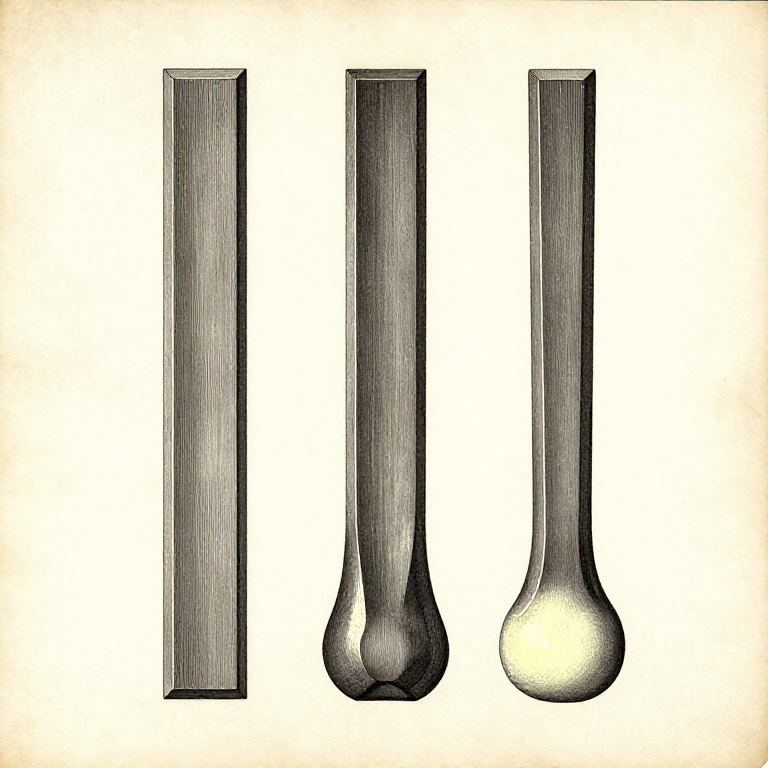


Upsetting: Making It Thicker by Making It Shorter
Upsetting is drawing out in reverse: shortening a bar to make part of it thicker. It is how you get a head on a bolt, a boss in the middle of a bar, or extra material where a joint needs it.
It is also the hardest basic operation, because a hot bar struck on its end wants to BUCKLE sideways rather than compress. Control that and upsetting works; lose it and you get an S-bend that has to be straightened out or cut off.
The answer is localised heat and short unsupported length — the same two levers, used deliberately.
Avançado
3 hours
Instruções
1
1
Heat ONLY the part you want to thicken
Heat ONLY the part you want to thicken
Bring a short section to a bright forging heat and leave the rest of the bar dark. Cold metal will not move, so the cold section acts as a rigid column and the deformation is confined to the hot part.
This is the heating-evenly rung used in reverse: there you were fighting uneven heat, here you are creating it on purpose. Quench the neighbouring section in water if it has picked up too much heat — a few seconds is enough.
The length of hot metal is what you are controlling. A long hot section buckles; a short one upsets. As a rule of thumb, keep the unsupported hot length under about two and a half times the bar's thickness.
Materiais para este passo:
 Barra de aço macio1 peça
 Água1 peça
Ferramentas necessárias:
 Forja de ferreiro
 Tenazes de ferreiro
 Óculos escuros de forja
 Luvas de couro de canhão longo
2
2
Strike along the axis, dead square
Strike along the axis, dead square
Stand the bar on end on the anvil face and strike straight down its axis, or hold it vertically and hammer the top. Every blow must be along the length of the bar, not at an angle.
An angled blow bends rather than upsets, and once a bend has started every subsequent blow makes it worse, because the bar is now a lever. Stop at the first sign of it and straighten before continuing.
For a heavy bar, reverse the method: heat the end, then drop the bar end-down onto the anvil so its own weight does the upsetting. The mass of the bar delivers far more energy than a hammer can, and it is automatically axial.
Materiais para este passo:
Barra de aço macio1 peçaFerramentas necessárias:
 Bigorna
 Martelo de ferreiroTenazes de ferreiroLuvas de couro de canhão longo
3
3
Straighten early and often
Straighten early and often
Check for straightness every few blows by sighting along the bar, and correct any bend immediately while the section is still hot.
A small bend corrected now takes two blows. The same bend after ten more upsetting blows has become a fold, and a fold in hot steel welds shut on itself and becomes a permanent internal flaw — a COLD SHUT — which is a crack waiting to open under load.
That is why upsetting is rated harder than drawing out. Drawing out forgives inattention; upsetting punishes it with a defect you often cannot see until the piece fails.
Materiais para este passo:
Barra de aço macio1 peçaFerramentas necessárias:
BigornaMartelo de ferreiro Régua
Régua Lupa de joalheiro
4
4
Or design so you never have to
Or design so you never have to
The honest professional answer to upsetting is often to avoid it. Start with a bar thick enough for the biggest section and DRAW DOWN everything else, rather than starting thin and upsetting a lump.
That is usually less work, always more controllable, and it is what the volume arithmetic in the drawing-out rung is for: pick the stock from the thickest part of the finished piece.
Upsetting earns its place where the thick section is in the MIDDLE of a long bar, or where drawing down would waste an unreasonable amount of material. Knowing which situation you are in before lighting the fire is the real skill here.
Materiais para este passo:
Barra de aço macio2 peçasFerramentas necessárias:
 CalculadoraRégua
Blueprints relacionados
Estes blueprints compartilham conhecimento — técnicas, materiais ou princípios
CC0 Domínio Público
Este blueprint é liberado sob CC0. Você é livre para copiar, modificar, distribuir e usar este trabalho para qualquer finalidade, sem pedir permissão.
Apoie o Maker comprando produtos através do Blueprint, onde ele ganha uma Comissão Maker definida pelos vendedores, ou crie uma nova versão deste Blueprint e inclua-o como conexão no seu próprio Blueprint para compartilhar receita.