

Making Skyr — Viking Cultured Dairy
Instruções
Heat the Milk
Heat the Milk
Pour fresh skimmed milk into a pot or cauldron. In the Viking era, cream was removed first for butter-making, and the remaining skimmed milk was used for skyr. Heat slowly over a low hearth fire until it reaches approximately 85°C — nearly simmering, with small bubbles forming at the edges but not a rolling boil.
Stir occasionally to prevent the milk from scorching on the bottom. Heating the milk kills unwanted bacteria and denatures the whey proteins, which helps produce a thicker final product. Hold at this temperature for several minutes.
Materiais para este passo:
 Milk (Skimmed)2-4 liters peçaMilk (Skimmed)2-4 tablespoons peça
 RennetA few drops peça
Ferramentas necessárias:
 Hearth (Forge Fire)
 Cloth (Straining)
 Wooden Barrel
Cool to Setting Temperature
Cool to Setting Temperature
Remove the pot from the fire and allow the milk to cool to approximately 40°C — warm to the touch but not hot (you should be able to hold your finger in it comfortably). This is the temperature at which the bacterial culture and rennet work most effectively.
Cooling can be sped by setting the pot in cold water or pouring the milk into a cool vessel. Do not let it cool too far below 35°C before adding the culture.
Add the Starter Culture
Add the Starter Culture
Stir in a small amount of existing skyr from a previous batch — this serves as the starter culture, containing the specific bacterial strains (primarily Streptococcus thermophilus) that produce skyr's characteristic flavor and texture. Use approximately 1-2 tablespoons of starter per liter of milk.
Add a few drops of rennet (extracted from the stomach lining of a young calf). The rennet aids coagulation, helping the milk set into a firm curd. Stir gently to distribute both the culture and rennet evenly throughout the milk.
Incubate Overnight
Incubate Overnight
Cover the vessel with a cloth or lid and place in a warm, draft-free location — near (but not on) the hearth, wrapped in blankets or furs, or in a warm corner of the longhouse. Allow to set undisturbed for 8-12 hours (overnight is traditional).
During this time, the bacterial culture acidifies the milk and the rennet causes coagulation. The milk will thicken into a soft, yogurt-like curd. Do not stir or disturb during incubation.
Strain Through Cloth
Strain Through Cloth
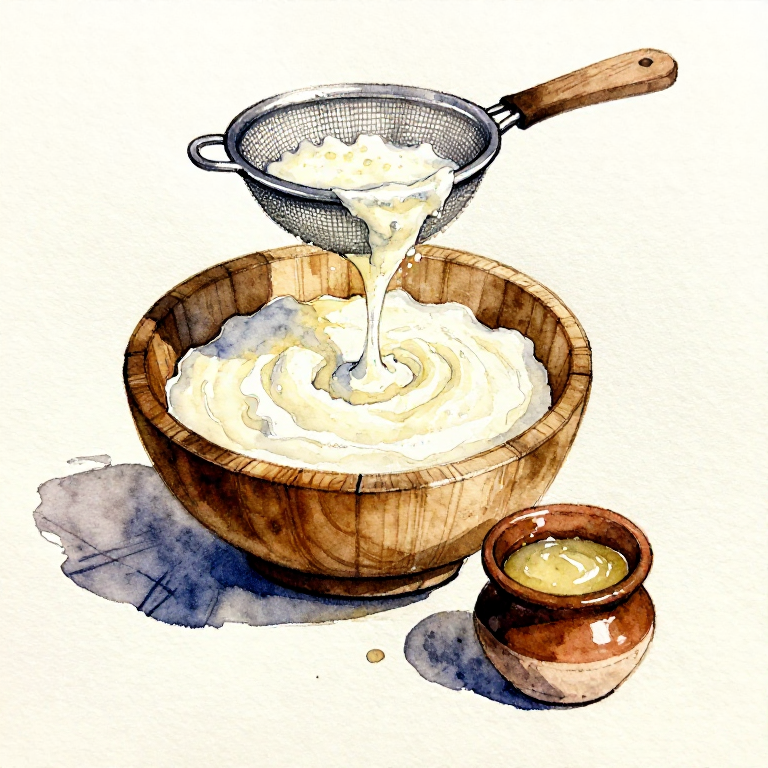
Line a large bowl with a fine cloth (linen works well). Pour the set skyr into the cloth. Gather the edges of the cloth and hang from a hook or cross-bar over the bowl, or press gently with a weight on top. Strain for several hours until the skyr is thick — thicker than yogurt, similar to cream cheese in consistency.
Save the whey! The liquid that drains off is whey — rich in lactic acid and nutrients. In Viking-era Iceland, this whey was collected, fermented further, and used to preserve meat for months. See the Viking Whey Preservation blueprint for this important next step.
Store and Serve
Store and Serve
The finished skyr is thick, creamy, and mildly tangy — less sour than yogurt, with a smooth texture. Transfer to a clean container and store in a cool location (a root cellar, cold stream, or outdoor cache in cold weather). Skyr keeps for several days to a week.
Serve with wild berries (lingonberries, bilberries), drizzled with honey, or alongside barley flatbread. Skyr is high in protein and was an important nutritional staple. Remember to save a small portion of each batch as starter culture for the next — this continuous culture has been passed down for over a thousand years in Iceland.
Ferramentas necessárias
3- Referência
- Referência
- Referência
CC0 Domínio Público
Este blueprint é liberado sob CC0. Você é livre para copiar, modificar, distribuir e usar este trabalho para qualquer finalidade, sem pedir permissão.
Apoie o Maker comprando produtos através do Blueprint, onde ele ganha uma Comissão Maker definida pelos vendedores, ou crie uma nova versão deste Blueprint e inclua-o como conexão no seu próprio Blueprint para compartilhar receita.