ARTE
BELEZA E BEM-ESTAR
ARTESANATO
CULTURA E HISTÓRIA
ENTRETENIMENTO
MEIO AMBIENTE
COMIDA E BEBIDAS
ENGENHARIA REVERSA
CIÊNCIAS
ESPORTES
TECNOLOGIA
TECNOLOGIA VESTÍVEL
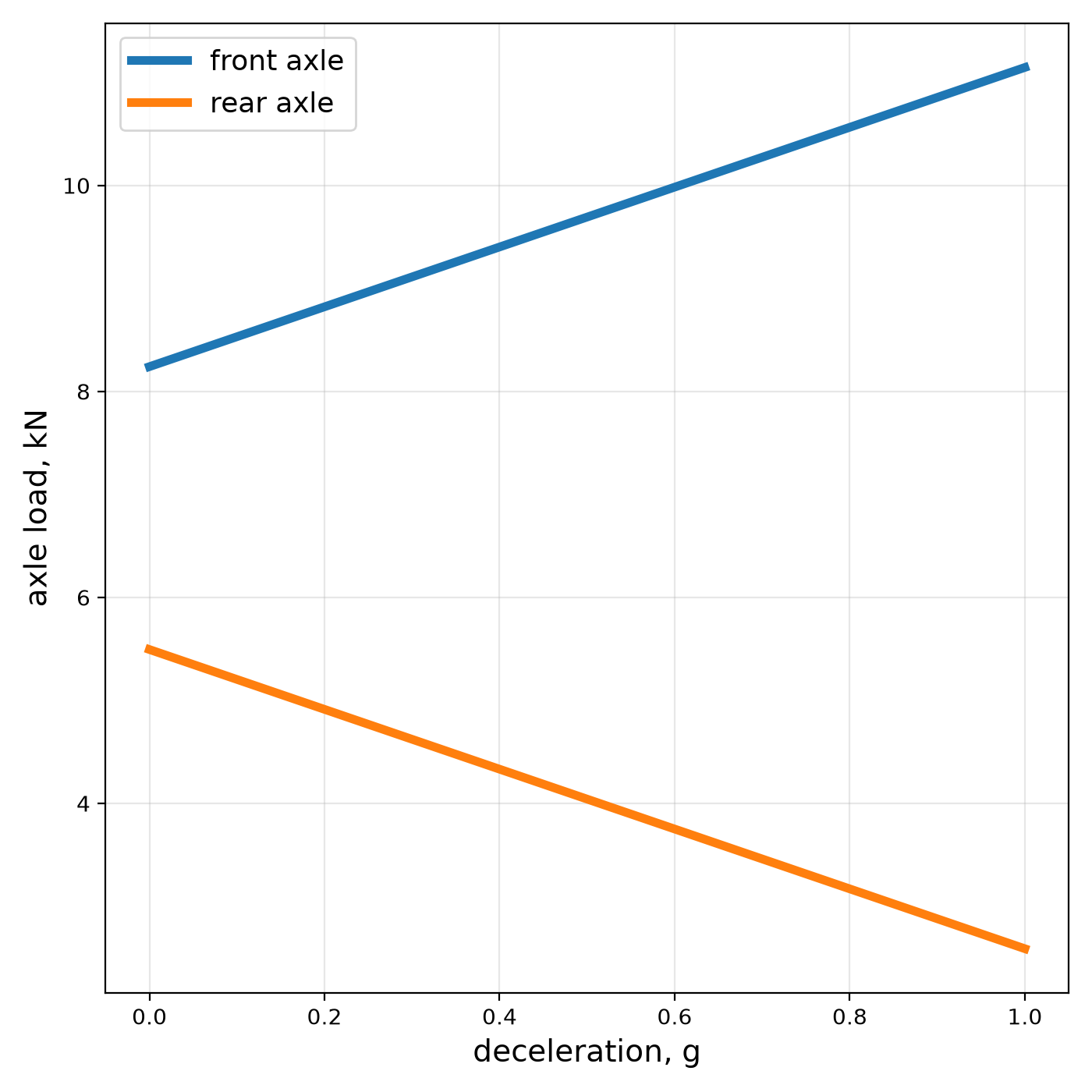
Youblob (generated from this blueprint's notebook) · CC0

Weight Transfer Under Braking: Why the Front Brakes Are Bigger
Brake hard and the nose dips: load moves from the rear wheels to the front. A tyre can only grip in proportion to the load on it, so in a hard stop the front tyres can do far more of the braking than the rear. Ask the rear brakes to do their static share and the rear wheels lock, and a car with locked rear wheels turns round.
This practice rung works out the load on each axle at several decelerations, and shows how to find a vehicle's centre-of-gravity height — the number the whole calculation turns on — with two scales and a block.
Iniciante
About 2 hours
Instruções
1
1
Axle loads and centre-of-gravity height
Axle loads and centre-of-gravity height
A carregar o notebook Jupyter…
2
2
Measure a cart's centre of gravity
Measure a cart's centre of gravity
Build or take a wheeled cart — the dynamics cart set, or a board on the axle-and-wheel kit — and load it with weights. Stand its front wheels on the kitchen scale and its rear wheels on a block of the same height; read the front load. Weigh the whole cart too.
Raise the rear wheels by 100 mm on a stack of books and read the front load again. Put your numbers into the notebook in place of the example inputs.
Now move the weights higher on the cart and repeat: the front load changes MORE when the cart is tilted, and the notebook gives a greater height. A high centre of gravity means more weight transfer — the reason a tall van pitches so much more than a low car.
Materiais para este passo:
 Peso1 conjunto
Ferramentas necessárias:
 Balança digital de cozinha
 Conjunto de carrinhos de dinâmica (baixo atrito)
 Régua
Régua3
3
Context
Context
A practice rung: the statics of a braking vehicle, which set the proportions of every brake system — bigger front brakes, pressure-limiting valves to the rear, and today anti-lock systems that keep each wheel just short of locking.
**Honest limits of the model.** Rigid body, no suspension movement, level road, and constant deceleration. Suspension geometry can resist the pitch (anti-dive); a slope changes the static loads; and a tyre's grip is not exactly proportional to its load.
Ferramentas necessárias
3- Referência
- Referência
Blueprints relacionados
Estes blueprints compartilham conhecimento — técnicas, materiais ou princípios
The Drum Brake: Shoes That Push Themselves Harder
por Martin
Mecânica
13
0
0
0
0
0
The Disc Brake: A Stop Is Heat, and the Disc Can Get Rid of It
por Emma
Mecânica
10
0
0
0
0
0

The Hydraulic Shock Absorber: Liquid Forced Through a Small Passage
por Emma
Mecânica
15
0
0
0
0
0
Hydraulic Brake
por Emma
TECNOLOGIA
38
0
0
0
0
0
Pneumatic Tyre
por Spartan
Corrida
39
0
0
0
0
0
CC0 Domínio Público
Este blueprint é liberado sob CC0. Você é livre para copiar, modificar, distribuir e usar este trabalho para qualquer finalidade, sem pedir permissão.
Apoie o Maker comprando produtos através do Blueprint, onde ele ganha uma Comissão Maker definida pelos vendedores, ou crie uma nova versão deste Blueprint e inclua-o como conexão no seu próprio Blueprint para compartilhar receita.