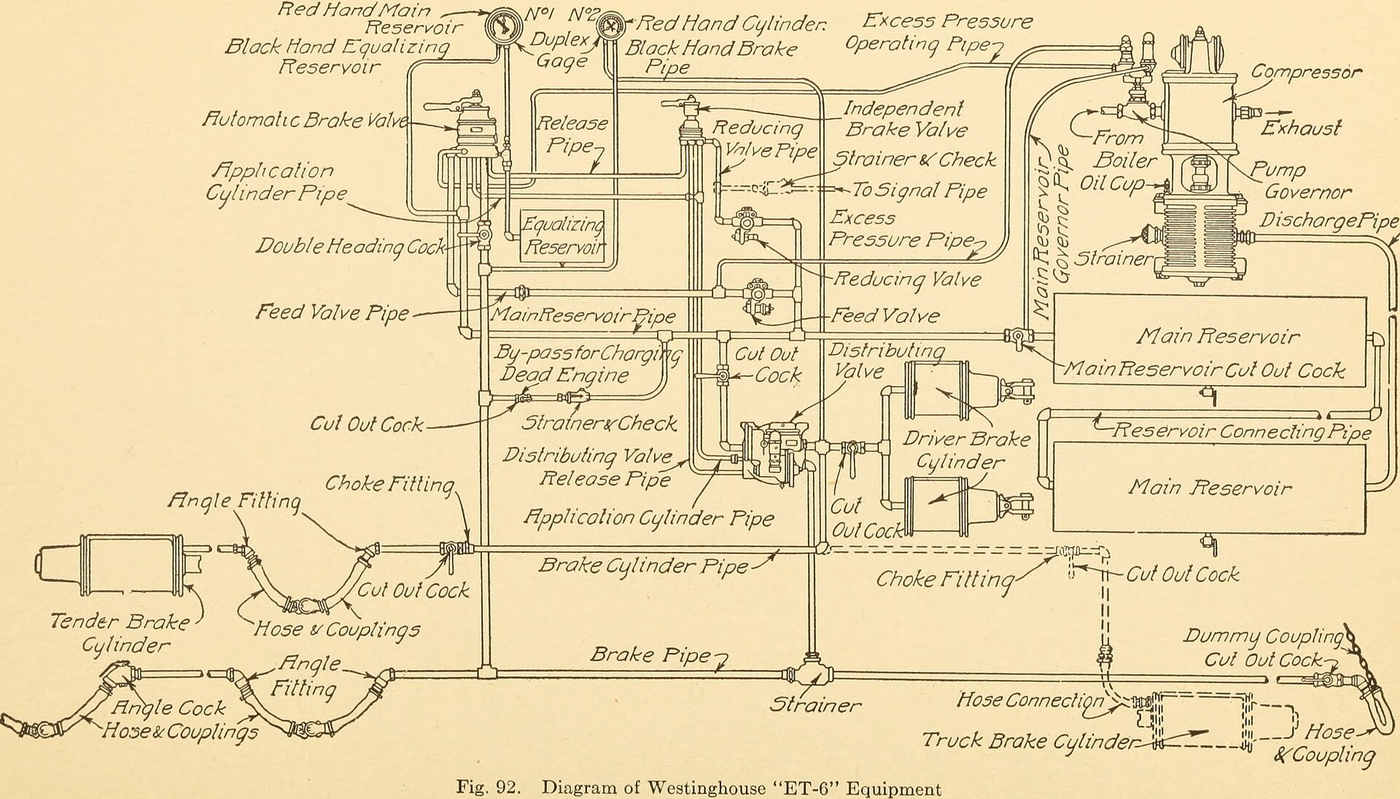


Westinghouse Air Brake
Before 1869 a train was stopped by men. The driver whistled, brakemen ran along the roofs of moving carriages turning handwheels one wagon at a time, and the train stopped whenever they finished. If a coupling broke, the runaway half had no brakes at all — nothing was connected to it any more.
Westinghouse's first patent puts compressed air down the train to apply the brakes. One driver, one valve, every wagon at once. It works, and it has the same fatal flaw: break the pipe and you lose the air, and with it the brakes.
The fix — which came a few years later and defines every train brake since — is to invert the logic. Keep the pipe pressurised to HOLD the brakes OFF, so that losing pressure applies them. A severed train brakes itself. This blueprint builds both versions, because you cannot appreciate the second without failing at the first.
Instruções
Treat compressed air as stored energy
Treat compressed air as stored energy
Keep test pressures low, use fittings rated well above what you run, and never stand in line with a plugged end. A failed joint throws its fitting hard.
Read US 88,929 and note what it does NOT do
Read US 88,929 and note what it does NOT do
Westinghouse's 1869 patent is a straight air brake: air is sent to apply. The fail-safe inversion is not in this patent — knowing that is the point of the exercise.
Build three wagons on a length of track
Build three wagons on a length of track
Make a locomotive and two wagons that roll freely and couple together. The demonstration needs a TRAIN — a single braked vehicle shows none of the interesting behaviour.
Materiais para este passo:
 Tábua de madeira de lei1 peça
Ferramentas necessárias:
 Serrote
Fit each wagon with a brake shoe on a lever
Fit each wagon with a brake shoe on a lever
Mount a shoe that presses a wheel when a lever is pushed. Spring it off so it releases cleanly when nothing acts on it.
Materiais para este passo:
 Conjunto de molas de compressão1 peça
Add a cylinder and piston to drive each lever
Add a cylinder and piston to drive each lever
Fit a small pneumatic cylinder per wagon, piston rod to brake lever. This is the brake cylinder, and it is the only part that touches the mechanism.
Materiais para este passo:
 Cilindro pneumático3 peças
Run a train pipe the whole length with flexible couplings
Run a train pipe the whole length with flexible couplings
Join wagon to wagon with hose and quick couplings so the pipe is continuous and can be parted deliberately.
Materiais para este passo:
 Tubo pneumático3 metros
Build the 1869 version: air applies the brake
Build the 1869 version: air applies the brake
Connect the train pipe straight to every brake cylinder. Open the driver's valve and all three wagons brake together. It works, and it is a real improvement on brakemen.
Now break the pipe with the brakes applied
Now break the pipe with the brakes applied
Pull a coupling apart mid-application. Every brake releases instantly. The detached wagons roll away completely free — this is the flaw, and you have just reproduced it.
Add a reservoir to each wagon
Add a reservoir to each wagon
Fit a small air tank per vehicle. Each wagon now carries its own energy supply and no longer depends on the pipe for the force to brake.
Fit a triple valve that watches the pipe
Fit a triple valve that watches the pipe
Install a valve on each wagon that senses train-pipe pressure and does three things: charge the reservoir, hold the brake off, or connect reservoir to cylinder when pipe pressure FALLS.
Charge the system and note the inversion
Charge the system and note the inversion
Pressurise the pipe. The reservoirs fill and the brakes stay off. Air now holds the brake OFF instead of putting it ON — the whole logic has flipped.
Brake by REDUCING pipe pressure
Brake by REDUCING pipe pressure
Vent a little from the driver's valve. Every triple valve sees the drop and admits its own reservoir air to its own cylinder. Less pressure, more braking.
Break the pipe again
Break the pipe again
Part a coupling. Pressure collapses, every triple valve fires, and the runaway half brakes itself hard. That is the entire safety argument, demonstrated on a bench.
Time the propagation from front to back
Time the propagation from front to back
Watch how long the rearmost wagon takes to respond. The signal travels at the speed the pressure wave moves down the pipe — this lag is why long freight trains take so far to stop.
Compendium — losing pressure must mean stopping
Compendium — losing pressure must mean stopping
The patent. US 88,929, "Improvement in Steam-Power-Brake Devices", granted 13 April 1869 to George Westinghouse, Jr. of Schenectady, New York. He was twenty-two. The system it describes is the straight air brake: a compressor on the locomotive, a pipe running the length of the train, and air sent along it to apply the brakes on every vehicle simultaneously. Compared with brakemen running along carriage roofs turning handwheels, it was transformative — and it still had the defect that any leak, burst hose or parted coupling released every brake at once.
The inversion is the real invention. Westinghouse's automatic air brake, developed in the early 1870s, reverses the sense of the signal. The train pipe is kept charged, and that pressure is what holds the brakes OFF while also keeping a reservoir on each vehicle topped up. To brake, the driver REDUCES pipe pressure; each wagon's triple valve detects the drop and connects its local reservoir to its local brake cylinder. A break in the pipe therefore causes a full emergency application on every vehicle, including any that have separated. This is fail-safe design in its clearest form: the failure mode of the control system is made identical to the safe command.
The triple valve is where the intelligence lives. It is a purely pneumatic device that compares train-pipe pressure against reservoir pressure and selects one of three states — charge, hold, or apply. No electricity, no wires, no central computer; each vehicle decides for itself using a signal that is broadcast by absence. Distributed control implemented in valve geometry, and it has been running the world's railways for a century and a half.
Why it had to be made compulsory. Railroads resisted the cost. In the United States the Railroad Safety Appliance Act of 1893 mandated air brakes and automatic couplers, and casualty rates fell sharply thereafter. The physics has one stubborn consequence you measured in step 14: because the command propagates as a pressure wave down the pipe, rear vehicles apply later than front ones. Long freight trains therefore brake progressively rather than instantly, which is why modern systems add electronically controlled pneumatic braking to signal every wagon at once — an improvement to the messenger, not to Westinghouse's logic.
Materiais
4- 1 peçaReferência
- Referência
- 3 peçasReferência
- 3 metrosReferência
Blueprints relacionados
Estes blueprints compartilham conhecimento — técnicas, materiais ou princípios

CC0 Domínio Público
Este blueprint é liberado sob CC0. Você é livre para copiar, modificar, distribuir e usar este trabalho para qualquer finalidade, sem pedir permissão.
Apoie o Maker comprando produtos através do Blueprint, onde ele ganha uma Comissão Maker definida pelos vendedores, ou crie uma nova versão deste Blueprint e inclua-o como conexão no seu próprio Blueprint para compartilhar receita.