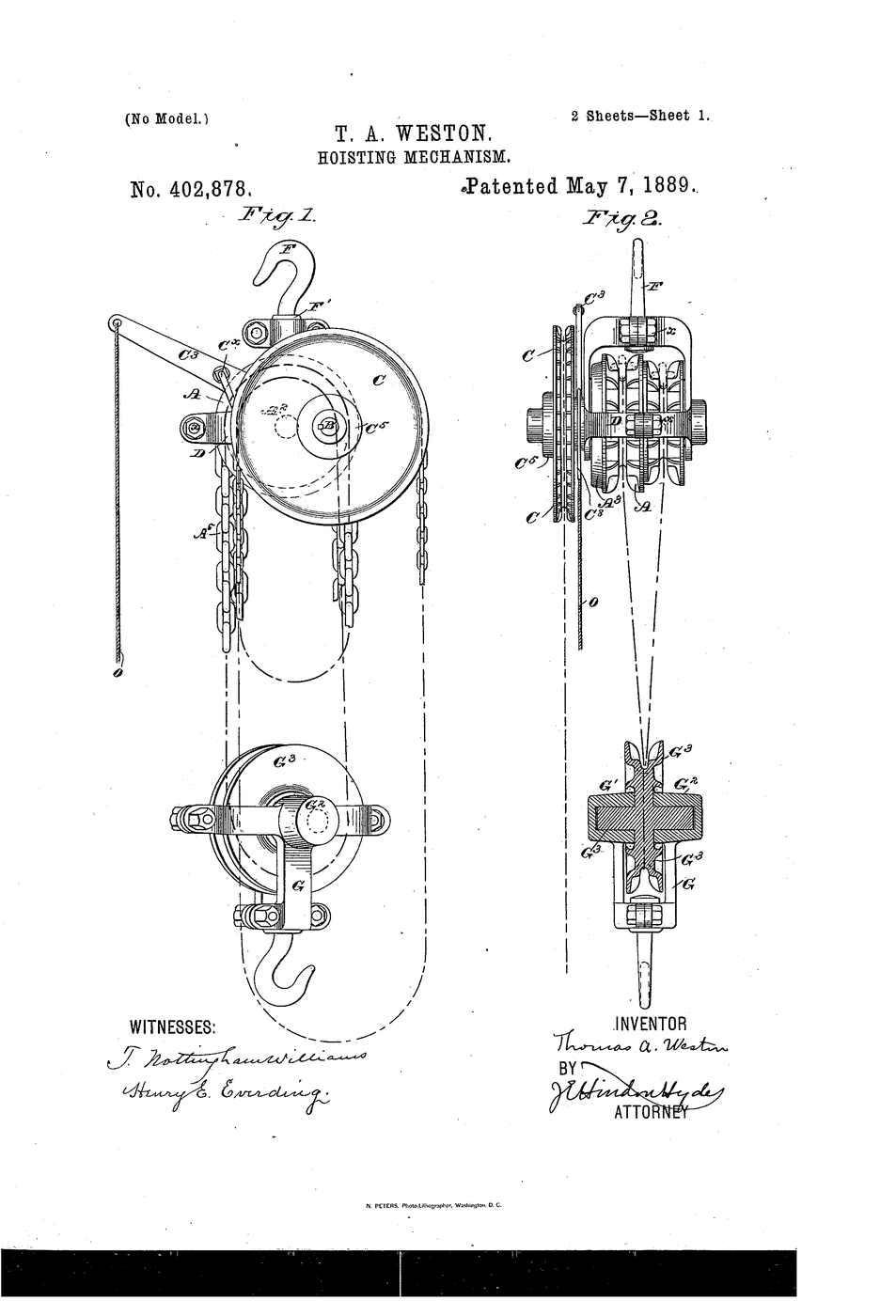


Weston Differential Pulley
To lift an engine block by hand you want a big mechanical advantage — but every ordinary block-and-tackle has a catch: the more rope you pull, the more it wants to run backwards the instant you let go. You need a second hand, or a ratchet, just to hold the load.
Weston's chain block does both jobs with one trick: two sheaves of almost the same size, fixed together. An endless chain runs down from the larger sheave to the load and back up to the smaller one. Each pull winds chain onto the big sheave and off the small one, so the load rises by only the tiny difference between them — which makes the mechanical advantage enormous.
And it holds itself. Because the two diameters are so close, friction in the chain pockets is enough to stop the load running back. Let go at any point and it simply stays put.
US Patent 402,878, "Hoisting Mechanism", granted 7 May 1889 to Thomas A. Weston.
Instruções
Read the claim and note the two diameters
Read the claim and note the two diameters
Weston's "hoisting mechanism" turns on two sheaves of slightly different size fixed on one axle. The whole effect lives in the small difference between them.
Lift a weight with a single fixed pulley
Lift a weight with a single fixed pulley
Hang a known weight over one fixed pulley and read the pull on the force meter. It equals the load: mechanical advantage of 1. Baseline.
Materiais para este passo:
 Conjunto de roldanas1 conjunto
Ferramentas necessárias:
 Dinamómetro (balança de mola)
Fix two different-sized pulleys together
Fix two different-sized pulleys together
Key a larger and a slightly smaller pulley onto the same shaft so they must turn together. This pair is the upper block.
Materiais para este passo:
 Conjunto de roldanas1 conjunto
 Vareta de madeira (cavilha)1 peça
Run one endless loop through a moving lower pulley
Run one endless loop through a moving lower pulley
Take an endless cord: down from the big sheave, under a single lower pulley that carries the load, back up to the small sheave. One continuous loop.
Materiais para este passo:
 Paracord2 metros
Hang the load and measure the pull to lift it
Hang the load and measure the pull to lift it
Hang the same known weight on the lower pulley and read the force needed to raise it. Compare with step 2 — it is a small fraction.
Measure how far you pull versus how far it rises
Measure how far you pull versus how far it rises
Pull a measured length of cord and measure how far the load rises. You pull far, it rises little — the price of the advantage.
Ferramentas necessárias:
 Paquímetro
Compute the ideal mechanical advantage
Compute the ideal mechanical advantage
Measure both sheave diameters D and d. Ideal advantage is 2D / (D − d). Because D − d is small, the number is large. Compare with your measured force ratio.
Let go of the cord at half height
Let go of the cord at half height
Stop pulling mid-lift and release. The load stays where it is — it does not run back. No ratchet, no brake, no second hand.
Swap in a bigger diameter difference
Swap in a bigger diameter difference
Replace the small sheave with one closer in size to a plain pair — a larger D − d. The pull needed rises sharply. The advantage really is set by the difference.
Try to make it back-drive
Try to make it back-drive
Hang extra weight and see if the load can pull the chain backward on its own. With sheaves close in size it refuses to back-drive — the friction ceiling is above the load. Note where it finally slips.
Feel where the effort goes
Feel where the effort goes
Compared to an ideal machine, some of your pull is eaten by friction. That lost effort is exactly what makes it self-locking — the flaw and the feature are the same thing.
Estimate the efficiency
Estimate the efficiency
Divide the ideal advantage (step 7) by your measured advantage (step 5). A self-locking block is deliberately under 50 % efficient — that is the trade for hands-free holding.
History & Context — the hoist that holds itself
History & Context — the hoist that holds itself
The patent. US 402,878, "Hoisting Mechanism", granted 7 May 1889 to Thomas A. Weston. Note the granted title says nothing about "differential pulley" — that is the name engineers gave the principle. Weston, an Englishman from King's Norton, first devised the differential chain block around 1854; this later US patent is one of his refinements, and the 1854 original is a British patent.
Why the small difference gives the big advantage. The two sheaves are locked together, so on one turn the chain is wound up onto the large sheave (gaining a length equal to its circumference) and simultaneously paid off the small one (losing the small circumference). The lower block, which carries the load, is fed by the difference of the two — so the load rises by only a sliver on each turn, and the ideal advantage works out to 2D/(D − d). Make D and d nearly equal and the advantage runs to twenty, thirty, more. Step 7 measures it; step 9 destroys it by widening the gap.
The self-locking is not a bonus — it is the reason to choose this design. A frictionless differential block would be reversible: hang enough load and it would spin backwards and drop it. Real chain running over real pockets has friction, and Weston's geometry is chosen so the friction is always enough to hold the load at rest. That deliberately caps the efficiency below 50 % — you never get out more than you put in, and you get a good deal less — but in exchange the hoist holds any load, at any height, with the operator's hands free (step 8). For a mechanic under a hanging engine, hands-free holding is worth more than efficiency.
Why a chain and pockets, not a rope. A smooth rope on smooth sheaves would slip, and slipping would defeat both the exact ratio and the self-locking. Weston used a chain running in pockets cast into the sheaves, so every link is positively engaged — no slip, exact ratio, dependable friction. Your cord model shows the principle; the real tool needs the chain to be trustworthy.
Where you still meet it. The Weston differential chain block hangs in workshops, garages and engine rooms to this day, unchanged in principle — a hand-powered hoist you can trust to hold a tonne while you walk away. It is one of the purest demonstrations in all of engineering that friction, usually the enemy, can be designed in on purpose.
Materiais
4- 1 conjuntoReferência
- 1 conjuntoReferência
- Referência
- 2 metrosReferência
Ferramentas necessárias
2- Referência
- Referência
Blueprints relacionados
Estes blueprints compartilham conhecimento — técnicas, materiais ou princípios



CC0 Domínio Público
Este blueprint é liberado sob CC0. Você é livre para copiar, modificar, distribuir e usar este trabalho para qualquer finalidade, sem pedir permissão.
Apoie o Maker comprando produtos através do Blueprint, onde ele ganha uma Comissão Maker definida pelos vendedores, ou crie uma nova versão deste Blueprint e inclua-o como conexão no seu próprio Blueprint para compartilhar receita.