Colaboração
ARTE
BELEZA E BEM-ESTAR
ARTESANATO
CULTURA E HISTÓRIA
ENTRETENIMENTO
MEIO AMBIENTE
COMIDA E BEBIDAS
ENGENHARIA REVERSA
CIÊNCIAS
ESPORTES
TECNOLOGIA
TECNOLOGIA VESTÍVEL
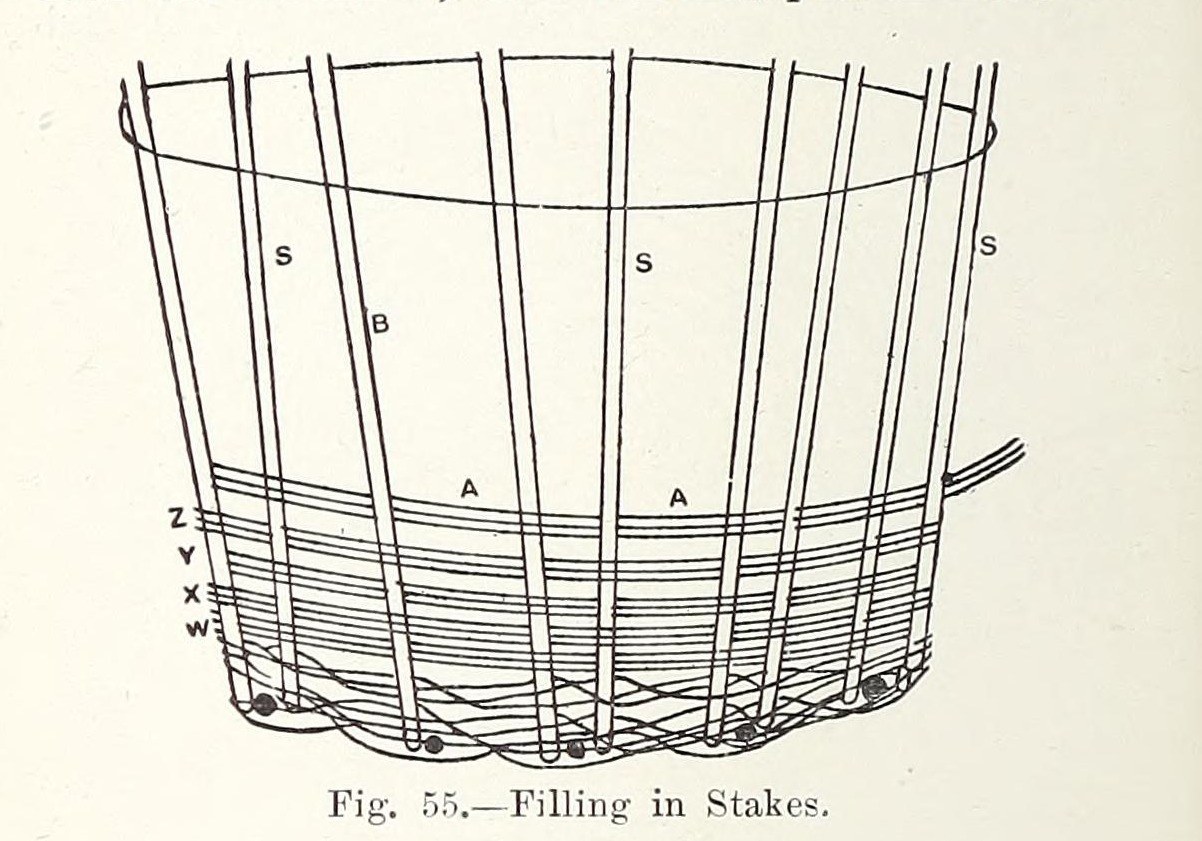


Wicker Harvesting Baskets: the Round Willow Cob (Hasluck, 1903)
The basket-maker's round 'cob': a crowned round bottom 8 in across, flaring sides slewed to 11 in across at 11 in deep, a laid border and a rope-wrapped bow handle across the top.
Variable: slewed (eight and a half pairs of stakes) or the better randed white cob (nine pairs).
Source: Paul N. Hasluck, Basket Work of All Kinds (1903), pp. 48-54. Picture: Fig. 55 of the book.
Intermediário
Unknown
Instruções
1
1
Lay the slarth
Lay the slarth
Cut four sticks about 11 in long and shave them along the middle so one pair crosses the other. Lay them under your feet (Fig. 52) and tie them with two rods, one of whose butts forms a half stick, so the bottom has four and a half sticks. Work the tie-rods round to open the sticks into nine parts (Figs. 53-54), keeping a crown in the bottom.
Materiais para este passo:
 Varas de vime mais grossas4 11 in
 Vime de salgueiro2 tie-rods
Ferramentas necessárias:
 Tesoura de podar de uma mão
 Tábua de madeira plana
 Água
2
2
Slew and pair the bottom
Slew and pair the bottom
Fill in by working two rods together (slewing), adding a rod now and then, until the bottom is 7 1/2 in across; then pair off with two pointed rods to 8 in. Push the ends in, pick the bottom and cut the sticks off with the shears.
Materiais para este passo:
Vime de salgueiro1 slewing, pairingFerramentas necessárias:
Tesoura de podar de uma mão Tesourão
3
3
Stake and upset
Stake and upset
Push in eight and a half pairs of stakes, one each side of eight sticks and one by the ninth. Prick them up and gather them in a hoop several times larger than the bottom, since the cob needs a 3 in spring at the border. Drive them level with the iron. Upset with the tops of four rods (7 to 9 in of tip cut off), each in front of three stakes and behind the fourth; after one round drop to three rods, each in front of two and behind the third, and piece the butts.
Materiais para este passo:
 Estacas de salgueiro17 8 1/2 pairsVime de salgueiro7 upsetting
Ferramentas necessárias:
Tesoura de podar de uma mão Martelo
 Passador de fitas
4
4
Slew the sides
Slew the sides
Pin the bottom to the board with the small bodkin or weight it, and fill in the stakes with a three-rod slew (Fig. 55), adding a butt inside as each top finishes outside. Let the sides spring gradually to 11 in across at 11 in deep; a round of white rods halfway up brightens it. Level with a two- or one-rod slew and pair off with two rods.
Materiais para este passo:
Vime de salgueiro1 slewingFerramentas necessárias:
Passador de fitasMartelo5
5
Border and bow handle
Border and bow handle
Push two pointed sticks down the slewing at opposite sides to keep the handle place. Lay down five stakes and border as for a square basket (Fig. 56), finishing by cramming. Wet the two sticks with the sponge and pull them out; point, bend and push in a stick for the bow handle and wrap it with twisted rods as for the square basket.
Materiais para este passo:
Varas de vime mais grossas1 bowVime de salgueiro4 handle wrapFerramentas necessárias:
 EsponjaTesoura de podar de uma mãoVaras de vime mais grossas
Materiais
3- Referência
- 4 handle wrapReferência
- 17 8 1/2 pairsReferência
Materiais de Blueprints conectados

Este projeto faz

CC0 Domínio Público
Este blueprint é liberado sob CC0. Você é livre para copiar, modificar, distribuir e usar este trabalho para qualquer finalidade, sem pedir permissão.
Apoie o Maker comprando produtos através do Blueprint, onde ele ganha uma Comissão Maker definida pelos vendedores, ou crie uma nova versão deste Blueprint e inclua-o como conexão no seu próprio Blueprint para compartilhar receita.