Colaboração
ARTE
BELEZA E BEM-ESTAR
ARTESANATO
CULTURA E HISTÓRIA
ENTRETENIMENTO
MEIO AMBIENTE
COMIDA E BEBIDAS
ENGENHARIA REVERSA
CIÊNCIAS
ESPORTES
TECNOLOGIA
TECNOLOGIA VESTÍVEL
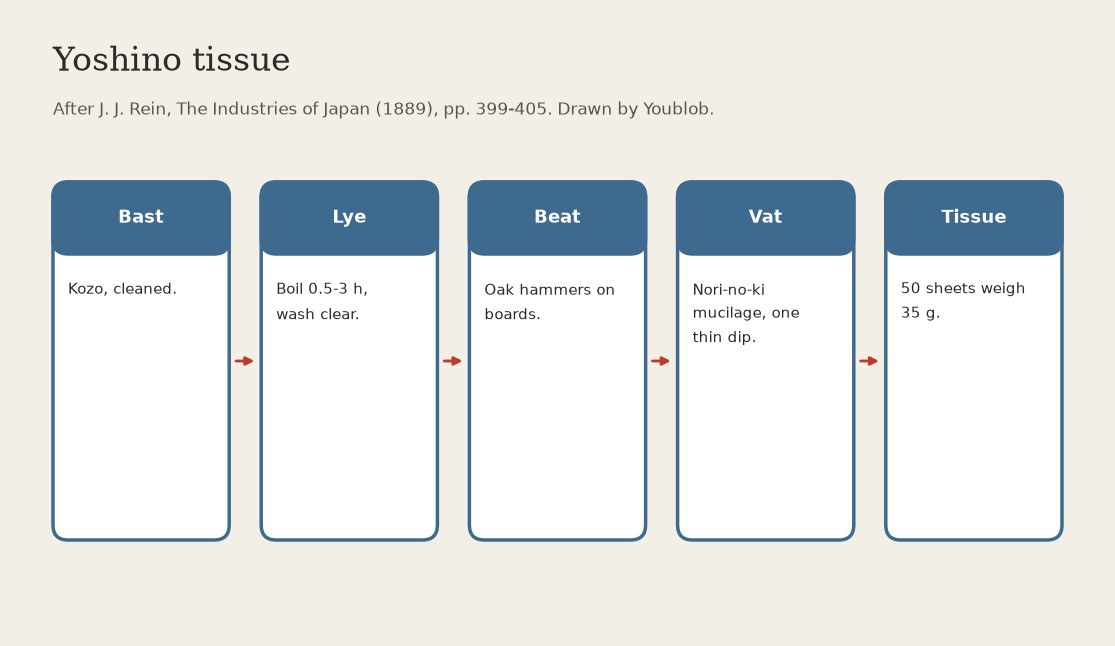


Yoshino Tissue: Kozo Paper So Thin Fifty Sheets Weigh 35 Grams (Nibu, after Rein 1889)
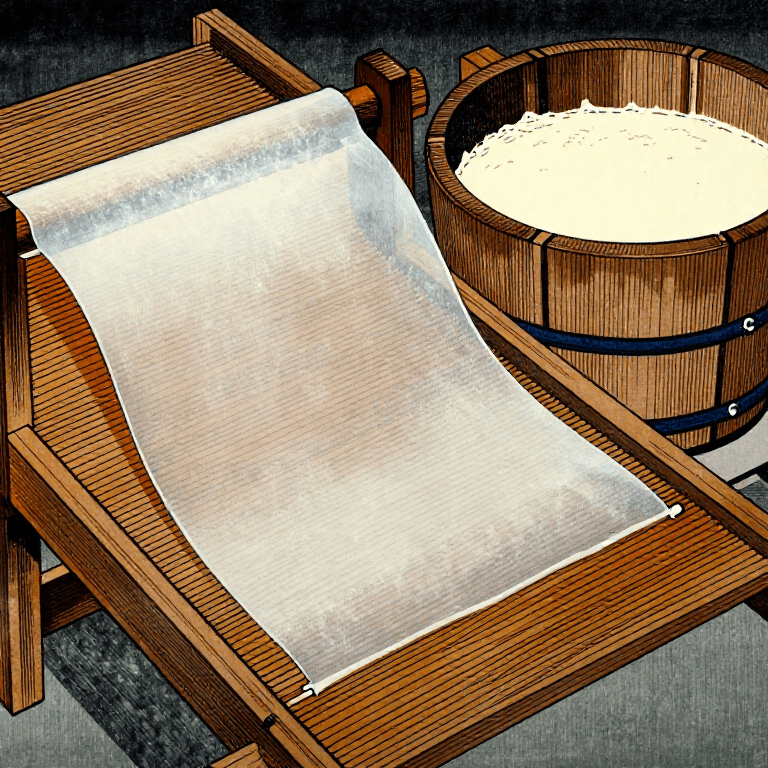
Yoshino-gami from Nibu in Yamato was the finest tissue of Japan: so thin that fifty sheets weigh 35 g, yet so strong that lacquer makers wrung thick lacquer through two or three layers and used them again. Light, tough tissue like this is what covers model wings.
Result: kozo tissue, sheets 48 x 25.5 cm, 50 sheets 35 g (about 5.7 g per square metre).
Source: J. J. Rein, The Industries of Japan (1889), pp. 399-405. Not given: amounts per vat, lye strength, beating time. Picture drawn by Youblob.
Avançado
3 days
Instruções
1
1
Clean the bast
Clean the bast
Take kozo bast freed of the dark outer skin and green parts, and cut out knot-holes and faulty spots.
Materiais para este passo:
 Casca de kozo1 as required
2
2
Boil in ash lye
Boil in ash lye
Boil the bast in an iron kettle with lye made from ashes, half an hour to three hours, until it is soft and crushes between the fingers.
Ferramentas necessárias:
 Barrela de cinza de madeira
 Chaleira de ferro
3
3
Wash clear
Wash clear
Wash the soft bast in a tub of fresh water, changing it four or five times until the water stays clear.
Materiais para este passo:
 Água1 as required
Ferramentas necessárias:
 Tina de madeira
4
4
Beat to pulp
Beat to pulp
Lay the wet bast on a thick hardwood board and beat it with oak hammers of 1 to 2 lb, stirring and mixing in water often, until it is an even fibrous pulp. If the fibres are not yet apart, boil it again in plain water.
Ferramentas necessárias:
 Tábua de madeira plana
 Maço de madeiraChaleira de ferro
5
5
Charge the vat
Charge the vat
Put the pulp in the vat with water. Press out Nori-no-ki (Hydrangea paniculata) bark in water and add the slippery mucilage; it keeps the fibres floating apart. Ours: press the bark out in a linen bag.
Materiais para este passo:
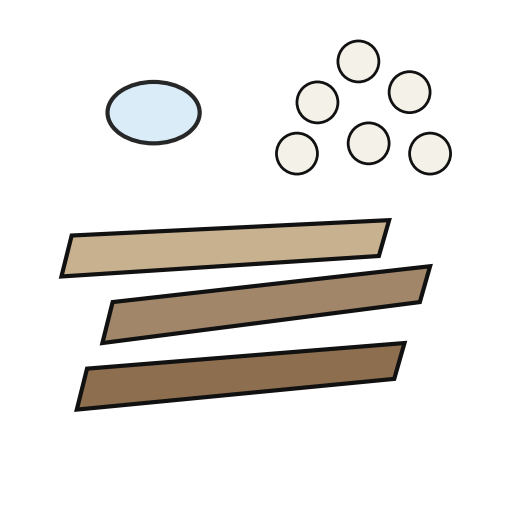 Casca de nori-no-ki (Hydrangea paniculata)1 as requiredÁgua1 as required
Ferramentas necessárias:
 Cuba
 Saco de linho
6
6
Scoop one thin layer
Scoop one thin layer
Dip a mould of fine bamboo sticks bound with silk thread and let the stuff flow toward you, so the fibres lie parallel. Fill it once only: a second, crossed filling makes a thicker paper.
Ferramentas necessárias:
 SugetaCuba
7
7
Pile and dry on boards
Pile and dry on boards
Pile the wet sheets on a mat with bamboo splints between them. When dry enough, brush each onto a smooth board and stand it slantwise in the sun; the dry sheet comes off by itself.
Ferramentas necessárias:
 Esteira de bambu
 Trincha largaTábua de madeira plana
8
8
Check the tissue
Check the tissue
Sheets 48 x 25.5 cm; fifty of them should weigh about 35 g. The tissue is yellowish, silky and strong enough to be wrung without tearing.
Materiais
3- 1 as requiredReferência
- 2 as requiredReferência
- 1 as requiredReferência
Ferramentas necessárias
10- Referência
- Referência
- Referência
- Referência
- Referência
- Referência
- Referência
- Referência
- Referência
- Referência
Este projeto faz
Blueprints relacionados
Estes blueprints compartilham conhecimento — técnicas, materiais ou princípios

CC0 Domínio Público
Este blueprint é liberado sob CC0. Você é livre para copiar, modificar, distribuir e usar este trabalho para qualquer finalidade, sem pedir permissão.
Apoie o Maker comprando produtos através do Blueprint, onde ele ganha uma Comissão Maker definida pelos vendedores, ou crie uma nova versão deste Blueprint e inclua-o como conexão no seu próprio Blueprint para compartilhar receita.