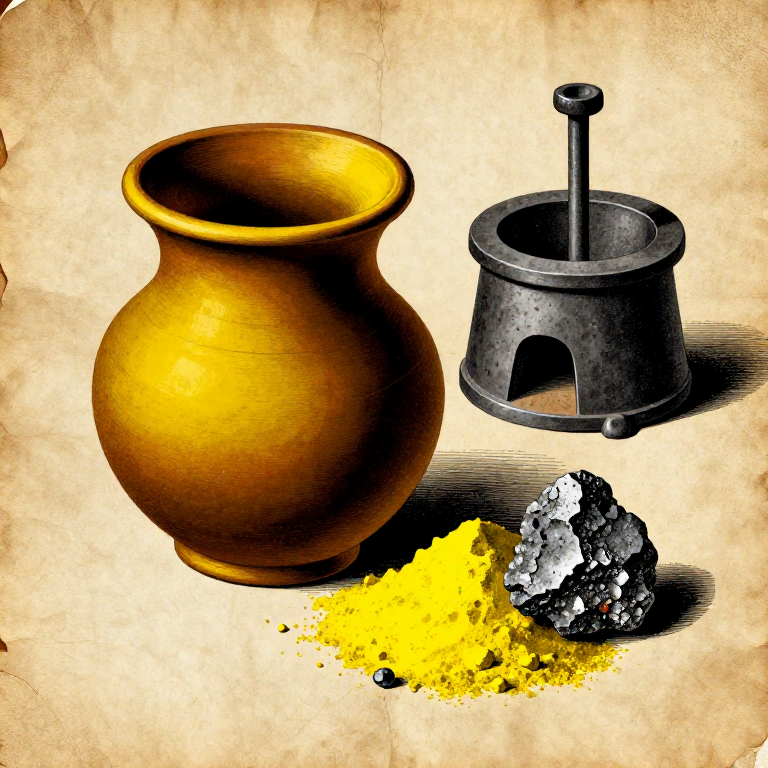


Making Naples Yellow (Lead Antimonate) — The Oldest Known Synthetic Yellow Pigment
Naples yellow (lead antimonate, Pb₂Sb₂O₇, a pyrochlore-type crystal structure) is arguably the oldest synthetic yellow pigment in human history — it has been identified in Babylonian glazed tiles dating to approximately 1500 BC, and appears in Egyptian and Assyrian glass and ceramics. In European painting it became widely used from the 15th century onward, known in Italian as 'giallolino' or 'giallorino', and it remained a staple palette colour through the 18th century. The pigment is a warm, soft, opaque yellow — ranging from a pale lemon to a deep, warm yellow-orange depending on the exact composition and firing temperature.
Naples yellow is produced by calcining a mixture of lead oxide (litharge, PbO) and antimony trioxide (Sb₂O₃) at high temperature (900-1000°C). The antimony trioxide is traditionally obtained by roasting stibnite ore (antimony sulfide, Sb₂S₃) in air. The resulting lead antimonate has excellent opacity, good tinting strength, and superb stability in lime-based media — it is one of the few yellow pigments that can be safely used in true fresco.
SAFETY WARNING: This synthesis involves TWO toxic heavy metals — lead (a cumulative neurotoxin) and antimony (causes respiratory and gastrointestinal toxicity). Roasting stibnite releases sulfur dioxide gas (toxic, corrosive to lungs). The kiln firing operates at 900-1000°C. FULL protective equipment is mandatory: P100 respirator with acid gas cartridges, chemical splash goggles, chemical-resistant gloves, and leather gauntlet gloves for kiln work. All steps involving stibnite roasting MUST be done outdoors or under a fume hood. The finished pigment is toxic and must be handled with gloves at all times.
Hazardous content
This blueprint contains hazardous procedures. Log in and enable hazardous content in your account settings to view the step-by-step instructions.
Related Blueprints
These blueprints share knowledge with this one — techniques, materials, or principles that connect them in the learning graph.
Related blueprints
Other builds that share materials, tools, or techniques with this one.
CC0 Public Domain
This blueprint is released under CC0. You are free to copy, modify, distribute, and use this work for any purpose, without asking permission.
Support the Maker by purchasing products through their Blueprint where they earn a Maker Commission set by Vendors, or create a new iteration of this Blueprint and include it as a connection in your own Blueprint to share revenue.