

Perkin's Mauveine — The First Synthetic Aniline Dye from Coal Tar
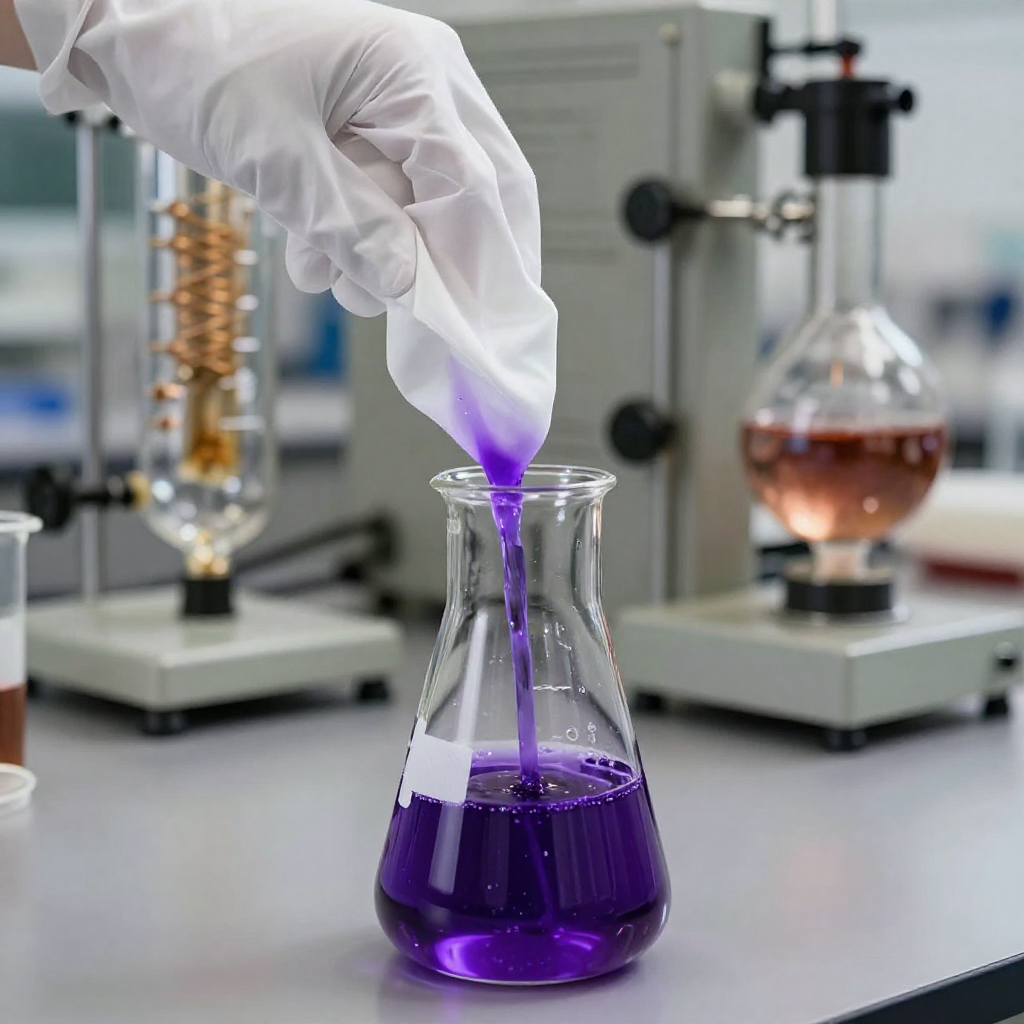
In 1856, eighteen-year-old William Henry Perkin, a chemistry student at the Royal College of Chemistry in London, accidentally synthesized the first synthetic dye while attempting to make quinine from coal tar derivatives. His experiment failed to produce quinine, but the reddish-brown residue in his flask dissolved in alcohol to produce a vivid purple solution that dyed silk beautifully and resisted washing and sunlight. He called it 'mauveine' — the color mauve.
Perkin immediately recognized the commercial potential. Natural purple dyes were among the most expensive in the world: Tyrian purple from murex shells cost more than gold by weight, and orchil lichen dye faded rapidly. Perkin's mauveine was cheap, consistent, and permanent. At age nineteen, he patented the process, built a factory in Greenford, and began mass-producing synthetic dye. By 1859, mauveine was fashionable across Europe — Queen Victoria wore a mauveine-dyed silk gown to her daughter's wedding in 1858.
Perkin's discovery launched the synthetic dye industry and, with it, the entire field of organic chemistry. Within twenty years, German chemists had synthesized dozens of new colors — fuchsine, alizarin, methyl violet, Congo red, indigo — each cheaper and more permanent than its natural counterpart. The natural dye trade collapsed. India's indigo plantations, Turkey's madder fields, and Mexico's cochineal farms lost their markets to factories in Germany and England. By 1900, over 90% of the world's dyes were synthetic, all descended from Perkin's accidental purple.
Instructions
Understand the starting material: coal tar
Understand the starting material: coal tar
Coal tar is a thick, dark liquid produced as a byproduct when coal is heated in the absence of air to make coke (for iron smelting) or coal gas (for gas lighting). In the 1850s, coal tar was an abundant industrial waste product with few uses. It contains hundreds of organic compounds including benzene, toluene, naphthalene, and aniline — the precursor to Perkin's dye. The entire synthetic dye industry was built on transforming this industrial waste into valuable color.
Materials for this step:
 Coal Tar100 ml
Distill aniline from coal tar
Distill aniline from coal tar
Heat coal tar in a distillation apparatus and collect the fraction boiling between 180°C and 186°C — this is crude aniline (aminobenzene, C₆H₅NH₂). Aniline is a pale, oily liquid with a faint fishy odor that darkens on exposure to air. Perkin obtained his aniline by reducing nitrobenzene with iron filings and acetic acid. Aniline is toxic and must be handled with gloves in a ventilated space.
Tools needed:
 Glass Distillation Flask
Add potassium dichromate as the oxidizing agent
Add potassium dichromate as the oxidizing agent
Dissolve potassium dichromate (K₂Cr₂O₇) in dilute sulfuric acid. Potassium dichromate is a powerful oxidizer — it provides the oxygen atoms that transform aniline into the complex ring structure of mauveine. Perkin used roughly equal weights of aniline sulfate and potassium dichromate. The dichromate solution is bright orange; it will turn dark as the reaction proceeds.
Materials for this step:
 Potassium Dichromate50 g
Mix the reagents and allow the reaction
Mix the reagents and allow the reaction
Combine the aniline sulfate solution with the acidified potassium dichromate in a glass flask. A dark, dirty-looking precipitate forms immediately — this is a complex mixture of oxidation products. Perkin's original reaction produced a reddish-brown sludge that looked like a failed experiment. Most chemists would have discarded it. Perkin's genius was in testing what this sludge could do.
Extract the dye with alcohol
Extract the dye with alcohol
Filter the dark precipitate and wash it with water to remove salts and acid. Then add methylated spirits (ethanol) to the filtered residue. The alcohol dissolves the mauveine component, producing a vivid purple solution. The intensity of the color is striking — even a small amount of mauveine produces a deeply saturated purple that is immediately recognizable as something extraordinary.
Test the dye on silk fabric
Test the dye on silk fabric
Dip a small piece of white silk into the purple alcohol solution. The silk absorbs the color immediately, turning a brilliant mauve-purple. This is the moment that changed chemistry: Perkin tested the dyed silk by washing it vigorously with soap and water, then exposing it to sunlight for days. The color held firm — it was both wash-fast and light-fast, superior to most natural purple dyes available at the time.
Mordant cotton for improved uptake
Mordant cotton for improved uptake
Unlike silk, cotton does not readily absorb mauveine directly. To dye cotton, first treat it with a tannin solution (tannic acid from oak galls), then immerse it in a solution of a metallic salt — tin chloride or alum works. This mordanting step creates chemical bonding sites on the cotton fiber that grip the dye molecules. Perkin's early commercial success was with silk; cotton dyeing required additional processing that later chemists refined.
Materials for this step:
 Alum (Potassium Alum)25 g
Scale up the reaction for production
Scale up the reaction for production
Perkin's factory process scaled the bench reaction to industrial volumes: hundreds of kilograms of aniline and dichromate reacted in large cast-iron vessels. The crude precipitate was extracted with alcohol in vats, the alcohol evaporated to recover the dye as a dry powder, and the powder packaged for sale to dye houses. By 1857, Perkin's Greenford factory was producing mauveine commercially — he was nineteen years old.
Understand the chemistry of mauveine
Understand the chemistry of mauveine
Mauveine is not a single compound but a mixture of closely related molecules — primarily mauveine A (C₂₆H₂₃N₄⁺) and mauveine B (C₂₇H₂₅N₄⁺). These are aromatic amines with extended conjugated ring systems that absorb yellow-green light and transmit purple. The conjugated double bonds act as a chromophore — the molecular feature responsible for color. This relationship between molecular structure and color became the foundation of dye chemistry.
Compare mauveine to natural purple dyes
Compare mauveine to natural purple dyes
Tyrian purple from murex sea snails required 12,000 snails to produce 1.4 grams of dye — it was literally worth more than gold. Orchil lichen dye produced a similar purple but faded rapidly in sunlight. Mauveine could be produced in unlimited quantities from cheap coal tar waste, was permanent, and was consistent batch to batch. Within a decade, synthetic purple rendered murex harvesting and lichen gathering economically pointless.
Trace the explosion of synthetic colors
Trace the explosion of synthetic colors
Perkin's success triggered a gold rush in synthetic dye chemistry. In 1858, François-Emmanuel Verguin synthesized fuchsine (magenta) from aniline. In 1868, Carl Graebe and Carl Liebermann synthesized alizarin (the red pigment of madder root), destroying Turkey's madder export trade. In 1880, Adolf von Baeyer synthesized indigo — threatening India's indigo plantations. By 1900, BASF, Bayer, and Hoechst dominated a global synthetic dye industry worth hundreds of millions.
Recognize the safety hazards
Recognize the safety hazards
Aniline is toxic by inhalation, skin contact, and ingestion — it causes methemoglobinemia (prevents blood from carrying oxygen). Potassium dichromate is a known carcinogen and strong oxidizer. Coal tar contains polycyclic aromatic hydrocarbons, many of which are carcinogenic. Early dye workers suffered 'aniline disease' — cyanosis, liver damage, and bladder cancer. This blueprint is for understanding the historical process; do not attempt the synthesis without proper laboratory equipment and training.
Understand mauveine's legacy beyond textiles
Understand mauveine's legacy beyond textiles
The synthetic dye industry created modern organic chemistry, the pharmaceutical industry, and the chemical industry as a whole. Paul Ehrlich used synthetic dyes to stain bacteria, leading to the germ theory of disease and eventually to the first antibiotics (Salvarsan, 1910). The German dye companies — BASF, Bayer, Hoechst — evolved into the world's largest chemical and pharmaceutical firms. Aspirin, fertilizers, explosives, plastics, and synthetic fibers all trace their industrial origins to the coal tar dye labs that Perkin's purple launched in 1856.
Materials
3- Placeholder
- Placeholder
Tools Required
1- Placeholder
Connected Blueprint Materials
Related Blueprints
These blueprints share knowledge with this one — techniques, materials, or principles that connect them in the learning graph.
Related blueprints
Other builds that share materials, tools, or techniques with this one.
CC0 Public Domain
This blueprint is released under CC0. You are free to copy, modify, distribute, and use this work for any purpose, without asking permission.
Support the Maker by purchasing products through their Blueprint where they earn a Maker Commission set by Vendors, or create a new iteration of this Blueprint and include it as a connection in your own Blueprint to share revenue.