

Polyester (PET) — The Fiber That Clothed the World
On March 22, 1941, John Rex Whinfield and James Tennant Dickson, working at the Calico Printers' Association laboratory in Accrington, Lancashire, synthesized polyethylene terephthalate (PET) — the polyester fiber that would become the most produced textile fiber in human history. By 2024, polyester accounts for over 54% of all fiber production worldwide: roughly 60 million tonnes per year, more than cotton, wool, silk, and all other fibers combined.
PET is made from two petrochemical monomers: terephthalic acid (or its ester, dimethyl terephthalate) and ethylene glycol. These react via condensation polymerization to form long chains linked by ester bonds (-COO-), hence 'polyester.' The resulting polymer is melt-spun into fibers, just like nylon — but polyester has properties nylon lacks. It resists stretching (high modulus), holds its shape through washing (dimensional stability), resists wrinkling (elastic recovery), and dries quickly (low moisture absorption at only 0.4%).
Whinfield and Dickson's work built directly on Wallace Carothers' polymer research at DuPont. Carothers had actually synthesized polyesters in the early 1930s but abandoned them as inferior to polyamides (nylon) because his polyesters had low melting points. Whinfield realized that using an aromatic acid (terephthalic acid, with its rigid benzene ring) instead of Carothers' aliphatic acids would raise the melting point above 250°C — high enough for textile use. DuPont licensed the patents and commercialized the fiber as Dacron in 1953; ICI launched it as Terylene in Britain. The wash-and-wear revolution of the 1960s and the global fast-fashion industry both depend on Whinfield's insight.
Instructions
Understand the two monomers
Understand the two monomers
PET polyester is built from two monomers. Terephthalic acid (TPA, C₈H₆O₄) is a benzene ring with a carboxylic acid group (-COOH) on opposite sides — a rigid, symmetrical molecule. Ethylene glycol (EG, HOCH₂CH₂OH) is a short, flexible chain with a hydroxyl group (-OH) at each end — the same antifreeze compound used in car radiators. When a carboxylic acid reacts with a hydroxyl, they form an ester bond (-COO-) and release water. This is condensation polymerization — the same principle as nylon, but with ester bonds instead of amide bonds.
React the monomers to form a prepolymer
React the monomers to form a prepolymer
Combine terephthalic acid and ethylene glycol in a reactor at 240–260°C under moderate pressure. The acid and glycol react to form bis(2-hydroxyethyl) terephthalate (BHET) — a short-chain ester — and water. Industrially, the alternative route uses dimethyl terephthalate (DMT) instead of TPA, reacting it with ethylene glycol in a transesterification catalyzed by antimony trioxide or titanium compounds. The prepolymer stage produces chains of only 2–5 repeat units — far too short for fiber formation.
Materials for this step:
 Ethylene Glycol200 ml
Tools needed:
 Glass Distillation Flask
Polycondense under vacuum to build chain length
Polycondense under vacuum to build chain length
Transfer the prepolymer to a large reactor and heat to 270–285°C under high vacuum (less than 1 millibar). The vacuum removes water and excess ethylene glycol, driving the condensation equilibrium toward longer chains (Le Chatelier's principle — the same strategy used in nylon production). Over 2–4 hours, the melt becomes increasingly viscous as chain lengths grow to 80–120 repeat units. The intrinsic viscosity — a measure of chain length — must reach 0.62–0.65 dL/g for standard textile fiber.
Extrude and chip the polymer
Extrude and chip the polymer
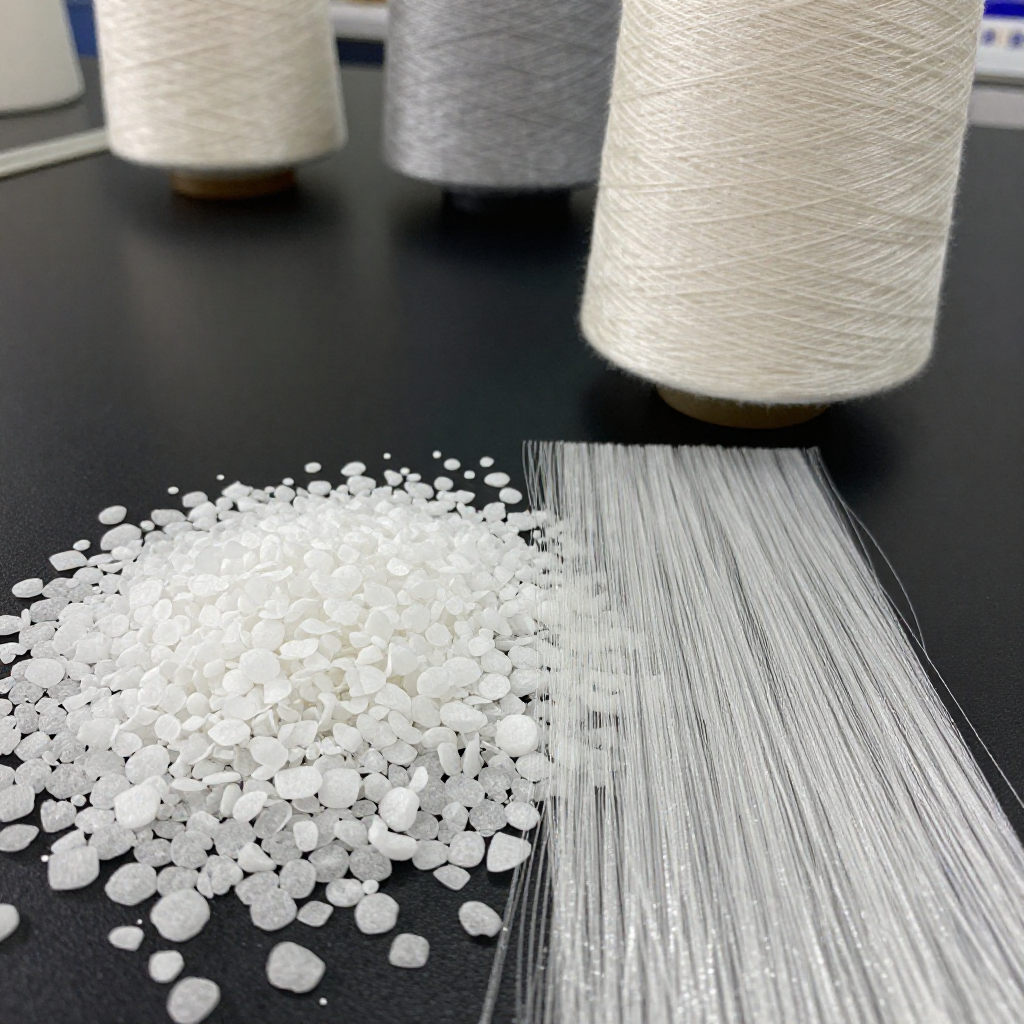
The finished PET melt is a clear, viscous liquid at 280°C. Force it through a die plate as thick strands, cool them in a water bath, and chop them into chips approximately 3 mm in diameter — identical in concept to nylon chips. PET chips are white, semi-translucent pellets. They can be dried, stored, and shipped to spinning plants worldwide. Global PET chip production exceeds 80 million tonnes per year (including both fiber and bottle-grade PET).
Dry the chips to remove moisture
Dry the chips to remove moisture
Before melt spinning, PET chips must be dried to below 30 parts per million moisture. PET is hygroscopic — it absorbs atmospheric moisture — and even trace water at spinning temperatures (280°C) causes hydrolysis, breaking polymer chains and reducing fiber strength. Dry the chips in a dehumidified hot-air dryer at 160–175°C for 4–6 hours. This drying step has no equivalent in nylon spinning because nylon is less sensitive to hydrolysis at its lower spinning temperature.
Melt-spin the polymer through a spinneret
Melt-spin the polymer through a spinneret
Melt the dried PET chips at 280–290°C in an extruder and pump the molten polymer through a spinneret — a metal plate with dozens to thousands of precision-drilled holes, each 0.2–0.4 mm in diameter. The molten polymer emerges as thin streams that solidify in a cross-flow of cool air within centimeters of the spinneret face. This is the same melt-spinning process used for nylon, but at higher temperature because PET's melting point (260°C) is higher than nylon 6,6's (255°C).
Cool, lubricate, and wind the filaments
Cool, lubricate, and wind the filaments
A quench air system solidifies the filaments uniformly. The solidified filaments are gathered into a yarn bundle, a spin finish (lubricant) is applied to reduce friction and static, and the bundle is wound onto a bobbin at high speed — 3,000 to 6,000 meters per minute for partially oriented yarn (POY). At this stage the filaments are partially oriented but not fully drawn — they are extensible and have lower tenacity than the finished product.
Draw the filaments to orient the molecules
Draw the filaments to orient the molecules
Pass the partially oriented filaments over heated rollers or through a hot zone while stretching them to 3–5 times their original length. This drawing aligns the PET chains parallel to the fiber axis and increases crystallinity — the ordered packing of chains into tight, regular arrangements. Polyester's crystalline regions are what give it wrinkle resistance: the rigid, closely packed chains spring back to their original positions after deformation. The drawn fiber has a tenacity of 4–7 grams per denier and an elongation of 15–30%.
Heat-set the fiber to lock in dimensions
Heat-set the fiber to lock in dimensions
Pass the drawn filaments through a heated zone at 180–220°C under controlled tension. Heat-setting relaxes internal stresses and stabilizes the crystalline structure. After heat-setting, the fiber will not shrink or distort during fabric dyeing, finishing, or garment laundering — the dimensional stability that made polyester the foundation of wash-and-wear clothing. The heat-set temperature determines the fiber's final shrinkage: higher setting temperature means lower residual shrinkage.
Texturize for softness and stretch
Texturize for softness and stretch
Smooth, drawn polyester filaments feel slick and synthetic against skin. Texturizing transforms them: the filaments are heated, twisted or crimped by air jet, and cooled in their deformed state. The result is a bulky, soft, stretchy yarn that mimics the hand-feel of natural fibers. False-twist texturizing — the most common method — twists the yarn, heat-sets the twist, then untwists it, leaving permanent crimps in each filament. Textured polyester is what makes fleece, activewear, and stretch fabrics possible.
Cut to staple for blending with natural fibers
Cut to staple for blending with natural fibers
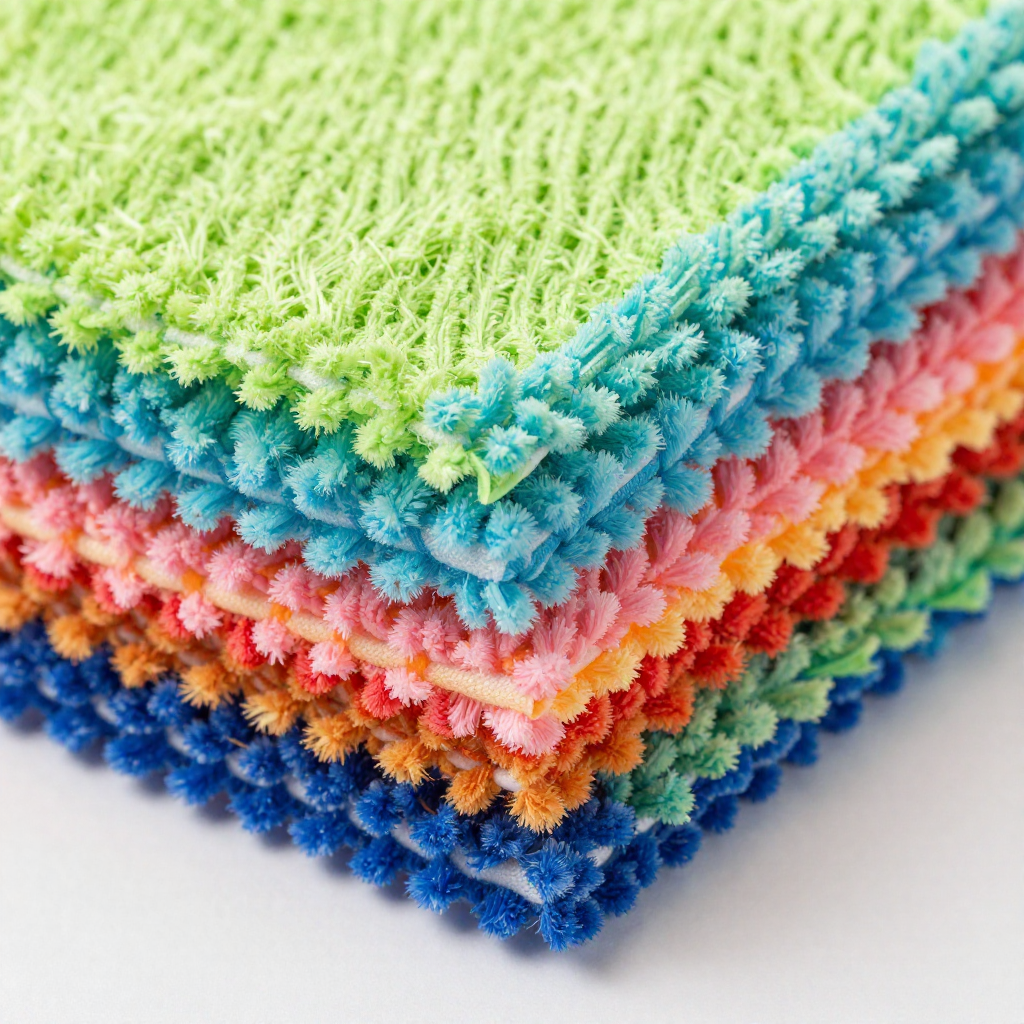
For blended fabrics — polyester-cotton being the most common — the continuous filament tow is crimped and cut into short staple lengths (typically 38 mm for cotton-type blends, matching cotton's natural staple length). The staple is then blended with cotton on conventional cotton spinning machinery. A 65/35 polyester-cotton blend combines polyester's wrinkle resistance and durability with cotton's moisture absorption and comfort. This blend dominates workwear, bedsheets, and everyday clothing worldwide.
Recognize the safety considerations
Recognize the safety considerations
The monomers present moderate hazards: ethylene glycol is toxic if ingested (lethal dose approximately 100 ml in adults); terephthalic acid is a mild irritant. Antimony trioxide, the most common polycondensation catalyst, is classified as a possible carcinogen. Melt spinning at 280°C releases trace fumes. PET fiber itself is safe in finished form but melts and drips when exposed to flame — a lower fire hazard than nylon (which drips flaming droplets) but still significant in furnishing applications. Recycled PET (rPET) from plastic bottles now accounts for a growing share of polyester fiber production.
Understand polyester's dominance in modern textiles
Understand polyester's dominance in modern textiles
Polyester surpassed cotton as the world's most-produced fiber in 2002 and has widened the gap every year since. The reasons are economic and functional: PET chips cost $0.80–1.20 per kilogram (versus $1.50–2.50 for raw cotton), polyester requires no agricultural land or water, and it can be engineered for any application — from gossamer-thin microfiber to heavy industrial webbing. The environmental cost is significant: polyester is derived from petroleum, sheds microplastic fibers during washing, and takes centuries to decompose. Whinfield's fiber solved the textile industry's material constraints but created a new set of planetary challenges that remain unresolved.
Materials
1- 200 mlPlaceholder
Tools Required
1- Placeholder
Connected Blueprint Materials
Related Blueprints
These blueprints share knowledge with this one — techniques, materials, or principles that connect them in the learning graph.
Related blueprints
Other builds that share materials, tools, or techniques with this one.

CC0 Public Domain
This blueprint is released under CC0. You are free to copy, modify, distribute, and use this work for any purpose, without asking permission.
Support the Maker by purchasing products through their Blueprint where they earn a Maker Commission set by Vendors, or create a new iteration of this Blueprint and include it as a connection in your own Blueprint to share revenue.