

Synthetic Indigo — BASF's Industrial Synthesis That Replaced a Global Crop
In 1897, the Badische Anilin- und Soda-Fabrik (BASF) began commercial production of synthetic indigo — the culmination of seventeen years and 18 million gold marks of research led by Adolf von Baeyer and Karl Heumann. Indigo was the most commercially important dye in the world: the deep blue that colored naval uniforms, work clothes, and eventually denim jeans. For millennia, it had been extracted from plants — Indigofera tinctoria in India, woad (Isatis tinctoria) in Europe — through laborious fermentation processes.
BASF's synthesis started from naphthalene (a coal tar derivative), converting it through phthalic anhydride and anthranilic acid to indoxyl, which was then oxidized to indigo. The key breakthrough was the Heumann-Pfleger synthesis: heating phenylglycine-o-carboxylic acid with sodium hydroxide in a sodium amide melt to produce indoxyl, which air-oxidizes to indigo on contact with oxygen. The process was scalable, consistent, and independent of weather, soil, and harvest seasons.
The impact was devastating for natural indigo producers. India's indigo exports — worth 3.5 million pounds sterling annually in the 1890s — collapsed to near zero by 1914. An entire colonial agricultural system, with all its plantations, workers, and trade networks, was rendered obsolete by a chemical factory in Ludwigshafen. Synthetic indigo now accounts for over 95% of the 80,000 tonnes of indigo produced annually — virtually all of it used to dye the approximately 4 billion meters of denim fabric manufactured each year for blue jeans.
Instructions
Understand the target molecule: indigo
Understand the target molecule: indigo
Indigo (C₁₆H₁₀N₂O₂) is a deep blue pigment consisting of two indoxyl units linked by a central double bond. This double bond is the chromophore — the molecular feature that absorbs red and yellow light and reflects blue. The same molecule occurs in both plant-derived and synthetic indigo; there is no chemical difference. Baeyer determined indigo's structure in 1883, earning the Nobel Prize in Chemistry in 1905 partly for this work.
Start from naphthalene (coal tar fraction)
Start from naphthalene (coal tar fraction)
BASF's industrial process begins with naphthalene — the simplest polycyclic aromatic hydrocarbon, distilled from coal tar at 218°C. Naphthalene is the characteristic white crystalline solid that gives mothballs their smell. In the 1890s, it was an abundant and cheap coal tar byproduct. The challenge was transforming this simple two-ring molecule into indigo's complex four-ring structure through a sequence of controlled chemical reactions.
Materials for this step:
 Coal Tar200 ml
Oxidize naphthalene to phthalic anhydride
Oxidize naphthalene to phthalic anhydride
Pass naphthalene vapor over a vanadium pentoxide catalyst at 350–400°C in the presence of air. The naphthalene ring partially oxidizes to phthalic anhydride (C₈H₄O₃) — a white crystalline solid. This catalytic oxidation was itself a major industrial achievement, later becoming one of the most important reactions in the entire chemical industry (phthalic anhydride is a precursor to plasticizers, alkyd resins, and polyester).
Tools needed:
 Glass Distillation Flask
Convert phthalic anhydride to anthranilic acid
Convert phthalic anhydride to anthranilic acid
React phthalic anhydride with ammonia and sodium hypochlorite (bleach) in a Hofmann rearrangement. The reaction inserts a nitrogen atom into the ring, producing anthranilic acid (2-aminobenzoic acid) — a pale yellow crystalline compound. Anthranilic acid carries both an amine group (-NH₂) and a carboxyl group (-COOH) on the benzene ring, providing the nitrogen that indigo requires.
React with chloroacetic acid to form phenylglycine
React with chloroacetic acid to form phenylglycine
Combine anthranilic acid with chloroacetic acid in aqueous sodium hydroxide. The amine group of anthranilic acid displaces the chlorine, forming N-phenylglycine-o-carboxylic acid — the key intermediate in the Heumann synthesis. This colorless compound carries all the carbon, nitrogen, and oxygen atoms needed to form indoxyl in the next step.
Materials for this step:
 Sodium Hydroxide (10% solution)200 ml
Fuse with alkali to form indoxyl
Fuse with alkali to form indoxyl
Heat the phenylglycine-o-carboxylic acid with a mixture of sodium hydroxide and sodium amide (NaNH₂) at 200–260°C. This alkali fusion — the Heumann-Pfleger process — cyclizes the molecule, forming indoxyl (3-hydroxyindole). The melt turns from white to deep yellow as indoxyl forms. This is the most critical step: temperature control is essential because too much heat decomposes the indoxyl, while too little leaves unreacted starting material.
Oxidize indoxyl to indigo
Oxidize indoxyl to indigo
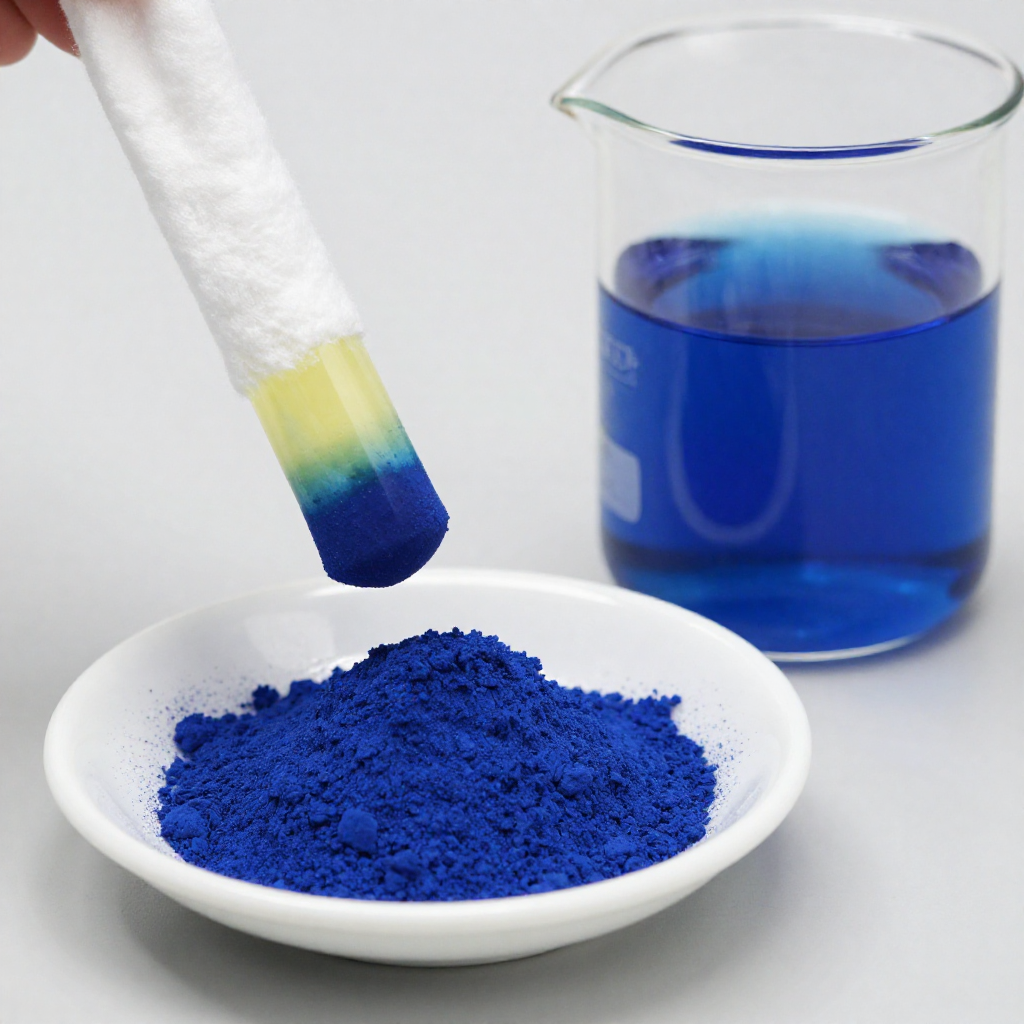
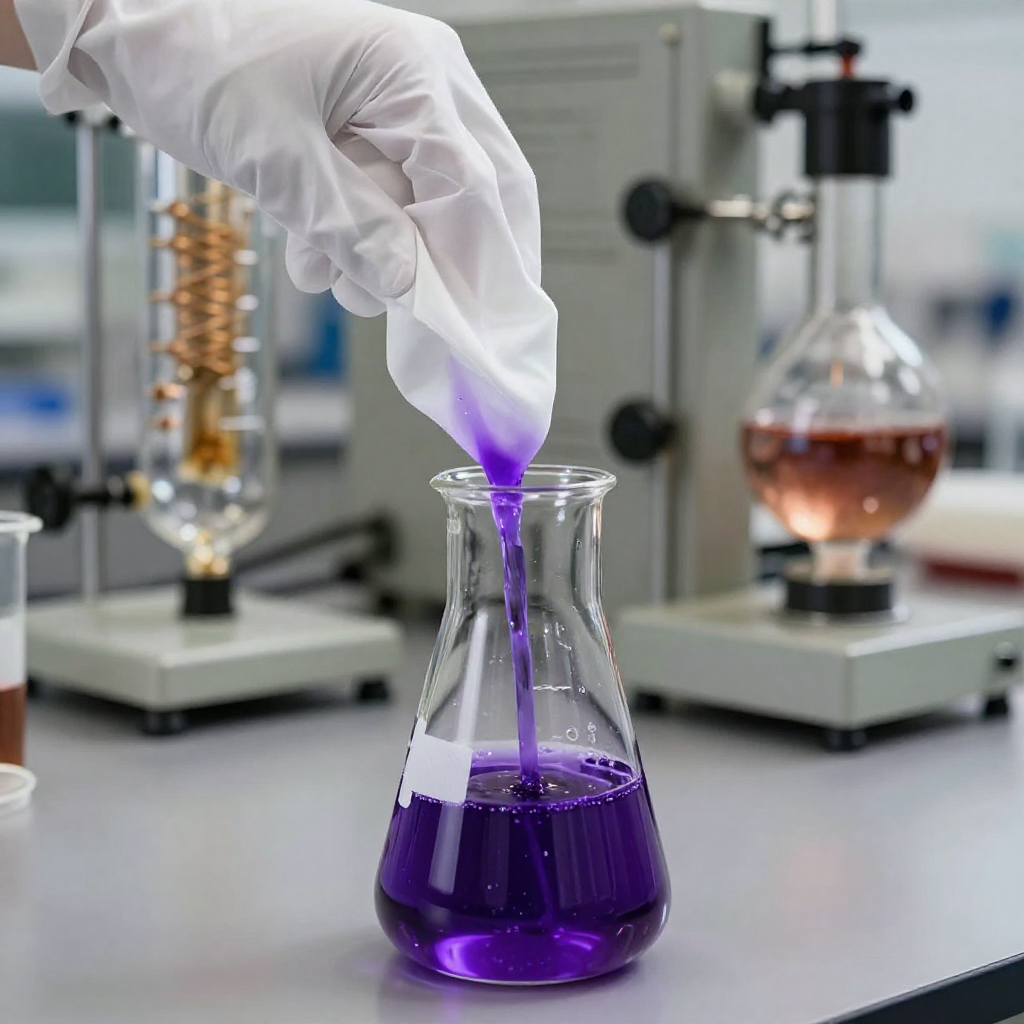
Dissolve the indoxyl-containing melt in water and blow air through the solution. Atmospheric oxygen oxidizes the pale yellow indoxyl: two indoxyl molecules couple through their central carbon atoms, losing two hydrogen atoms and forming the C=C double bond that links the two halves of the indigo molecule. The solution turns blue as indigo precipitates — an insoluble blue powder that settles to the bottom of the vessel.
Filter and wash the precipitated indigo
Filter and wash the precipitated indigo
Filter the blue precipitate, wash it repeatedly with water to remove residual alkali and salts, and dry it. The product is synthetic indigo — a fine, deep blue powder chemically identical to plant-derived indigo. BASF's early batches were tested against natural Bengal indigo by experienced dyers: they could not distinguish the synthetic from the natural. The purity of synthetic indigo was actually more consistent than the plant-derived product.
Understand vat dyeing with indigo
Understand vat dyeing with indigo
Indigo is insoluble in water — it cannot dye fabric directly. To use it, the dyer must first reduce it (remove oxygen) to form leuco-indigo ('white indigo'), which is soluble. Traditionally this was done with fermentation (stale urine, woad vat); industrially, sodium hydrosulfite (sodium dithionite) in sodium hydroxide is used. The fabric is immersed in the yellow-green leuco-indigo solution, then removed and exposed to air. Oxygen reconverts the leuco-indigo back to blue indigo — but now it is trapped inside the fiber. This is vat dyeing.
Observe the characteristic blue oxidation
Observe the characteristic blue oxidation
When indigo-dipped fabric emerges from the vat, it appears yellow-green (the color of reduced leuco-indigo). Within seconds of air exposure, the color shifts to green, then to the characteristic deep blue as oxygen re-forms the indigo chromophore. Multiple dips build deeper color — denim jeans are typically dipped 6–12 times to achieve their distinctive shade. This air oxidation is the same reaction that occurs during synthesis: indoxyl → indigo is an oxidative coupling.
Recognize the safety hazards
Recognize the safety hazards
The synthesis involves multiple hazardous chemicals. Naphthalene is flammable and a suspected carcinogen. Sodium amide reacts violently with water and must be handled under inert atmosphere. The alkali fusion at 200–260°C involves molten caustic soda — a splash causes severe burns. Sodium hydrosulfite (used in dyeing) can spontaneously combust when dry. Industrial indigo production requires full chemical process safety engineering. This blueprint is for understanding, not for amateur synthesis.
Understand synthetic indigo's global impact
Understand synthetic indigo's global impact
BASF's synthetic indigo destroyed an entire agricultural commodity. India's indigo acreage fell from 700,000 hectares in 1897 to under 50,000 by 1914 — a social and economic catastrophe for millions of Indian farmers and laborers. Germany became the world's chemical superpower partly on the profits of synthetic dyes. Today, approximately 80,000 tonnes of synthetic indigo are produced annually, virtually all for denim. The molecule is identical to what Indian farmers extracted from Indigofera 4,000 years ago — but the factory in Ludwigshafen proved that chemistry could replace agriculture, permanently changing the relationship between human industry and the natural world.
Tools Required
1- Placeholder
Connected Blueprint Materials
Related Blueprints
These blueprints share knowledge with this one — techniques, materials, or principles that connect them in the learning graph.
Related blueprints
Other builds that share materials, tools, or techniques with this one.
CC0 Public Domain
This blueprint is released under CC0. You are free to copy, modify, distribute, and use this work for any purpose, without asking permission.
Support the Maker by purchasing products through their Blueprint where they earn a Maker Commission set by Vendors, or create a new iteration of this Blueprint and include it as a connection in your own Blueprint to share revenue.