

Arkwright's Water Frame — Roller-Drafted Warp Yarn by Water Power
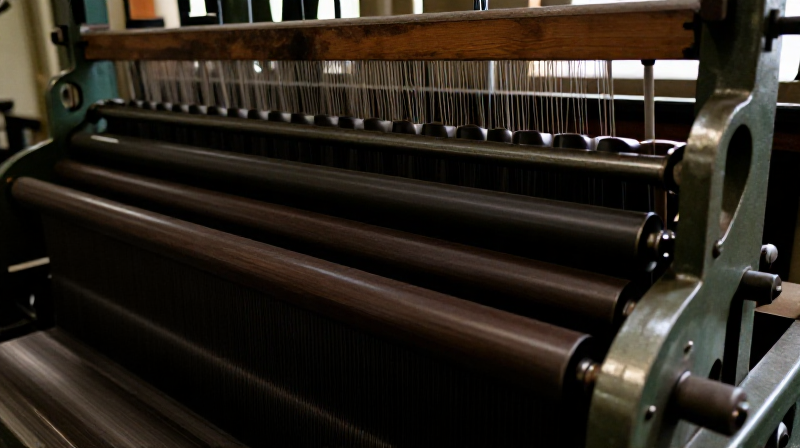
In 1769, Richard Arkwright patented the water frame — the first spinning machine capable of producing thread strong enough for warp. Where Hargreaves' spinning jenny drafted fiber by pulling a carriage backward (mimicking the hand spinner's draw), Arkwright's machine used pairs of rotating rollers set at increasing speeds to draft the roving continuously. The front rollers turned faster than the back rollers, stretching the fiber between them with mechanical precision impossible to achieve by hand.
The critical innovation was roller drafting. Two pairs of rollers, spaced slightly farther apart than the average fiber length, grip the roving. The front pair turns faster than the rear pair, stretching the fiber to the desired thickness before twist is inserted by a flyer-and-bobbin assembly. This produces a hard-twisted, even yarn strong enough to serve as warp — something the jenny could never do. For the first time, both warp and weft could be machine-spun.
Arkwright's machine was too heavy for hand power, so he harnessed water wheels to drive it — hence 'water frame.' His Cromford Mill in Derbyshire (1771) became the world's first successful water-powered cotton spinning factory, employing hundreds of workers under one roof. This was the birth of the factory system: centralized power, division of labor, and machine-paced production that defined the Industrial Revolution.
说明
Prepare cotton roving from carded sliver
Prepare cotton roving from carded sliver
Begin with cotton that has been ginned (seeds removed), carded (fibers aligned into a web), and drawn into a roving — a loose, continuous rope of roughly parallel fibers approximately 2 cm thick. Cotton was the water frame's primary fiber because its short staple length (2–4 cm) is ideal for roller drafting. Wool fibers are too long and slippery for the closely spaced rollers of the original design.
此步骤所需材料:
 棉粗纱500 克
Thread the roving through the back rollers
Thread the roving through the back rollers
Feed the roving between the first pair of rollers (the back rollers). These rollers grip the roving gently and feed it forward at a controlled speed. The rollers are weighted or spring-loaded to maintain consistent pressure — too little pressure and the roving slips, too much and it crushes the fibers. The back rollers set the input speed of the drafting system.
所需工具:
 Water frame(水力纺纱机)
Pass the roving to the front rollers
Pass the roving to the front rollers
Guide the roving from the back rollers across a gap of 4–5 cm to the front pair of rollers. This gap (the drafting zone) is where the fiber is stretched thin. The distance between roller pairs must be slightly greater than the longest fibers in the roving — for cotton, this is typically 4–5 cm. If the gap is too short, fibers jam between the rollers; too long, and they float uncontrolled.
Set the front rollers to a faster speed
Set the front rollers to a faster speed
The front rollers turn faster than the back rollers — typically 3 to 5 times faster. This speed difference is the draft ratio: a 4:1 ratio means the roving is stretched to four times its original length, reducing its thickness by a factor of four. The draft ratio is set by gear ratios in the drive mechanism and determines the final yarn thickness. A higher ratio produces finer yarn.
Observe roller drafting in action
Observe roller drafting in action
When the machine runs, the back rollers feed roving slowly while the front rollers pull it away fast. In the drafting zone between them, individual fibers slide past each other under tension, thinning the roving into a delicate ribbon of loosely held fibers. This continuous mechanical drafting replaces the hand spinner's intermittent pull-and-release motion, producing vastly more even yarn.
Feed the drafted fiber to the flyer assembly
Feed the drafted fiber to the flyer assembly
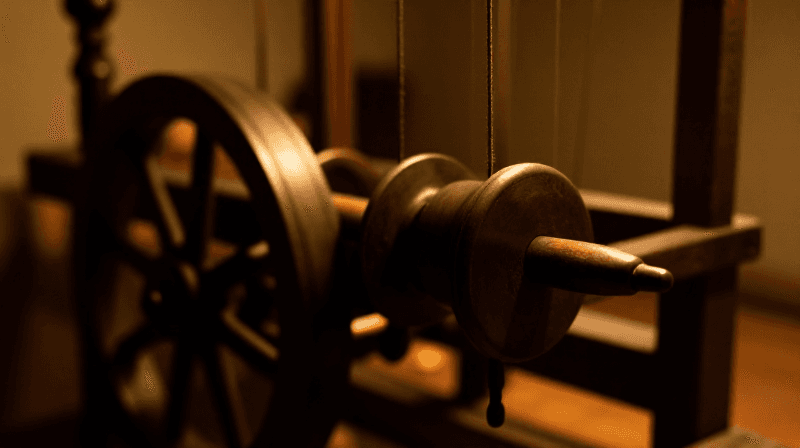
The thinned fiber exits the front rollers and passes directly into a flyer-and-bobbin assembly — the same mechanism used on Saxony spinning wheels. The flyer is a U-shaped arm that rotates around a stationary bobbin. As the flyer spins, it twists the drafted fiber into yarn and simultaneously winds it onto the bobbin. This makes the water frame a continuous process — drafting, twisting, and winding happen simultaneously.
Understand the twist insertion
Understand the twist insertion
Each rotation of the flyer inserts one turn of twist into the yarn. The twist rate (turns per centimeter) determines yarn strength and character. The water frame's flyer spins at a fixed ratio to the front rollers, so the twist rate is built into the machine's gearing. Arkwright's design produced a hard Z-twist (clockwise when viewed from above) that gave the yarn its characteristic strength for warp use.
Monitor the bobbin filling
Monitor the bobbin filling
The bobbin fills from bottom to top as yarn accumulates. A bobbin rail moves the bobbin slowly upward during operation so the yarn winds in even layers. When the bobbin is full, the machine must be stopped briefly to replace it with an empty one. Each bobbin holds approximately 50–100 grams of yarn depending on thickness.
Manage multiple spindles simultaneously
Manage multiple spindles simultaneously
Arkwright's original water frame had 4 spindles; later versions expanded to 96 or more. Each spindle has its own pair of rollers and flyer assembly, all driven from a single power source through a system of gears and belts. The operator's job is to watch for broken threads, replace full bobbins, and feed new roving — not to spin by hand. The machine does the spinning.
Splice broken threads when they occur
Splice broken threads when they occur
Thread breakage is the most common interruption. When a thread snaps, the spindle continues turning empty. The operator must stop that spindle, re-thread the broken end through the flyer, and overlap it with the incoming drafted fiber. Speed and dexterity matter — every second a spindle runs empty is lost production. This task was often assigned to children in early factories because of their small, nimble fingers.
Understand the water power connection
Understand the water power connection
The water frame requires substantial continuous power — far more than human muscle can sustain for a full working day. Arkwright connected his machines to water wheels via a main shaft and belt system. A single large water wheel (3–5 meters diameter) could drive dozens of frames simultaneously. The requirement for water power dictated factory location: mills were built beside fast-flowing rivers, creating the first industrial towns like Cromford and Belper.
Compare water frame yarn to jenny yarn
Compare water frame yarn to jenny yarn
Pull a length of water frame yarn and a length of jenny yarn side by side. The water frame yarn is noticeably harder, smoother, and more tightly twisted. It resists snapping under tension — this is why it works as warp. Jenny yarn is softer, loftier, and breaks more easily under tension — suitable only for weft. Before the water frame, all warp in English cotton cloth was linen because no machine could spin cotton strong enough.
Wind the finished yarn into skeins
Wind the finished yarn into skeins
Remove full bobbins from the machine and wind the yarn into skeins on a reel or swift. Each skein is tied in four places with figure-eight ties. The yarn can be used directly for weaving or sent to a dyer. Water frame yarn does not require the soaking and twist-setting step that jenny yarn needs — its hard twist is permanent from the moment it leaves the flyer.
Recognize the water frame's legacy
Recognize the water frame's legacy
The water frame's roller drafting principle remains the foundation of all modern ring spinning, which produces over 80% of the world's yarn today. Every cotton shirt, denim jean, and bed sheet is spun using descendants of Arkwright's rollers. The machine also established the factory system — centralized production, shift work, and machine-paced labor — that became the template for all industrial manufacturing. Cromford Mill is now a UNESCO World Heritage Site.
已连接蓝图材料
此蓝图制作
相关蓝图
这些蓝图共享知识——技术、材料或原理
CC0 公共领域
此蓝图以 CC0 协议发布。你可以自由复制、修改、分发和使用此作品,无需征得许可。
通过购买蓝图中的产品支持创客,他们将获得 创客佣金 (由供应商设定),或创建此蓝图的新版本并将其作为连接包含在你自己的蓝图中以分享收入。