艺术
美容与健康
工艺
文化与历史
娱乐
环境
食品与饮料
逆向工程
科学
体育
技术
可穿戴设备
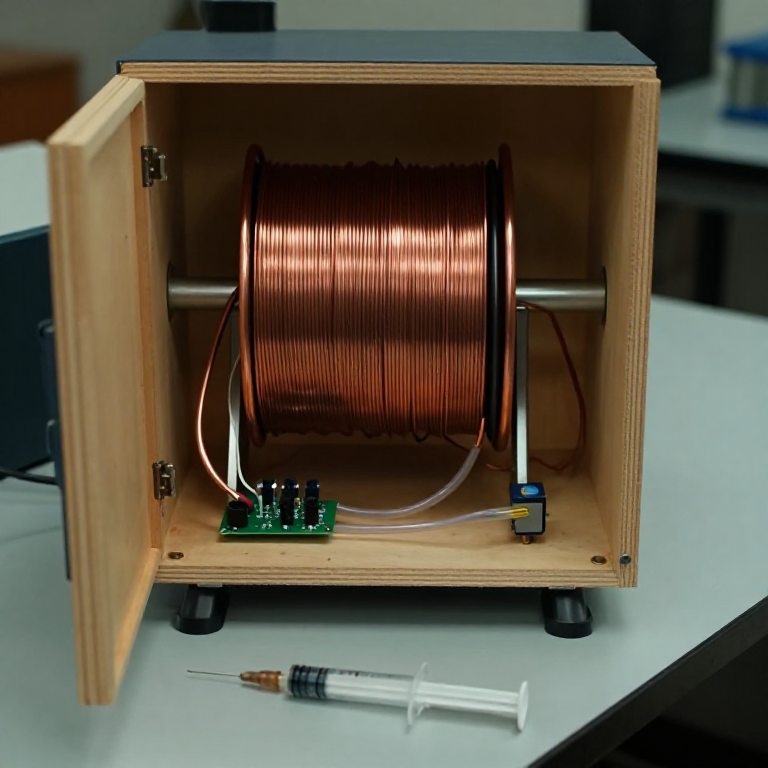

Building a Gas Chromatograph
Every separation so far has used a liquid to carry the sample. In 1952 Archer Martin and Anthony James — Martin again, eight years after paper chromatography — used a GAS instead, and the whole business got faster by a factor of a hundred.
A gas is thin. Molecules diffuse through it quickly, so they find the stationary phase, partition into it and come back out again thousands of times a second rather than thousands of times an hour. That speed is why a gas chromatograph resolves a mixture in minutes where a column takes an afternoon, and it is why the method now sits in every forensic, environmental and flavour laboratory on earth.
The catch is that the sample must survive being vaporised, so this works for what boils without decomposing: solvents, fuels, essential oils. You will build a working instrument from copper tube, an aquarium pump and a thermistor, and separate the components of a lavender oil you distilled yourself.
高级
2 days
说明
1
1
Understand the three parts before you build any of them
Understand the three parts before you build any of them
A gas chromatograph is an injector, a column and a detector, with a carrier gas flowing through all three and heat holding the column at a steady temperature.
The carrier gas does nothing chemically — it only pushes. The column is a long tube whose inside is coated with a high-boiling liquid: THAT liquid is the stationary phase and it does the separating. The detector reports when something other than pure carrier gas comes out the far end. Everything expensive about a commercial instrument is refinement of those three; nothing about them is beyond a workshop.
2
2
Make a packed column
Make a packed column
Crush firebrick, sieve it to a narrow size range, and soak the granules in silicone grease thinned with acetone so each one carries a thin film. Spread it out until the acetone has gone completely, then pack it into 2 metres of 4 mm copper tube, tapping constantly, and coil the tube.
The brick is only a support with a huge surface area; the grease film is the actual stationary phase. Sieving matters more than it sounds — mixed grain sizes pack unevenly, gas finds a fast channel, and every peak comes out broad. Plug both ends with a little glass wool so the packing cannot migrate into your pump or your detector.
此步骤所需材料:
 铜管2 metre
 耐火砖1 个
 真空润滑脂(硅基)50 克
 丙酮100 毫升
 玻璃棉保温材料1 包
所需工具:
 数字天平
数字天平 丁腈手套
丁腈手套3
3
Heat the column evenly, and measure the temperature you actually have
Heat the column evenly, and measure the temperature you actually have
Wind nichrome wire evenly along the coiled column, insulate it, and drive it from a variable supply. Bond a thermocouple to the tube itself, not to the air near it.
Retention time depends steeply on temperature — roughly halving for every 20 to 30 °C you add — so a column that is hotter at one end than the other smears every peak, and a column whose temperature drifts between runs gives retention times you cannot compare. Even winding and a real measurement of the metal are what make the instrument repeatable rather than merely working.
此步骤所需材料:
 镍铬丝5 metre
所需工具:
 直流电源
直流电源 K 型热电偶配 MAX6675 模块
 万用表
万用表4
4
Build a thermal conductivity detector
Build a thermal conductivity detector
Mount two matched thermistors in small chambers, one in the gas leaving the column and one in carrier gas that has bypassed it, and wire them as two arms of a bridge. Feed the bridge a steady low voltage and read the imbalance.
Each thermistor is self-heated by the current through it and cooled by the gas around it. Pure carrier gas cools both equally and the bridge sits balanced. The moment a different molecule emerges, the gas around one thermistor conducts heat differently, that bead changes temperature, its resistance changes and the bridge tips. This is a universal detector — it sees anything that is not the carrier — and it was the detector on the first commercial instruments.
此步骤所需材料:
 NTC 热敏电阻套件1 套件
所需工具:
直流电源万用表 鳄鱼夹测试线
5
5
Set a steady carrier flow — steady matters more than fast
Set a steady carrier flow — steady matters more than fast
Run an aquarium pump through a ballast vessel and a needle valve into the injector end, and measure the flow at the outlet by timing a soap bubble up a graduated tube.
The ballast is what turns a pump's pulsing into a smooth stream, and a pulsing carrier makes the detector baseline oscillate so hard that small peaks disappear into it. Air works as a carrier for this build; it is not ideal, because oxygen slowly degrades the stationary phase at temperature and its thermal conductivity is close to many analytes, which costs sensitivity. Nitrogen is better if you have it, helium better still.
所需工具:
 气泵
气泵 秒表
秒表 硼硅玻璃烧杯
6
6
Inject fast, inject tiny
Inject fast, inject tiny
Fit a septum at the column inlet, heat that inlet above the boiling point of your sample, and inject a fraction of a microlitre with a fine syringe in one quick motion.
Everything about injection is about making the sample enter as a narrow plug. A slow injection feeds the column over several seconds and every peak is that many seconds wide before separation even begins. Too much sample overloads the stationary phase and gives leaning, tailing peaks whose retention times shift with how much you put in — which quietly destroys the identification the whole instrument exists to provide.
所需工具:
 实验室注射器
7
7
Run a lavender oil, and read the chromatogram
Run a lavender oil, and read the chromatogram
Inject a dilute solution of lavender essential oil and log the detector voltage against time. You should see a solvent peak early, then a series of peaks over several minutes: linalool and linalyl acetate are the two largest components of real lavender oil.
Retention time identifies; peak area quantifies. Run a known pure compound to find its retention time, then look for that time in your unknown. This is exactly how a laboratory tells adulterated essential oil from genuine — a cheap oil cut with synthetic linalool shows the right peak in the wrong proportion to its neighbours.
此步骤所需材料:
 乙醇——实验级,95 %50 毫升
所需工具:
实验室注射器万用表秒表8
8
Van Deemter: why there is a best flow rate
Van Deemter: why there is a best flow rate
正在加载 Jupyter 笔记本…
所需工具:
秒表材料
8- 2 metre占位符
- 1 个占位符
- 50 克占位符
- 100 毫升占位符
- 1 包占位符
- 5 metre占位符
- 1 套件占位符
- 50 毫升占位符
相关蓝图
这些蓝图共享知识——技术、材料或原理


CC0 公共领域
此蓝图以 CC0 协议发布。你可以自由复制、修改、分发和使用此作品,无需征得许可。
通过购买蓝图中的产品支持创客,他们将获得 创客佣金 (由供应商设定),或创建此蓝图的新版本并将其作为连接包含在你自己的蓝图中以分享收入。