艺术
美容与健康
工艺
文化与历史
娱乐
环境
食品与饮料
逆向工程
科学
体育
技术
可穿戴设备
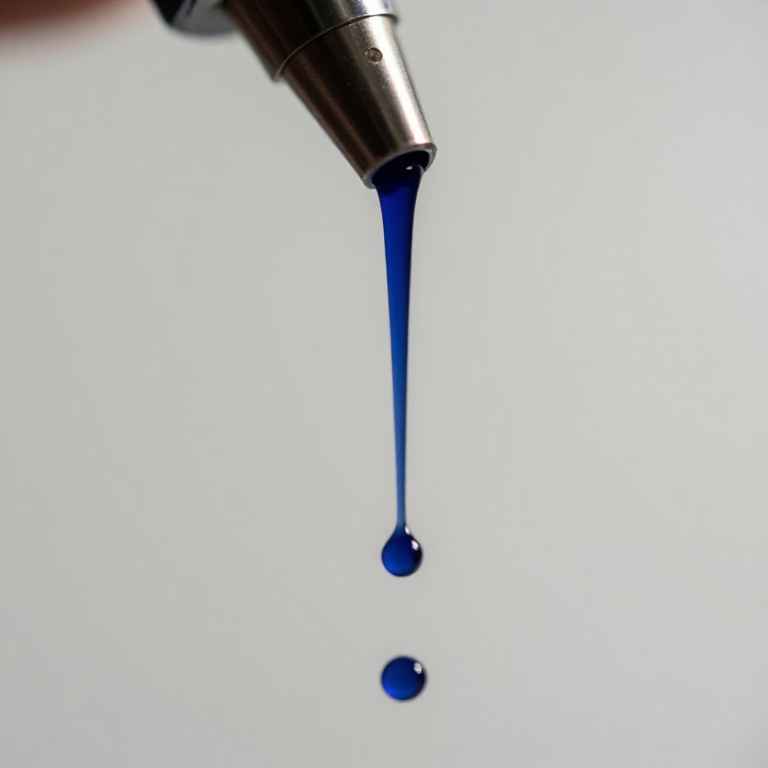


Continuous Inkjet
Rayleigh worked out in 1878 that a liquid jet cannot stay a jet. Surface tension amplifies any disturbance along it until the column pinches into drops, and the wobble that grows fastest has a wavelength of about four and a half times the jet's diameter. A fifty-micrometre nozzle therefore breaks up into drops at tens of kilohertz whether you want it to or not.
Rune Elmqvist at Siemens used that in 1951 to make a chart recorder that wrote with ink instead of a pen. Richard Sweet at Stanford turned it into printing in 1964 by adding the two things that make it controllable: drive the jet with a piezo AT its natural break-up frequency, so every drop is identical and arrives on schedule, then put a charge on each drop at the instant it separates and deflect it electrostatically on its way to the paper.
The consequence is a machine that is always firing. Drops you do not want are simply left uncharged, fly straight on into a gutter, and are pumped back to the reservoir. That sounds wasteful and is the single reason the technology survives: a nozzle with ink permanently flowing through it cannot dry out, so a continuous inkjet can sit in a factory for years and start instantly.
It is why every date code on every can and bottle you have ever bought was printed this way, at conveyor speed, onto a curved and moving surface. It is also why nobody put one on a desk: the gutter, the pump, the filter, the viscosity controller and the evaporating solvent are the price of never clogging.
中级
3 hours
说明
1
1
Make a jet break up, and photograph it
Make a jet break up, and photograph it
Feed water through a fine nozzle - a syringe needle ground flat - under a metre of head, into a sink.
Strobe an LED from the function generator and sweep the frequency until the drop train freezes. Read that frequency; measure the jet diameter with the loupe. That is Rayleigh's result on a bench.
此步骤所需材料:
 实验室注射器1 个
 硅胶管1 米
所需工具:
 函数发生器
函数发生器 LED 光源
 10 倍手持放大镜
 台式电脑
台式电脑 6 英寸数显卡尺
2
2
Drive it, then deflect it
Drive it, then deflect it
Clamp a piezo disc to the nozzle body and drive it at that frequency. The drop train stops wandering and locks.
Now stand two foil plates 6 mm apart with the stream running between them, touch a charging electrode to the ink upstream, and wind the supply up to 5 kV. The stream bends. Goggles on, one hand behind your back.
此步骤所需材料:
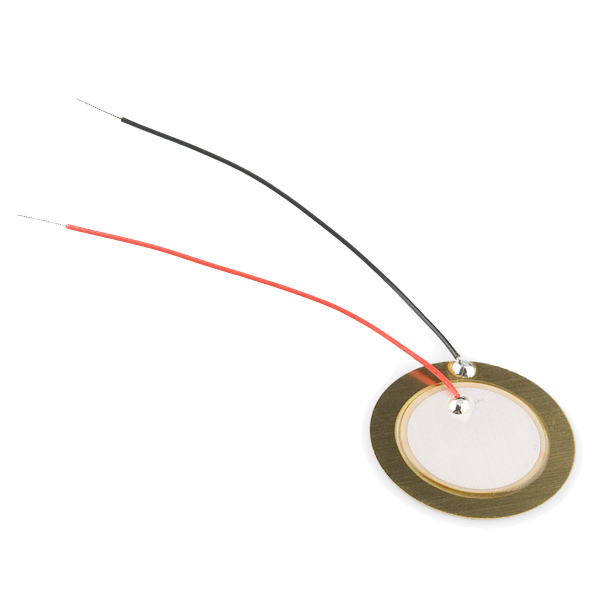 Piezo Element1 个
 铝箔1 张
铝箔1 张所需工具:
函数发生器 高压直流电源(台式)
 密闭式护目镜
 实验室级数字万用表
 直尺
直尺3
3
Break-up rate, deflection, and the two inkjets
Break-up rate, deflection, and the two inkjets
正在加载 Jupyter 笔记本…
所需工具:
台式电脑4
4
Compendium: charge at one instant, in a solvent
Compendium: charge at one instant, in a solvent
A drop can only be charged while still joined to the conducting jet - once it separates its charge is fixed for ever. So the electrode must switch in the microseconds around break-up, for every drop, at tens of kilohertz, and if the break-up point drifts by one wavelength the charge lands on the wrong drop. Production machines watch break-up optically and servo the piezo amplitude to hold it still. That loop, not the nozzle, is the hard part.
The ink is therefore not water. It must conduct (dissolved salts), dry on glass, foil and polypropylene (methyl ethyl ketone), and survive months of recirculation without settling. Solvent evaporates from the open gutter continuously, so the machine also carries a make-up fluid supply and a viscosity sensor. Compare the aqueous dye ink of blueprint 9, whose only requirement is that it can be boiled.
所需工具
9- 占位符
- 占位符
- 占位符
- 占位符
- 占位符
- 占位符
- 占位符
- 占位符
- 占位符
估计总额
制作者买了什么。未标价的材料,在你购买的地方获取。
相关蓝图
这些蓝图共享知识——技术、材料或原理


CC0 公共领域
此蓝图以 CC0 协议发布。你可以自由复制、修改、分发和使用此作品,无需征得许可。
通过购买蓝图中的产品支持创客,他们将获得 创客佣金 (由供应商设定),或创建此蓝图的新版本并将其作为连接包含在你自己的蓝图中以分享收入。