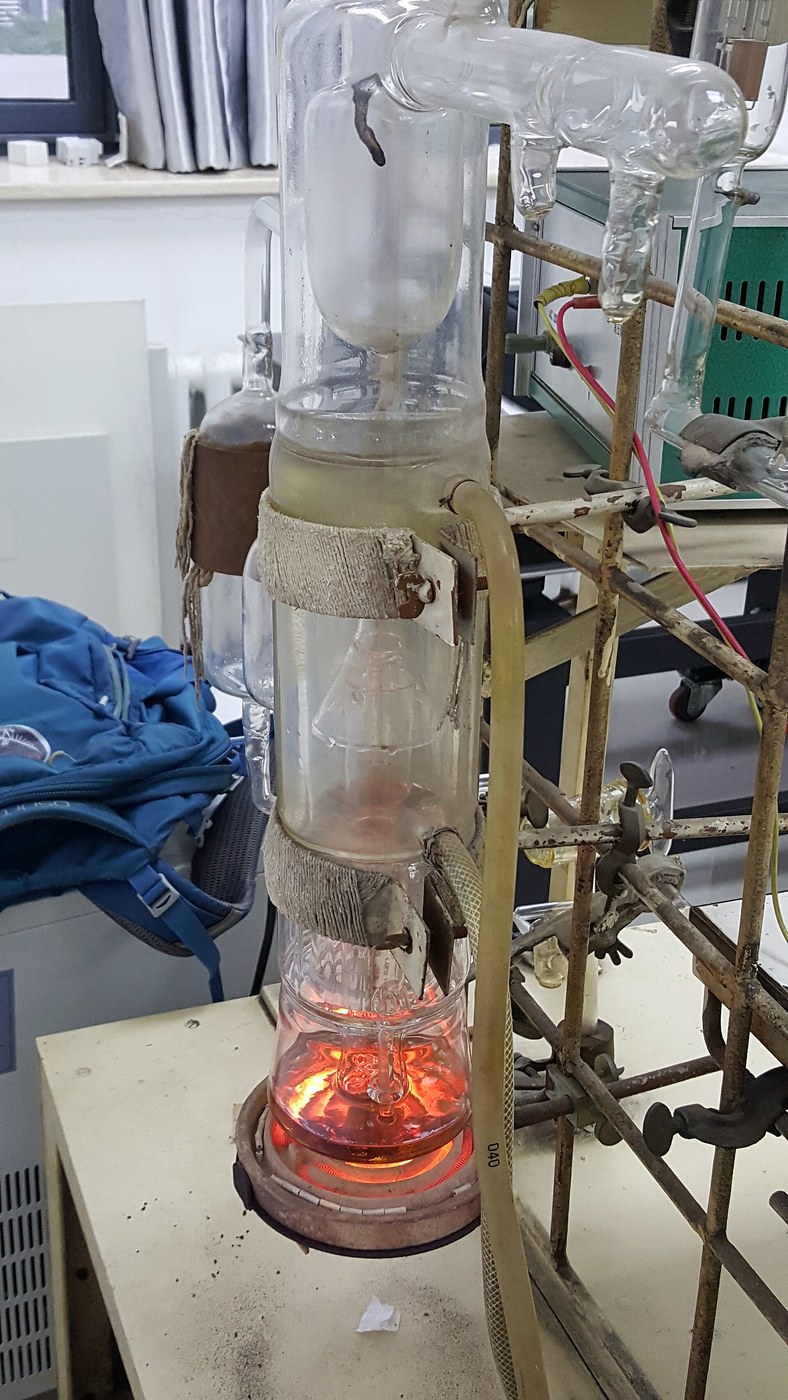


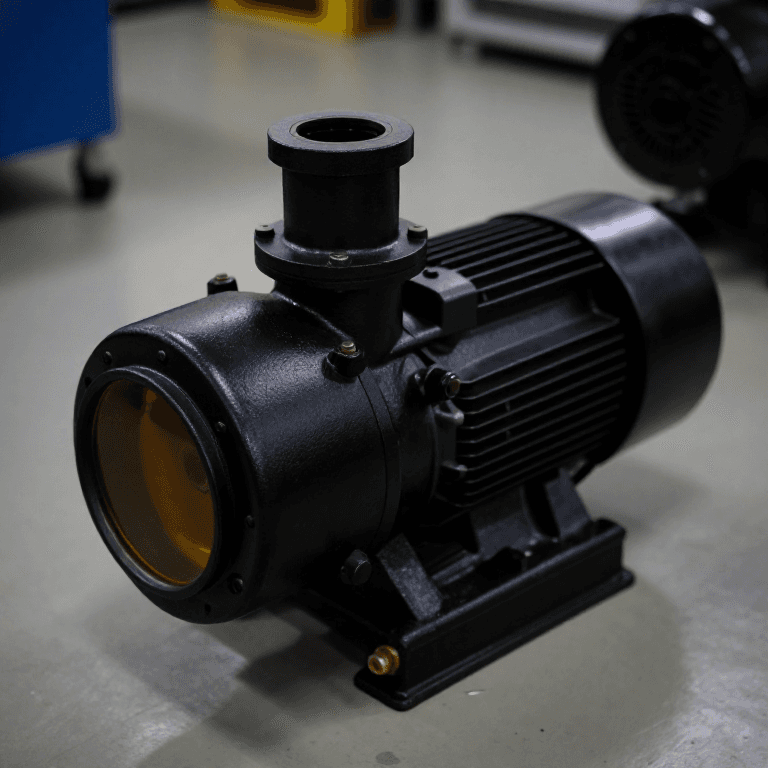
Diffusion Pump
说明
Understand why it cannot work alone
Understand why it cannot work alone
A diffusion pump discharges into a pressure, not into the atmosphere. Get this wrong and nothing works.
- Connect a rotary vane pump to the diffusion pump's outlet — this is the backing pump.
- Note that the diffusion pump must never be started until the backing pump has pulled the system down.
- Establish the rough vacuum FIRST, then apply heat to the boiler.
- On shutdown, reverse: cool the boiler completely before stopping the backing pump.
The vapour jet has almost no compression ability. It can move molecules from a very low pressure to a moderately low one, but it cannot push against atmosphere — the jet simply collapses. So the two pumps are not alternatives, they are a series: the rough pump handles atmosphere down to a fraction of a millibar, and the diffusion pump takes it from there. Starting the boiler at atmospheric pressure oxidises the oil and ruins it.
This staged architecture is universal in vacuum work. Every high-vacuum system in this batch, including the turbomolecular pump, needs a backing pump beneath it for exactly this reason.此步骤所需材料:
 熟亚麻籽油1 瓶
 玻璃管套件1 套件
所需工具:
 6 英寸数显卡尺
 秒表
秒表Build the boiler, chimney and nozzle stack
Build the boiler, chimney and nozzle stack
Vapour must be forced out sideways and DOWNWARD, never upward toward the vessel.
- Make a body from a wide steel or glass tube, closed at the bottom as an oil boiler.
- Fit a central chimney rising from the boiler.
- Cap it with two or three umbrella-shaped nozzles at different heights, each directing vapour outward and DOWN at a steep angle.
- Leave an annular gap between each nozzle and the wall.
- Fit a heater under the boiler and a cooling jacket or fins around the outside.
The downward angle is the entire mechanism. A molecule entering the jet receives momentum in the jet's direction, so the jet must point toward the backing pump. Angle a nozzle upward and it drives gas back into the vessel, which is worse than no pump at all. Multiple stages exist because each one can only compress by a limited ratio.
The cooling jacket is not optional. Vapour must condense on the walls and drain back to the boiler; if the walls are warm the vapour escapes into the vessel instead, which is the backstreaming problem in step 4.此步骤所需材料:
 铝圆棒1 个
 铝板1 个
铝板1 个 铜圆棒1 个
所需工具:
 充电式电钻
充电式电钻 钻头套装
钻头套装 锉刀套装
锉刀套装 钢锯弓配锯条6 英寸数显卡尺
 台虎钳
台虎钳Start it in the right order and watch the pressure fall
Start it in the right order and watch the pressure fall
Sequence matters more than in any other pump in this batch.
- Run the backing pump until the Pirani gauge shows the rough vacuum is established.
- Only then switch on the boiler heater.
- Watch the Pirani reading and note when it goes off the bottom of its range.
- Record the time from heater-on to that point.
- Shut down in reverse order and note what happens if you stop the backing pump first.
所需工具:
 实验室级数字万用表秒表6 英寸数显卡尺
Find the backstreaming, and trap it
Find the backstreaming, and trap it
The pump's working fluid is also its main contaminant.
- Run the pump for an hour with a clean glass slide mounted above the inlet.
- Examine the slide for an oil film.
- Now fit a cold trap or a chevron baffle between the pump and the vessel.
- Repeat with a fresh slide and compare.
此步骤所需材料:
 亚克力板1 张
 铝扁条1 个
所需工具:
6 英寸数显卡尺秒表锉刀套装Pumping with vapour, and history
Pumping with vapour, and history
Wolfgang Gaede invented the diffusion pump in 1915, using mercury vapour; Irving Langmuir improved it at General Electric shortly after, and later designs replaced mercury with low-vapour-pressure oils, removing the toxicity while keeping the principle. Gaede is the central figure of this whole batch — he also produced the rotary and molecular pumps that bracket this one.
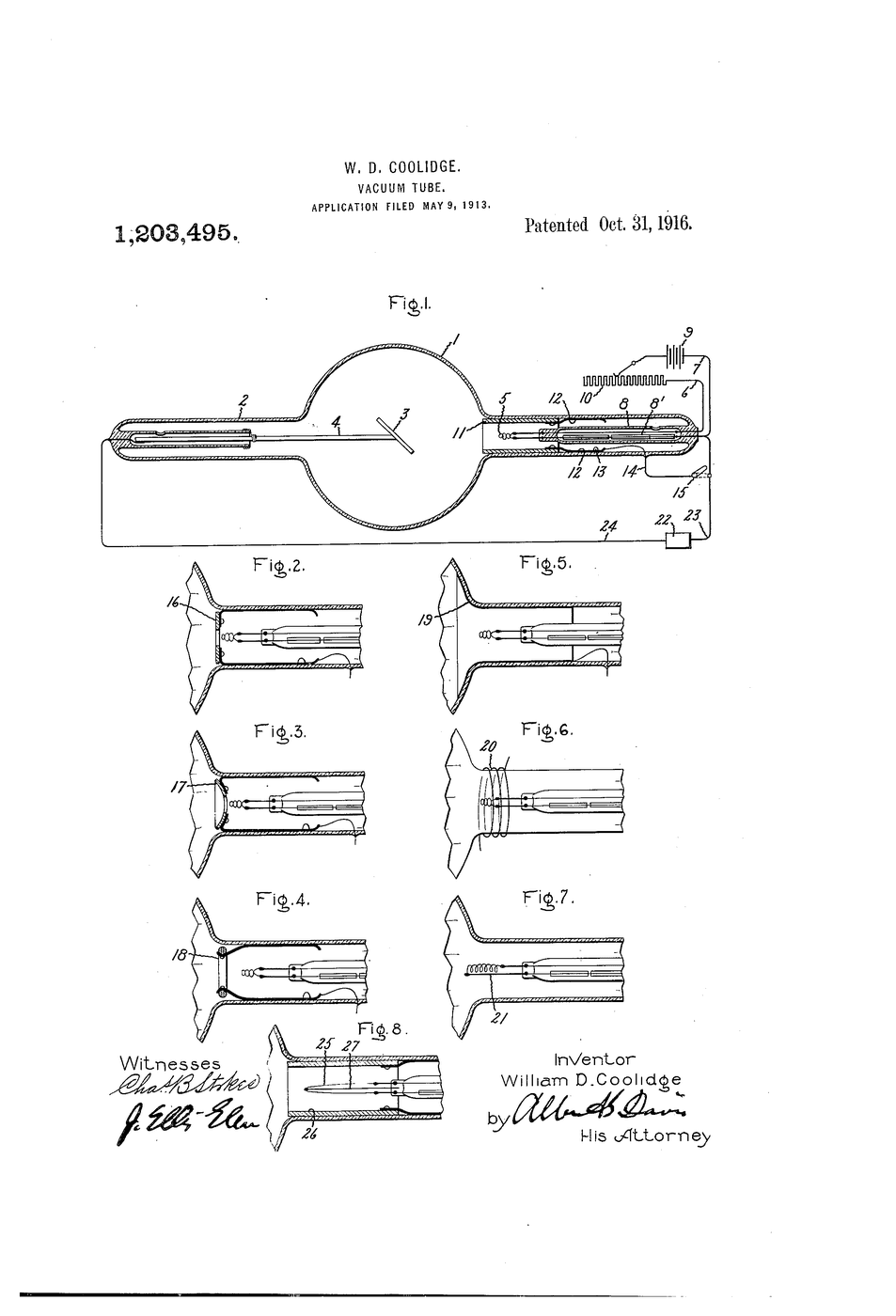
What it made possible. High vacuum on demand, cheaply and continuously, is the precondition for the vacuum tube industry, for X-ray tubes, for electron microscopy, for thin-film coating and eventually for semiconductor manufacture. The Coolidge X-ray tube and the Fleming valve in this catalogue both depend on vacuums this pump can reach and the Sprengel pump could only approach after hours of work.
The mechanism is worth stating plainly: at these pressures molecules rarely collide with each other, so you cannot push gas the way you push a fluid. Instead you hit individual molecules and give them momentum in the direction you want. Every high-vacuum pump does some version of this — the diffusion pump hits them with vapour, the turbomolecular pump at the end of this batch hits them with solid blades.
Its honest limits: backstreaming, the need for a backing pump, warm-up and cool-down times measured in tens of minutes, and a catastrophic failure mode — lose cooling water or admit air while hot and the oil oxidises and coats the entire system. Turbomolecular pumps displaced it in clean applications for exactly these reasons, while diffusion pumps remain common where robustness and low cost matter more than cleanliness.
CC0 公共领域
此蓝图以 CC0 协议发布。你可以自由复制、修改、分发和使用此作品,无需征得许可。
通过购买蓝图中的产品支持创客,他们将获得 创客佣金 (由供应商设定),或创建此蓝图的新版本并将其作为连接包含在你自己的蓝图中以分享收入。