
Extracting Neodymium-Rich Rare Earth Oxide from Monazite — The Magnet Metal That Reshaped Technology
Neodymium is element 60 — a silvery-white lanthanide rare earth metal that would be utterly obscure if not for one extraordinary property: neodymium-iron-boron (NdFeB) magnets are the strongest permanent magnets ever created, generating magnetic fields up to 1.4 tesla. These magnets made possible the miniaturization of electric motors, hard drives, headphones, MRI machines, and wind turbines. Without neodymium, modern technology would be physically larger, heavier, and less efficient.
Neodymium was discovered in 1885 by Carl Auer von Welsbach, who separated the supposed element didymium (from the Greek 'didymos', twin) into two new elements: praseodymium (green twin) and neodymium (new twin). The separation required hundreds of fractional crystallizations of ammonium didymium nitrate — a testament to both patience and precision. Today, neodymium is extracted almost exclusively from monazite ((Ce,La,Nd,Th)PO₄) and bastnäsite ((Ce,La,Nd)CO₃F), both rare earth phosphate/carbonate minerals found in placer sands and carbonatite deposits.
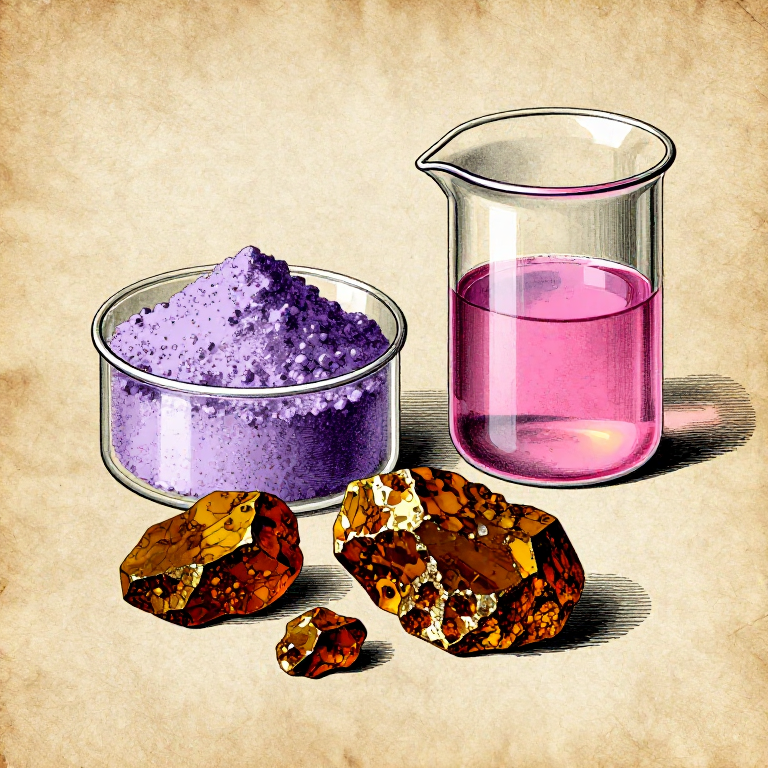
This blueprint covers the caustic cracking of monazite sand to produce a neodymium-enriched rare earth oxide concentrate. The process — gravity concentration, alkaline digestion, selective precipitation, and cerium removal — follows the same chemistry used in industrial rare earth processing, scaled to a laboratory bench. The final product is a mixed rare earth oxide with the characteristic lilac-violet color of Nd₂O₃, confirmed by the sharp absorption bands unique to neodymium in solution.
HAZARD: Monazite contains thorium (typically 5–9% ThO₂), a radioactive alpha emitter. While the external radiation risk from small samples is minimal, inhalation or ingestion of monazite dust is dangerous. Concentrated NaOH at 140 °C causes severe chemical burns and produces caustic steam. HCl fumes are corrosive to lungs. All work must be performed with chemical splash goggles, acid-resistant gloves, and a P100 respirator with acid gas cartridge, in a well-ventilated area or under a fume hood.
此蓝图制作

相关蓝图
这些蓝图共享知识——技术、材料或原理
CC0 公共领域
此蓝图以 CC0 协议发布。你可以自由复制、修改、分发和使用此作品,无需征得许可。
通过购买蓝图中的产品支持创客,他们将获得 创客佣金 (由供应商设定),或创建此蓝图的新版本并将其作为连接包含在你自己的蓝图中以分享收入。