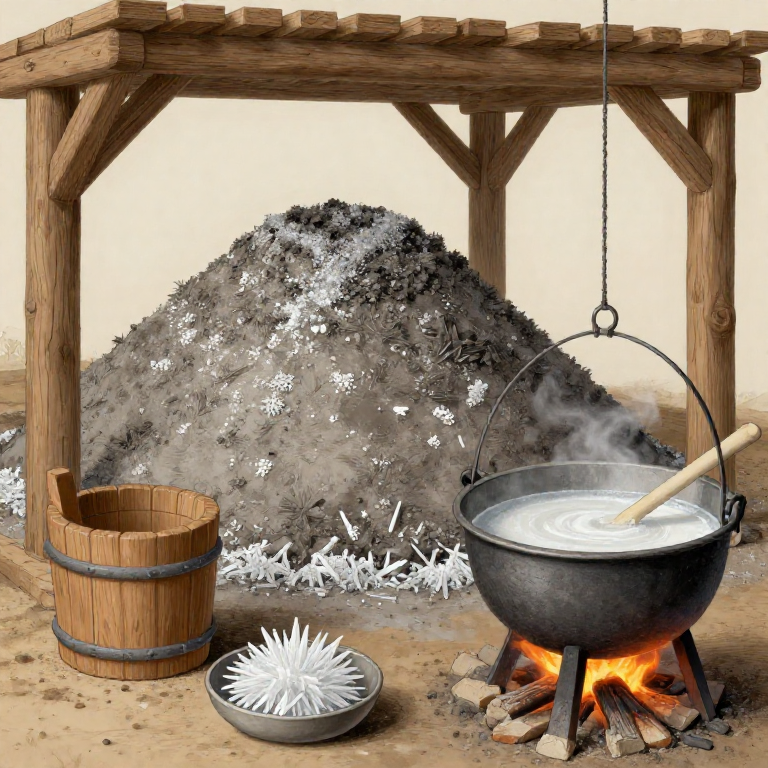


Growing Saltpeter from Niter Beds — The Explosive Element in Every Living Thing
Nitrogen (N, element 7) makes up 78% of Earth's atmosphere — every breath you take is mostly nitrogen gas (N₂). Yet this abundant element was one of the hardest to isolate and understand, because the N≡N triple bond (945 kJ/mol) is the strongest bond in any common diatomic molecule. Nitrogen gas is almost completely inert at room temperature, earning its name from Greek 'nitron genes' — 'niter-forming,' after its role in producing saltpeter (potassium nitrate, KNO₃).
Daniel Rutherford first isolated nitrogen in 1772 by burning and absorbing all other gases from a sealed jar of air, but the element's true significance lies in its compounds. Nitrogen is the fourth most abundant element in living organisms (after hydrogen, oxygen, and carbon) because every amino acid, every protein, and every strand of DNA contains nitrogen atoms. The nitrogen cycle — atmospheric N₂ fixed into NH₃ by bacteria, oxidized to NO₃⁻ by soil microbes, absorbed by plants, eaten by animals, decomposed back to N₂ — is the chemical engine that makes all life possible.
Before the Haber-Bosch process (1913) made synthetic ammonia possible, humanity's primary source of fixed nitrogen was saltpeter — potassium nitrate (KNO₃) — painstakingly produced in niter beds by composting organic waste with potash-rich earth. This blueprint teaches the traditional niter bed process that produced the gunpowder ingredient that changed warfare, the fertilizer that fed pre-industrial agriculture, and the food preservative that made long-distance trade in salted meat possible.
说明
Understand nitrogen's properties and place in the periodic table
Understand nitrogen's properties and place in the periodic table
Nitrogen (N, element 7) sits in Group 15 (pnictogens), Period 2. It has an atomic weight of 14.007 and electron configuration [He] 2s² 2p³. With five valence electrons, nitrogen can form up to three covalent bonds, creating the enormously strong N≡N triple bond in molecular nitrogen (N₂). This triple bond makes N₂ gas almost completely unreactive at ordinary temperatures — it takes temperatures above 3000 °C or specialized enzymes (nitrogenase) to break it.
Pure nitrogen is a colorless, odorless, tasteless gas that condenses at −196 °C into a clear liquid. It is the most abundant gas in Earth's atmosphere (78.09% by volume). In compounds, nitrogen ranges from oxidation state −3 (in ammonia, NH₃) to +5 (in nitrate, NO₃⁻). This chemical versatility makes nitrogen essential for life: it forms the backbone of amino acids (−NH₂ groups), nucleotide bases (purines and pyrimidines in DNA/RNA), and chlorophyll (the molecule that captures sunlight in photosynthesis).
Understand the nitrogen cycle and natural nitrate formation
Understand the nitrogen cycle and natural nitrate formation
Atmospheric N₂ enters the biosphere through nitrogen fixation: lightning strikes convert N₂ to nitrogen oxides (NO, NO₂), and nitrogen-fixing bacteria (Rhizobium in legume root nodules, free-living Azotobacter) use the enzyme nitrogenase to convert N₂ to ammonia (NH₃). This ammonia enters the soil.
Nitrification is the key process for saltpeter production: soil bacteria Nitrosomonas oxidize ammonia to nitrite (NH₃ → NO₂⁻), and Nitrobacter oxidize nitrite to nitrate (NO₂⁻ → NO₃⁻). Nitrate (NO₃⁻) is water-soluble and mobile in soil. When it encounters potassium ions (K⁺) — from wood ash, for example — it forms potassium nitrate (KNO₃, saltpeter). This is a natural process that occurs wherever decomposing organic matter meets alkaline, potassium-rich earth. The niter bed method accelerates this process by providing optimal conditions for nitrifying bacteria.
Select a sheltered site and prepare the niter bed foundation
Select a sheltered site and prepare the niter bed foundation
Choose a sheltered location protected from rain — a roof or lean-to is essential because rain dissolves and washes away the soluble nitrate crystals before they can be harvested. Historical niter beds were built against barn walls, under overhanging roofs, or in purpose-built niter sheds. The ground should be well-drained; standing water kills the aerobic nitrifying bacteria.
Dig a shallow rectangular pit about 2 meters long, 1 meter wide, and 30 cm deep. Line the bottom with a 5 cm layer of compacted clay to prevent the valuable nitrate-rich liquid from draining into the ground below.
所需工具:
 挖掘铲
挖掘铲 平头铁锹
平头铁锹Mix the niter bed composting material
Mix the niter bed composting material
The niter bed requires three components: a nitrogen source (decomposing organic matter), an alkaline potassium source (wood ash or old mortar), and a porous matrix (straw) that provides airflow for the aerobic bacteria. Mix composted animal manure with chopped straw in roughly equal volumes by eye. Then add wood ash (potash source) at approximately 10–15% of the total volume. The manure provides the ammonia that bacteria will oxidize to nitrate; the straw provides structure and airflow; the potash provides potassium ions to combine with nitrate.
Old lime mortar or plaster rubble is an excellent addition — the calcium carbonate helps maintain the alkaline pH (7.5–8.5) that nitrifying bacteria prefer. Crush any mortar chunks and mix them in.
此步骤所需材料:
 腐熟牛粪
腐熟牛粪 碎麦秸
碎麦秸 硬木灰
硬木灰 熟石灰(氢氧化钙)
所需工具:
平头铁锹Build up the niter bed in layers
Build up the niter bed in layers
Fill the prepared pit with the mixed material in layers, tamping lightly. Build the bed up to 40–50 cm high — it should be mounded slightly above ground level to ensure drainage. The bed must remain porous enough for air to circulate through it; the nitrifying bacteria are strictly aerobic and will die without oxygen. Do not compact the material into a dense mass.
Shape the top of the mound into a gentle slope so any accidental water exposure runs off rather than soaking in.
所需工具:
平头铁锹Maintain the bed over 6–12 months
Maintain the bed over 6–12 months
The niter bed requires regular maintenance during its 6–12 month growing period. Turn the bed every 2–4 weeks with a shovel, mixing the outer material inward and the inner material outward. This ensures even aeration and distributes the bacterial colonies throughout the bed. Moisten the bed sparingly with urine or manure-water if it dries out completely — the bacteria need some moisture but not saturation.
The biological process is: organic nitrogen (proteins) → ammonia (NH₃) by decomposition bacteria → nitrite (NO₂⁻) by Nitrosomonas → nitrate (NO₃⁻) by Nitrobacter → potassium nitrate (KNO₃) by reaction with potash. This chain takes months because each bacterial population must establish before the next can begin. White crystalline efflorescence (salt crust) on the surface after several months indicates nitrate formation is underway.
所需工具:
平头铁锹Harvest the nitrate-rich earth
Harvest the nitrate-rich earth
After 6–12 months, the niter bed earth should show white crystalline crusts on exposed surfaces. Scrape the surface crusts and collect the top 10–15 cm of earth — this is where nitrate concentration is highest because capillary action draws the soluble KNO₃ toward the surface as moisture evaporates. Collect this nitrate-rich earth into a dry bucket or barrel.
所需工具:
平头铁锹 采集桶
采集桶Leach the nitrate from the earth with water
Leach the nitrate from the earth with water
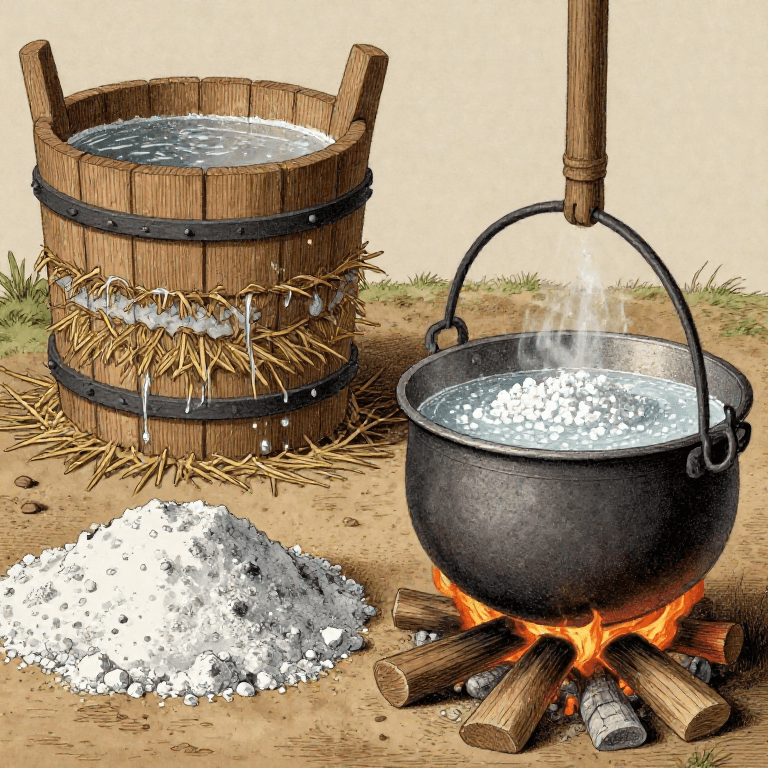
Pack the harvested niter earth into a wooden barrel with a straw filter at the bottom — the same leaching barrel design used for potash extraction. Pour clean water slowly through the earth. The water dissolves the soluble potassium nitrate (KNO₃), along with other salts (NaCl, KCl, calcium salts). The brown liquid draining from the bottom is crude niter liquor.
Pass the liquor through the earth a second time for higher concentration, just as with potash lye. The resulting solution should taste noticeably bitter and cool on the tongue — a traditional field test for nitrate solutions.
此步骤所需材料:
 清洁水(用于漂洗)碎麦秸
所需工具:
 木桶采集桶
木桶采集桶Boil down the niter liquor to crystallize saltpeter
Boil down the niter liquor to crystallize saltpeter
Pour the concentrated niter liquor into a large iron pot and boil it over a steady fire to evaporate the water. As the solution concentrates, impurities (calcium sulfate, sodium chloride) precipitate out first because they are less soluble in hot water than KNO₃. Skim off these impurities with a slotted spoon or ladle.
When the liquid has reduced to about one-third its original volume, remove the pot from heat and let it cool slowly. As the temperature drops, potassium nitrate crystallizes out of solution because KNO₃ is far more soluble in hot water (246 g/100 mL at 100 °C) than in cold water (32 g/100 mL at 20 °C). Long, needle-like crystals of saltpeter form as the liquid cools. This dramatic difference in solubility — the basis of recrystallization — is why KNO₃ can be purified simply by dissolving, filtering, and cooling.
此步骤所需材料:
 薪柴
薪柴所需工具:
 大铸铁锅
大铸铁锅 火钳(拨火棍)
Collect and dry the saltpeter crystals
Collect and dry the saltpeter crystals
Once the liquid has cooled to room temperature, pour off the remaining liquid (mother liquor) and collect the crystalline mass at the bottom and sides of the pot. Spread the wet crystals on a clean cloth or wooden tray in a warm, dry, sheltered place. Allow them to dry completely over 1–2 days. The dried crystals are crude saltpeter — potassium nitrate (KNO₃) with some impurities.
For higher purity, dissolve the crude saltpeter in a minimum of boiling water, filter hot through a cloth to remove insoluble impurities, and allow to recrystallize slowly by cooling. Each recrystallization cycle increases purity. Two or three cycles produce saltpeter pure enough for gunpowder manufacture.
所需工具:
 细目筛采集桶
Test saltpeter purity with the burn test
Test saltpeter purity with the burn test
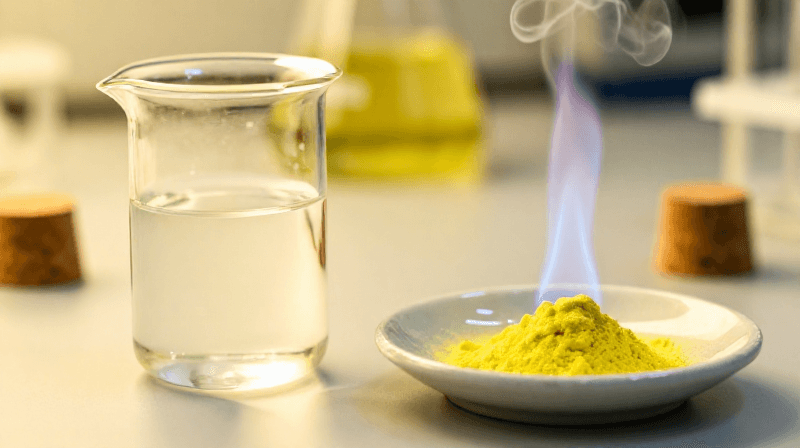
Place a small amount of dried saltpeter crystals on a charcoal disc or fire-safe surface. Touch a flame to the crystals. Pure potassium nitrate decomposes at 400 °C, releasing oxygen gas: 2KNO₃ → 2KNO₂ + O₂. The crystals glow intensely and fizz as the liberated oxygen feeds combustion. Place a glowing ember or thin splint near the decomposing saltpeter — it should burst into bright flame as the released oxygen reignites it. This is the same property that makes KNO₃ essential in gunpowder: it provides the oxygen that allows charcoal and sulfur to burn explosively in a sealed space.
If the sample merely melts without fizzing or releasing oxygen, it is contaminated with too much sodium chloride (common salt) or other impurities and needs another recrystallization cycle.
此步骤所需材料:
 块状木炭
块状木炭Understand nitrogen's connections to civilization
Understand nitrogen's connections to civilization
Nitrogen compounds have shaped civilization through three channels. Agriculture: nitrogen is the N in the N-P-K fertilizer system. Every crop requires nitrogen for amino acids and proteins. Before synthetic fertilizer, all agricultural nitrogen came from manure, legume rotation, or niter deposits — limiting how many people the land could feed. The Haber-Bosch process (Fritz Haber, 1909; Carl Bosch, industrial scale, 1913) synthesizes ammonia from atmospheric N₂ and H₂ at high temperature and pressure: N₂ + 3H₂ → 2NH₃. This single invention feeds approximately half the world's current population. Warfare: gunpowder (75% KNO₃, 15% charcoal, 10% sulfur) dominated warfare from the 13th century through the 19th. European nations maintained saltpeter men — government agents with legal authority to dig up barn floors and cellars to harvest nitrate-rich earth. Food preservation: saltpeter cures meat by converting to nitrite (NO₂⁻), which reacts with myoglobin to form the pink color of cured meats and inhibits Clostridium botulinum (botulism bacteria).
Nitrogen is the element that connects the dinner table to the battlefield — and the invisible gas in every breath to the chemistry that makes life itself possible.
材料
8- 1 个占位符
- 1 个占位符
- 1 个占位符
- 1 个占位符
- 1 个占位符
- 1 个占位符
- 1 个占位符
- 1 个占位符
已连接蓝图材料

CC0 公共领域
此蓝图以 CC0 协议发布。你可以自由复制、修改、分发和使用此作品,无需征得许可。
通过购买蓝图中的产品支持创客,他们将获得 创客佣金 (由供应商设定),或创建此蓝图的新版本并将其作为连接包含在你自己的蓝图中以分享收入。