
Morse Telegraph
Electricity travels a wire almost instantly, which was known long before anyone could send a message with it. The obstacle was never speed. It was that a wire has exactly one signal to offer — current or no current — and a language has thousands of words.
The answer is to spend TIME instead of wires. Earlier telegraphs used five wires and five needles pointing at letters on a board. Morse's system uses one wire and encodes each character as a pattern of short and long closures, so the alphabet is carried in duration rather than in parallel channels.
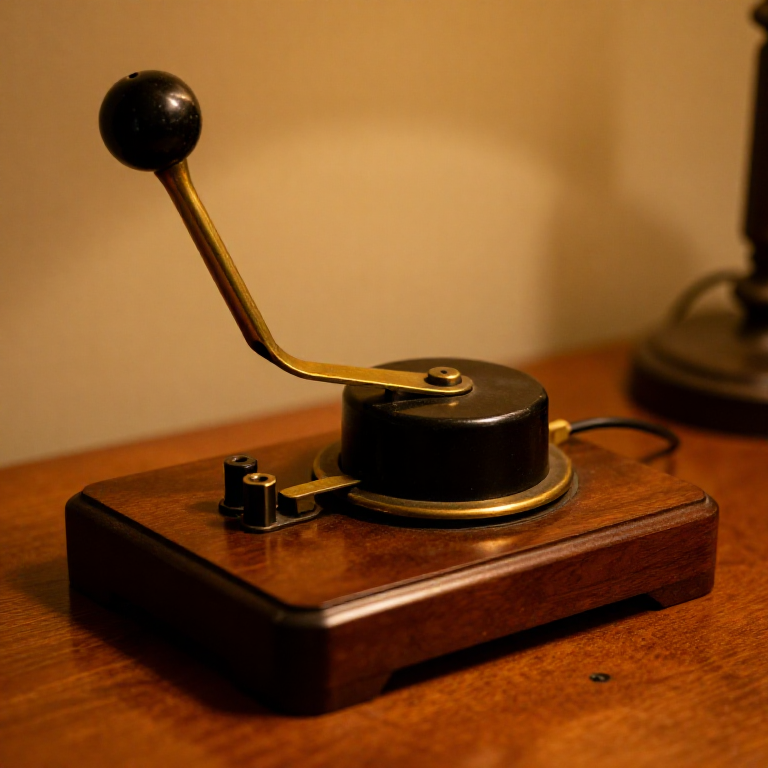
The patent is titled "Improvement in the Mode of Communicating Information by Signals by the Application of Electro-Magnetism" — US Patent 1,647, granted to Samuel F. B. Morse on 20 June 1840. This blueprint builds the sounder, the key and the register, and works out why the code assigns E a single dot.
说明
Work at low voltage from a battery
Work at low voltage from a battery
Everything here runs from a few volts. Never connect a telegraph line to the mains, and keep the coil circuit isolated from anything else on the bench.
Read US 1,647 and note the register
Read US 1,647 and note the register
Morse's patent describes a machine that writes the message on a moving paper tape. Reading by ear came later, from operators who found they no longer needed the paper.
Count the wires a needle telegraph would need
Count the wires a needle telegraph would need
Cooke and Wheatstone's system used five wires and five needles. Work out the cost of five wires over a hundred miles — that arithmetic is why coding won.
Wind an electromagnet on a soft iron core
Wind an electromagnet on a soft iron core
Wind several hundred turns of enamelled wire on an iron core. Soft iron, so it releases the armature the instant current stops.
此步骤所需材料:
 漆包铜线50 米
Mount a pivoted armature above the core
Mount a pivoted armature above the core
Hang a steel lever over the pole so it is attracted when energised. Set the gap small — a big gap needs far more current for the same pull.
此步骤所需材料:
 低碳钢板1 张
Fit a return spring and make it adjustable
Fit a return spring and make it adjustable
Spring the armature away from the pole. Spring tension sets how fast the sounder can follow — too strong and it misses dots, too weak and it sticks down.
此步骤所需材料:
 压缩弹簧套装1 个
Build the key as a simple lever switch
Build the key as a simple lever switch
Make a pivoted brass lever closing onto a contact. It is only a switch — all the intelligence is in the timing of your hand.
此步骤所需材料:
 260 黄铜板 24 号1 张
Set the dash at three times the dot
Set the dash at three times the dot
Fix the ratios: dash = 3 dots, gap between elements = 1 dot, between letters = 3, between words = 7. The code is a rhythm, and the ratios are the code.
Build the register with a clockwork tape drive
Build the register with a clockwork tape drive
Drive a paper strip past the armature at constant speed so a stylus marks it. Constant speed is essential — variable speed makes dots and dashes indistinguishable.
Send a letter and read it off the tape
Send a letter and read it off the tape
Key a few characters and inspect the marks. You are reading duration converted to length — the tape is a chart recorder.
Now listen instead of looking
Now listen instead of looking
Ignore the tape and listen to the armature clicks. Down-click to up-click is the element length, and most operators found this faster than reading paper.
Count letter frequencies in a page of text
Count letter frequencies in a page of text
Tally the letters in any English paragraph. E is far commonest, then T. Compare with the code: E is one dot, T is one dash.
Time a message in the standard code and in a fixed-length one
Time a message in the standard code and in a fixed-length one
Send the same sentence using the real code, then using five elements per letter. The frequency-weighted version is markedly shorter — that saving IS the invention.
Lengthen the line until it stops working
Lengthen the line until it stops working
Add resistance in series to simulate distance. Beyond a point the sounder will not pull in — which is exactly the problem the relay was invented to solve.
此步骤所需材料:
 铜线30 米
所需工具:
 万用表
万用表Compendium — spending time instead of wire
Compendium — spending time instead of wire
The patent. US 1,647, "Improvement in the Mode of Communicating Information by Signals by the Application of Electro-Magnetism", granted 20 June 1840 to Samuel Finley Breese Morse. Morse was a professional portrait painter, not an engineer, and two collaborators were essential: Leonard Gale, a chemistry professor who showed him how to wind the electromagnet properly and how to use Joseph Henry's relay principle to extend range, and Alfred Vail, whose mechanical skill produced the working instruments and who has a strong claim to much of the code itself. The first public line, Washington to Baltimore, opened in 1844.
Serial beats parallel when wire is the expensive part. The competing Cooke and Wheatstone telegraph, patented in Britain in 1837, used five wires and five needles that pointed directly at letters on a diamond board — no code to learn, and it worked immediately. Morse's needed operators trained in a code, but it needed ONE wire. Over long distances the wire dominates the cost, so the system that trades hardware for time and training wins. That trade is still being made: it is why serial buses replaced parallel ones inside computers, once signalling got fast enough.
Variable-length coding, a century before information theory. The code assigns short symbols to frequent letters and long ones to rare letters — E is one dot, T one dash, while Q and Y are four elements each. Vail is said to have derived the frequencies by counting type in the cases at a Morristown newspaper office, which is empirical linguistics done with a printer's type tray. This is exactly the principle Claude Shannon formalised in 1948 and that underlies Huffman coding and every compression scheme since. Morse code is a hand-optimised prefix-free variable-length code, arrived at by counting.
Two things worth separating. The code and the apparatus are different inventions with different authorship, and American Morse — the code actually used on US landlines, with internal spaces in some characters — is not the International Morse standardised in 1865 and used ever since. The register that wrote on tape was in the patent and was abandoned in practice within a decade, because trained operators read faster by ear than the machine could print. A patent describing a printing telegraph became, in the field, a listening one.

CC0 公共领域
此蓝图以 CC0 协议发布。你可以自由复制、修改、分发和使用此作品,无需征得许可。
通过购买蓝图中的产品支持创客,他们将获得 创客佣金 (由供应商设定),或创建此蓝图的新版本并将其作为连接包含在你自己的蓝图中以分享收入。