艺术
美容与健康
工艺
文化与历史
娱乐
环境
食品与饮料
逆向工程
科学
体育
技术
可穿戴设备
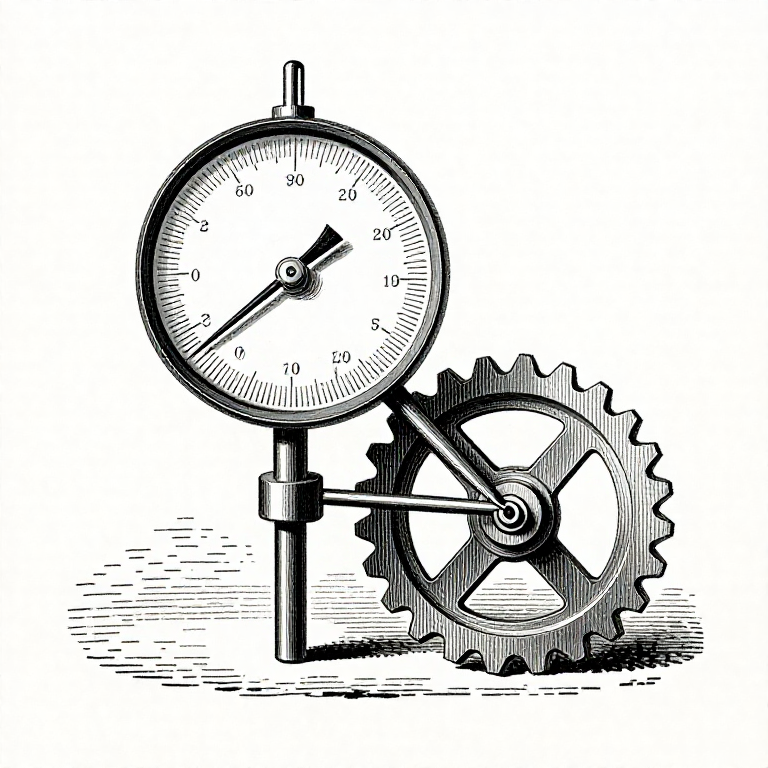


Mounting and Alignment: Runout, Misalignment and the Contact Pattern
A gear cut to a precision grade and mounted carelessly performs worse than an ordinary gear mounted well. The tooth form is one of four things that decide how the pair runs, and the other three belong to the shaft, the bearings and the housing.
Runout — the gear not running true on its shaft — makes the centre distance breathe once per revolution, so the backlash is tight at one point and slack half a turn later. Misalignment tips the tooth so it touches at one end of its face, and the load that was meant to be spread across 20 mm arrives on 6. Neither is visible on the parts. Both are visible in five minutes with engineer's blue.
This rung is how much each error costs, where it comes from, and how to read the contact pattern that shows all of them at once.
中级
4 hours
说明
1
1
Getting the gear onto the shaft
Getting the gear onto the shaft
**The bore and the shaft.** A gear on a clearance fit will run eccentric by the clearance, every time. Use a transition or light interference fit — H7/k6 or H7/m6 for general work — and locate the torque with a key, not with the fit.
**A key does not centre anything.** It transmits torque. The centring is the fit, and a keyway cut too deep or a key that bottoms in the gear's slot will lift the gear off its seat and throw it out by more than any manufacturing error. Check the key is clear at the top.
**Press, do not hammer.** A gear driven on with a hammer arrives tilted and carries the shock into the bearings. Press it, or heat the gear 80–100 °C above the shaft and drop it on.
**Square it against a shoulder.** A gear butted to a shoulder is only as square as the shoulder; a shoulder with a radius left in the corner and no relief in the gear will hold the gear off and tilt it.
**Then measure, on the assembled shaft, between centres.** Dial indicator on the tooth flanks with a pin or ball in the tooth space, turn a full revolution and read the total indicated runout. Also run the indicator on the shaft journals to separate a bent shaft from an eccentric gear — the two give the same reading at the teeth and need different fixes.
**Write the number down before and after** anything is disturbed. A runout that changed is the most useful evidence there is.
此步骤所需材料:
 正齿轮组(钢,20 齿)1 个
 30 毫米钢轴1 个
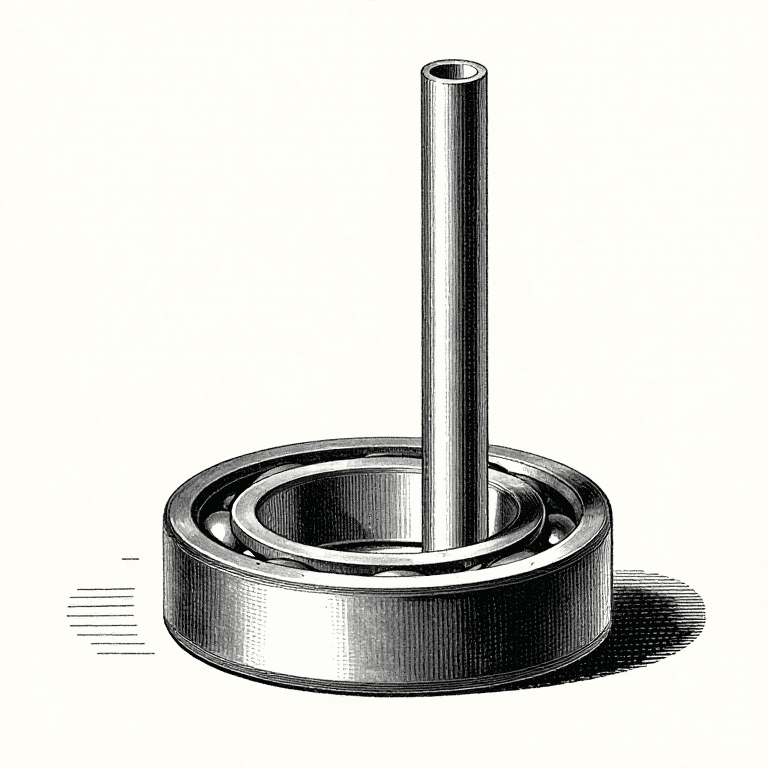
 滚珠轴承2 个
所需工具:
 百分表
百分表 千分尺
千分尺2
2
What runout and misalignment cost
What runout and misalignment cost
正在加载 Jupyter 笔记本…
所需工具:
 台式电脑
台式电脑3
3
Reading the contact pattern
Reading the contact pattern
Five minutes with a tube of engineer's blue tells you more than an hour of measurement, because it shows the assembly under its own errors rather than the parts in isolation.
**Method.** Wipe the teeth clean. Put a thin, even film of blue on three or four teeth of the pinion — thin enough to see metal through it. Turn the pair through a few revolutions against a light brake, so the flanks are loaded. Read the marking transferred to the wheel.
**A good pattern** sits centrally on the flank, covers roughly 70–80% of the face width, and stops short of both ends — the ends are deliberately relieved on good gears so that the corner never carries.
**Contact at one end only** is misalignment. Which end tells you the direction. If it swaps ends when the load is reversed, the shaft is bending rather than the bores being wrong.
**Contact at both ends and nothing in the middle** is a bowed gear or a shaft deflecting between two widely spaced bearings.
**Contact high on the tooth, at the tips** means the centre distance is too large, or the tips need relieving.
**Contact low, at the root**, means the centres are too close — and root contact is the dangerous one, because that is where the bending stress is highest.
**A pattern that moves round the wheel** from tooth to tooth is runout or pitch error, not alignment.
**On bevels, the pattern IS the adjustment.** Move the pinion in and out on its shims until the mark sits centrally and slightly towards the toe, and record the shim stack. That mounting distance is the setting.
此步骤所需材料:
 蓝色显示剂1 个正齿轮组(钢,20 齿)2 个
 锥齿轮组(钢,1:1)1 个
所需工具:
 放大目镜
放大目镜 塞尺套装
塞尺套装4
4
Fixing what the pattern shows
Fixing what the pattern shows
**Misalignment in a housing you can machine.** Line bore both seats in one setup, or bore them from the same side without moving the work. Two bores done separately are parallel only by luck.
**Misalignment you cannot machine out.** Shim the bearing housings, or fit an eccentric bush in one seat and rotate it to the setting. This is standard on large open gearing.
**Shaft deflection.** Move the bearings closer to the gear, increase the shaft diameter, or centre the gear between its bearings rather than overhanging it. Deflection goes with the cube of span and the fourth power of diameter, so a small change in either is a large change in deflection.
**Deliberate helix correction.** On large gears the lead is ground with a built-in twist that cancels the known deflection at the design load. It is correct at one load only, which is the compromise.
**Crowning.** Relieving the flank slightly towards each end so contact stays central whatever the misalignment. It reduces the contact area and therefore the capacity, and it makes the gear tolerant of exactly the errors above — which is why it is standard on gears that will be mounted by someone else.
**Let it run in.** A moderate pattern will improve over the first hours under light load, as the high spots polish down. A bad pattern will not improve; it will pit. The difference is whether the peak load is above or below the contact fatigue limit, and running in a badly aligned pair simply damages it faster.
此步骤所需材料:
蓝色显示剂1 个滚珠轴承2 个正齿轮组(钢,20 齿)2 个所需工具:
百分表塞尺套装千分尺材料
5- 2 个占位符
- 1 个占位符
- 占位符
- 1 个占位符
- 1 个占位符
相关蓝图
这些蓝图共享知识——技术、材料或原理
CC0 公共领域
此蓝图以 CC0 协议发布。你可以自由复制、修改、分发和使用此作品,无需征得许可。
通过购买蓝图中的产品支持创客,他们将获得 创客佣金 (由供应商设定),或创建此蓝图的新版本并将其作为连接包含在你自己的蓝图中以分享收入。