艺术
美容与健康
工艺
文化与历史
娱乐
环境
食品与饮料
逆向工程
科学
体育
技术
可穿戴设备

Nylon 66 Pellets: Nylon Salt Polymerised in an Autoclave, Carothers 1938
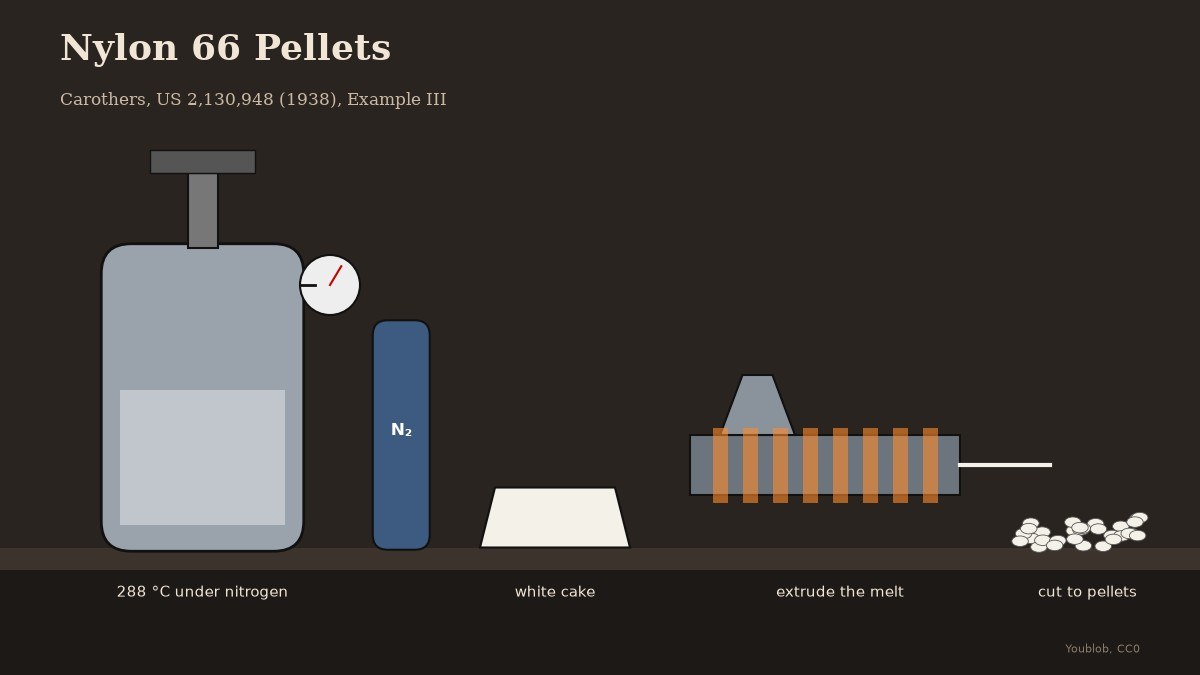
Nylon salt heated to 288 °C under oxygen-free nitrogen gives off water and joins into long chains of nylon 66 (Carothers, du Pont, US 2,130,948, 1938: two moles of salt in a silver-lined autoclave). A pinch of extra adipic acid keeps the melt's viscosity steady. The polymer is then extruded and cut into pellets.
The picture: our drawing of the autoclave and the pellet line.
高级
A day
说明
1
1
Charge the autoclave
Charge the autoclave
Put two moles of nylon salt (525 g) and 0.02 mole of adipic acid (2.9 g) in a two-litre silver-lined autoclave with a stainless stirrer and a reflux condenser leading to a receiver.
此步骤所需材料:
 尼龙盐525 克
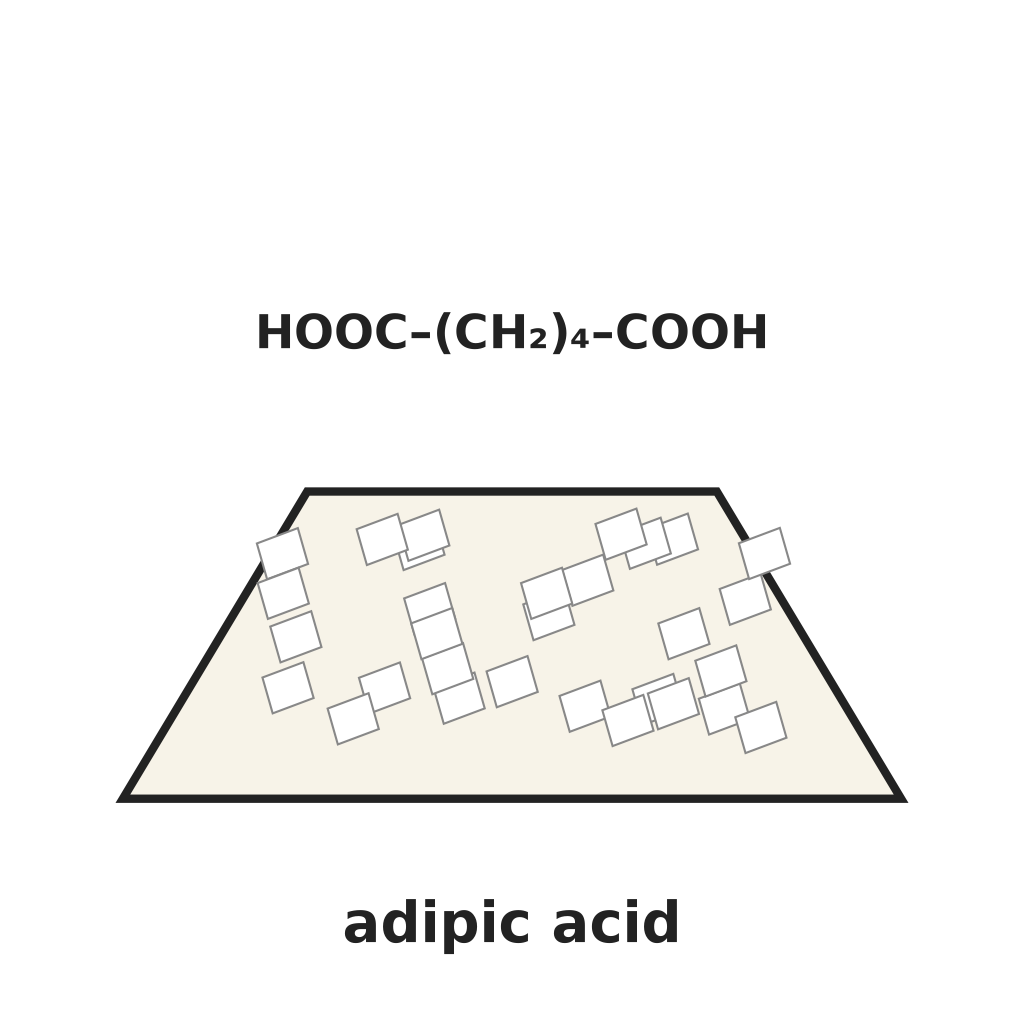 己二酸2.9 克
所需工具:
 压力反应器
 冷凝器盘管
 数字厨房秤
2
2
Drive out the air
Drive out the air
Evacuate, fill with nitrogen, evacuate again, then apply 80 lb/in² of nitrogen. Use nitrogen free of oxygen; oxygen spoils the polymer.
所需工具:
 真空泵
 氮
 压力表
3
3
Heat to 288 °C
Heat to 288 °C
Start the stirrer and heat to 288 °C over 1.5 hours.
所需工具:
压力反应器 带读数的热电偶
4
4
Let the water off
Let the water off
Bring the pressure down to atmospheric over half an hour and keep heating and stirring 2.5 hours. Then pull to 200 mm absolute for a few minutes.
所需工具:
压力反应器真空泵压力表带读数的热电偶5
5
Cool and take out
Cool and take out
Cool. The polymer comes out as a white solid cake that melts at about 263 °C.
所需工具:
压力反应器6
6
Pelletise
Pelletise
Break up the cake (our step), melt it in the extruder, draw the strand and cut it into pellets.
所需工具:
 塑料挤出机
 挤压模
7
7
Grams and pressures
Grams and pressures
正在加载 Jupyter 笔记本…
此蓝图制作
相关蓝图
这些蓝图共享知识——技术、材料或原理


CC0 公共领域
此蓝图以 CC0 协议发布。你可以自由复制、修改、分发和使用此作品,无需征得许可。
通过购买蓝图中的产品支持创客,他们将获得 创客佣金 (由供应商设定),或创建此蓝图的新版本并将其作为连接包含在你自己的蓝图中以分享收入。