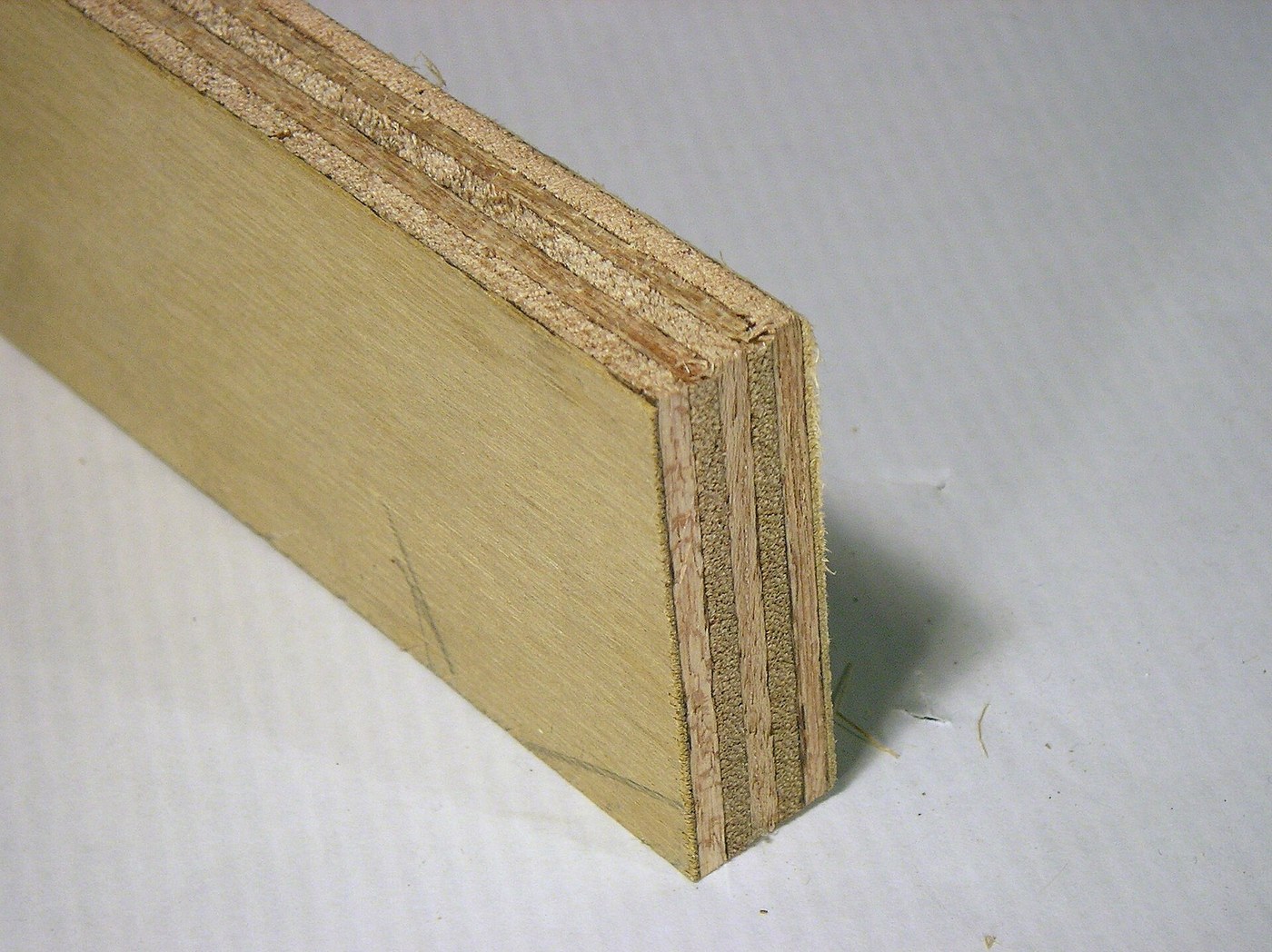


Plywood
说明
Measure how anisotropic wood is
Measure how anisotropic wood is
Prove the problem with numbers before solving it.
- Take two identical strips of veneer, one with grain along the length and one across.
- Support each and load the middle until it fails.
- Compare, and also try splitting each by hand.
此步骤所需材料:
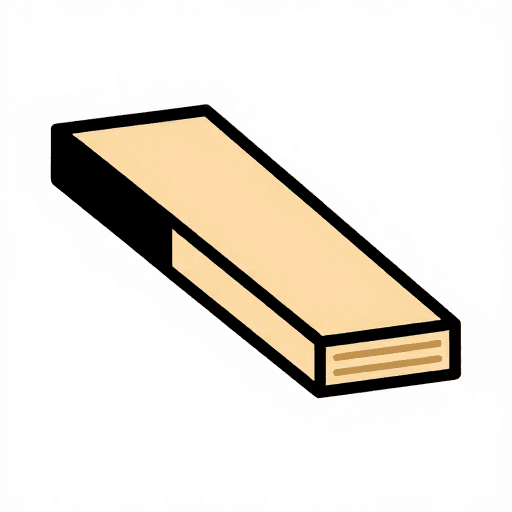
 木皮贴片1 张
Lay up crossed plies — an odd number
Lay up crossed plies — an odd number
Alternate the grain direction and keep the stack balanced.
- Cut an odd number of veneer pieces — three or five.
- Glue them with each layer's grain at 90 degrees to its neighbours.
- Check that the two outer faces run the SAME direction.
此步骤所需材料:
 PVA 木工胶1 瓶
Press it flat and hard
Press it flat and hard
Even pressure across the whole area, not just at the edges.
- Spread glue thinly and evenly on both mating faces.
- Press between two stiff flat boards with clamps or weight distributed across the area.
- Leave until fully cured.
此步骤所需材料:
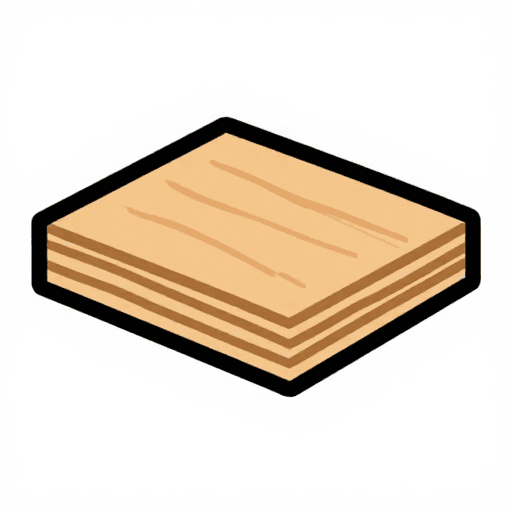
 波罗的海桦木胶合板1 包
Test the panel against solid wood
Test the panel against solid wood
Compare your laminate with a solid piece of the same thickness.
- Load both to failure in bending, in each direction.
- Try to split both along the grain.
- Leave offcuts of each somewhere damp overnight and measure dimensional change.
此步骤所需材料:
 直尺1 个
直尺1 个 数字厨房秤1 个
History and context
History and context
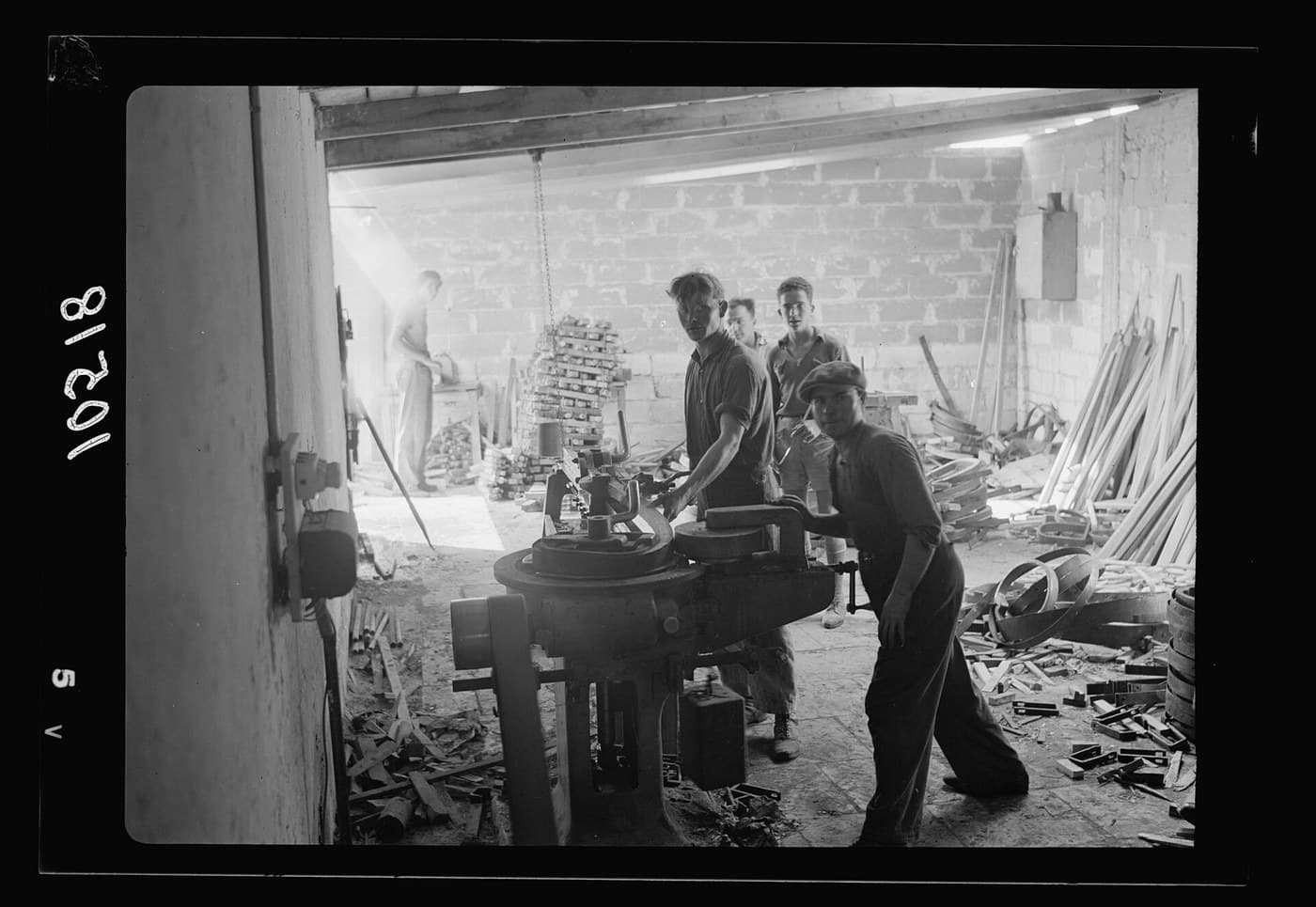
Laminating wood with crossed grain is ancient — Egyptian furniture and coffins used it, and eighteenth-century cabinetmakers veneered over cheaper cores. What made plywood an industrial material was the rotary veneer lathe, which mounts a log on a spindle and peels a continuous sheet off it like unrolling paper. Immanuel Nobel is commonly credited with developing it in the mid nineteenth century, and by the late 1800s plywood was being manufactured in quantity.
Rotary peeling is why plywood is cheap and why it looks the way it does. Sawing veneer wastes a kerf of wood for every slice; peeling wastes almost nothing but the core. It also produces that characteristic wide, wandering grain pattern, because the cut follows the log's growth rings around rather than crossing them.
The glue determines the grade. Interior plywood uses urea-formaldehyde, which fails when damp. Exterior and marine grades use phenol-formaldehyde, which is genuinely waterproof — the layers will fail before the glue does. A panel's grade is a statement about its adhesive far more than about its wood, and using an interior panel outdoors is the classic and expensive mistake.
What it made possible: cheap flat panels transformed furniture, packing cases, building sheathing and aircraft. The de Havilland Mosquito was built largely of plywood and balsa and was among the fastest aircraft of its day. The same cross-grain logic now appears in cross-laminated timber, which does it with structural planks and puts up buildings many storeys tall.
CC0 公共领域
此蓝图以 CC0 协议发布。你可以自由复制、修改、分发和使用此作品,无需征得许可。
通过购买蓝图中的产品支持创客,他们将获得 创客佣金 (由供应商设定),或创建此蓝图的新版本并将其作为连接包含在你自己的蓝图中以分享收入。